


With a declining economy, rising prices and stagnant wages, 77 percent of office workers in an online survey said they were willing to switch to skilled blue-collar jobs because graduate education is no longer the guarantee to a good job that it once was.
The top choices for a new career were bakers, plumbers and electricians, online job board yes123, which conducted the survey, said at a press conference on Tuesday.
A majority — 66.9 percent — of white-collar workers who said they would consider switching career tracks said they would do so because of worries about “diploma devaluation.”
“Pressure due to stagnant wages” (59.6 percent) and “training or school diploma not matching employers’ needs” (48.9 percent) were the next most common responses.
A former elementary-school teacher turned bureaucrat, Chen Jung-teng (陳榮豋) is one such worker who moved from white-collar to blue-collar. After switching from teaching, he climbed the career ladder to become a section chief in a government agency.
“It was all going smoothly with my work. So when I lost my job because of my age, it was very hard to take,” Chen told the press conference.
He decided to start over, putting away the traditional stigma of manual labor, and enrolled in plumbing and electrical repair classes. After some years of diligent work, Chen is now a store manager for Living Rescue International Co, reputedly Taiwan’s largest franchise chain for household repairs and cleaning services.
Wang Ta-wei (王大維) and Wei Shih-hsuan (衛世軒) also recounted their experiences. Both men have master’s degrees and used to work as engineers. Wang now runs an ice cream shop and Wei is a motorcycle mechanic.
“Working in a restaurant or in the food catering business was always an interest,” Wang said. “Striking out on one’s own to operate a store requires just about the same hard work as being an engineer. So why not work in a job that you love?”
“Now I work more than 12 hours a day in my ice cream shop, but I love my job,” he said.
Wei’s father has long run a motorcycle shop, so he sees many advantages to his career switch. He is taking over the family business, using an in-demand trade skill and he no longer has to worry about getting laid off.
Most of the respondents said Taiwan is in an era of “devaluation of school degrees.” Only 31.5 percent percent indicated they want to continue their education to the master’s level or doctoral studies.
Looking at current salary structures, 89.5 percent of respondents said the return on their investment in education is too low, while 53 percent said having a master’s or a doctorate would not enhance their competitiveness in the job market.
Asked what trades they would be interested in learning or working in, bread and pastry making came in first with 13.2 percent, followed by plumbing and electrical repair with 11.8 percent and telecommunications repair and maintenance at 10.9 percent.
The survey was conducted between May 10 and July 10 and gathered 1,083 valid responses.

SECURITY: Starlink owner Elon Musk has taken pro-Beijing positions, and allowing pro-China companies to control Taiwan’s critical infrastructure is risky, a legislator said Starlink was reluctant to offer services in Taiwan because of the nation’s extremely high penetration rates in 4G and 5G services, the Ministry of Digital Affairs said yesterday. The ministry made the comments at a meeting of the legislature’s Transportation Committee, which reviewed amendments to Article 36 of the Telecommunications Management Act (電信管理法). Article 36 bans foreigners from holding more than 49 percent of shares in public telecommunications networks, while shares foreigners directly and indirectly hold are also capped at 60 percent of the total, unless specified otherwise by law. The amendments, sponsored by Chinese Nationalist Party (KMT) Legislator Ko

The military has spotted two Chinese warships operating in waters near Penghu County in the Taiwan Strait and sent its own naval and air forces to monitor the vessels, the Ministry of National Defense (MND) said. Beijing sends warships and warplanes into the waters and skies around Taiwan on an almost daily basis, drawing condemnation from Taipei. While the ministry offers daily updates on the locations of Chinese military aircraft, it only rarely gives details of where Chinese warships are operating, generally only when it detects aircraft carriers, as happened last week. A Chinese destroyer and a frigate entered waters to the southwest
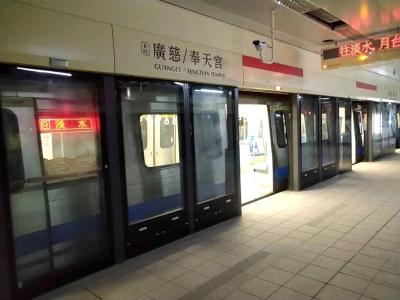
The eastern extension of the Taipei MRT Red Line could begin operations as early as late June, the Taipei Department of Rapid Transit Systems said yesterday. Taipei Rapid Transit Corp said it is considering offering one month of free rides on the new section to mark its opening. Construction progress on the 1.4km extension, which is to run from the current terminal Xiangshan Station to a new eastern terminal, Guangci/Fengtian Temple Station, was 90.6 percent complete by the end of last month, the department said in a report to the Taipei City Council's Transportation Committee. While construction began in October 2016 with an

NON-RED SUPPLY: Boosting the nation’s drone industry is becoming increasingly urgent as China’s UAV dominance could become an issue in a crisis, an analyst said Taiwan’s drone exports to Europe grew 41.7-fold from 2024 to last year, with demand from Ukraine’s fight against Russian aggression the most likely driver of growth, a study showed. The Institute for Democracy, Society and Emerging Technology (DSET) in a statement on Wednesday said it found that many of Taiwan’s uncrewed aerial vehicle (UAV) sales were from Poland and the Czech Republic. These countries likely transferred the drones to Ukraine to aid it in its fight against the Russian invasion that started in 2022, it said. Despite the gains, Taiwan is not the dominant drone exporter to these markets, ranking second and fourth


 RSS
RSS