


Dotted along the coastal highway cutting across Pingtung County’s Chiatung Township (佳冬), motorized paddles in fishponds churn up a froth as fish larvae and fish fry swim to and fro.
Chiatung has become one of the nation’s primary sites for grouper farming in recent years after the fish became a major export product to China after the signing of the Economic Cooperation Framework Agreement (ECFA).
However, despite previous good economic returns on fish farming, 26-year-old Wang Che-chien (王哲謙) is not convinced that the traditional method of grouper farming is the key to his family’s future success.
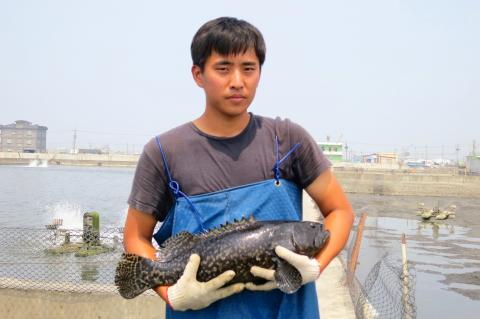
Photo: Chung Li-hwa, Taipei Times
Wang, a third-generation fish farmer, said he took over the family business after finishing college because of his father’s deteriorating health.
Despite his family’s long history of fish farming — the Wangs had been in aquaculture for two decades starting with Wang Che-chien’s grandfather — Wang said his family did not employ very scientific methods of fish farming.
“Many of the older generation believe that drugs are a panacea to all problems the fish may experience. They refuse to explore any alternative solutions,” Wang said.
Wang said that he once asked a professor about fish farming methods using decreased dosages of drugs, but his father only said derisively: “I doubt experts can provide your next meal for you.”
Fish farmers are most afraid of their fish stock becoming diseased, Wang said, adding that he had once suffered NT$900,000 (US$30,115) of losses in a week because an infection had spread rapidly through his stock.
“I learned my lesson,” Wang said, adding that after the incident he put greater emphasis on controlling water quality.
Wang also started sending fish samples to the Bureau of Animal and Plant Health Inspection and Quarantine every 15 days for health checks.
Wang said he also learned how to observe fish through a microscope and deal with smaller problems on his own, feeding the fish probiotics that he had made himself, adding that his efforts had provided him a yield rate of 80 percent.
“The results speak for themselves, and now even my father listens to my advice on fish farming,” Wang said.
Wang said that he had been interested in aquaculture since he was a young man, adding that he had only studied mechanical engineering at Chung Hua University because his parents had disapproved of him studying fish farming.
Despite their disapproval, Wang said he attended many lectures and seminars at the university on aquafarming, and also went to an international seminar on grouper farming.
On his relative youth compared with his peers, Wang said: “I have always been the youngest and I’m still the youngest fish farmer in Chiatung.”
Although many people his age spend their time partying or playing computer games all night, Wang has always put a lot of stock in being early to bed and early to rise.
Sometimes camping out by the fishponds, Wang spends the majority of his time managing the fish farm that brings in money for his family, but also keeps an eye on the future of the business.
With 19,398m2 of fish ponds, Wang said that his family has been involved in the nation’s aquafarming industry since the early days.
Wang said his family had experienced the many changes the industry has undergone from farming eels in the early 1990s, through the years when giant tiger prawns were popular up to the current trend for grouper farming.
With this legacy in mind, Wang said he is concerned about the future of grouper farming
“In the two years since the ECFA took effect, the price of rock grouper has dropped from about NT270 per jin [600g] to about NT110 per jin, while prices of the Hybrid Giant Tiger variety have dropped from between NT$300 and NT$400 to about NT$150 per jin,” Wang said.
Wang said that the Council of Agriculture’s policy of trying to increase production volumes is causing grouper prices to plummet.
Wang said that current prices mean that if farmers do not have a yield rate of 50 percent, they can barely cover their overheads.
Focusing instead on quality rather than quantity, Wang said he plans to package his farm’s groupers with a certificate indicating where the fish were raised and packed, adding that he also intends to open a seafood restaurant to promote his own products.

NATIONAL SECURITY: Authorities are working to confirm the identities of the military personnel involved and investigating possible illegal conduct and regulatory violations Authorities are probing possible national security implications after Kinmen police and immigration officers on Sunday found a Chinese woman allegedly posing as a tourist while engaging in prostitution involving more than 10 military personnel. The woman, surnamed Chen (陳), has since been deported, authorities said, adding that investigators are still working to confirm the identities of those implicated, as the records only listed code names and aliases. The case stemmed from a report received by the Kinmen District Prosecutors’ Office on Friday last week from the Jinhu Precinct of the Kinmen County Police Bureau. On Sunday, police, along with the National Immigration

GLOBALGIVING: ‘ Caving to external pressure is not acceptable for an organization that has cultivated justice reform and human rights for 30 years,’ one NGO said A slew of non-government organizations (NGOs) have withdrawn from the GlobalGiving fundraising platform after it announced it would use “Chinese Taipei” instead of “Taiwan” from next month. The Taiwan Good Rice Association wrote on Facebook on Friday that it was informed on April 28 via a teleconference call of the change, which was made because the platform wanted to operate in China. Taiwan Good Rice is to terminate all cooperative relationships with GlobalGiving in response to the platform’s “unilateral and non-negotiable” decision to remove references to Taiwan, the NGO said. “Taiwan is in the official name of Taiwan Good Rice Association and the
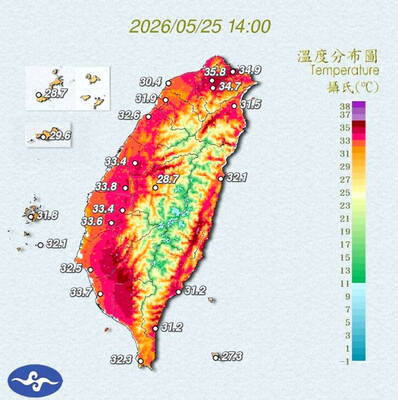
STAY COOL: The HPA recommended that people stay hydrated, use air-conditioning or fans while indoors, wear loose-fitting clothes and walk in the shade while outdoors Employers must implement measures such as installing cooling equipment, and providing drinking water and rest breaks for outdoor workers starting from Monday next week, the Taipei Department of Labor said on Sunday. Employers who fail to comply could face fines of NT$30,000 to NT$300,000 under the Occupational Safety and Health Act (職業安全衛生法), the department said. Businesses in Taipei employing fewer than 100 workers, as well as registered self-employed workers with labor insurance coverage, could receive on-site assessments and guidance from occupational safety consultants to help them apply for central government subsidies to implement or improve heat-protection measures, it said. Under the Ministry of

Chinese Nationalist Party (KMT) Chairwoman Cheng Li-wun (鄭麗文) yesterday briefed her party’s Central Standing Committee regarding her scheduled visit to the US between Monday next week and June 16, saying that her purpose would be to persuade the US that the Republic of China (ROC) Constitution was a “one China” constitution that would foster stable and peaceful cross-strait relations. The ROC Constitution is the most important defense for all Taiwanese citizens, as it upholds our democracy and has contributed to our robust economy, which aligns with international and US interests, she said. “We would not be troublemakers and drag the US under,”


 RSS
RSS