


A research team from National Taiwan Normal University (NTNU) has invented a robot that can carry out automated nighttime surveillance, climb stairs and move freely around buildings, the team announced yesterday.
The team was comprised of researchers from the school’s Computational Intelligence and Robotics Lab and led by Wang Wei-yen (王偉彥), a chair professor in the Department of Applied Electronics Technology.
It took the team three years to develop the robot, named “NTNU-CIR-I,” which is capable of carrying out surveillance patrols in complicated landscapes during the day and at night.
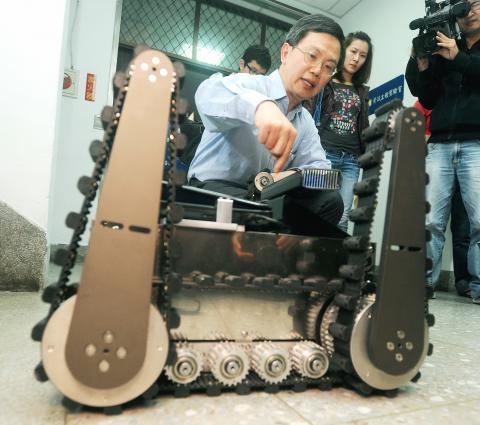
Photo: Lin Cheng-kung, Taipei Times
The team said the robot was meant to fill the gap in the security of school campuses that are open to the public after class hours. The robot can patrol areas that are not patrolled so often by campus security and that the scope of mounted surveillance cameras cannot reach.
Many other robots rely on four wheels to move and are thereby limited to flat surfaces, but the NTNU-CIR-I was designed to overcome this limitation by employing highly sensitive sensors to detect and navigate past obstacles, even in the dark, Wang said, adding that it can also calculate the angles of slopes or stairs to adjust its movements as it climbs.
The team said they think the robot could be a useful addition to security systems in factories, buildings and campuses because it can transmit real-time footage through the Internet.
It could also be used for educational purposes, such as though the application of its sensors, motor control, image processing and intelligence algorithm design, the team added.
Wang was awarded the titles of Institute of Electrical and Electronics Engineers Fellow and Institution of Engineering and Technology Fellow this year for his contribution to the field of robotics, the school said, adding that the team is applying for a patent for the robot.
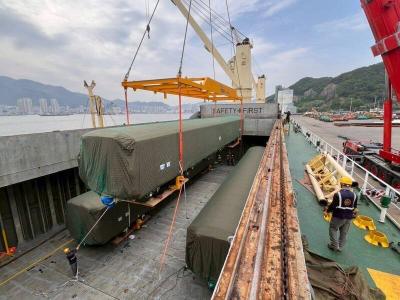
The first of 10 new high-capacity trains purchased from South Korea’s Hyundai Rotem arrived at the Port of Taipei yesterday to meet the demands of an expanding metro network, Taipei Rapid Transit Corp (TRTC) said yesterday. The train completed a three-day, 1,200km voyage from the Port of Masan in South Korea, the company said. Costing NT$590 million (US$18.79 million) each, the new six-carriage trains feature a redesigned interior based on "human-centric" transportation concepts, TRTC said. The design utilizes continuous longitudinal seating to widen the aisles and optimize passenger flow, while also upgrading passenger information displays and driving control systems for a more comfortable
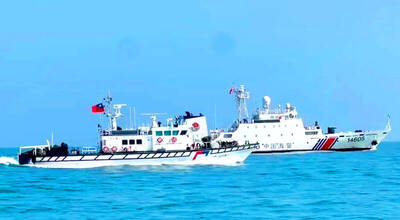
Instead of focusing solely on the threat of a full-scale military invasion, the US and its allies must prepare for a potential Chinese “quarantine” of Taiwan enforced through customs inspections, Stanford University Hoover fellow Eyck Freymann said in a Foreign Affairs article published on Wednesday. China could use various “gray zone” tactics in “reconfiguring the regional and ultimately the global economic order without a war,” said Freymann, who is also a nonresident research fellow at the US Naval War College. China might seize control of Taiwan’s links to the outside world by requiring all flights and ships entering or leaving Taiwan
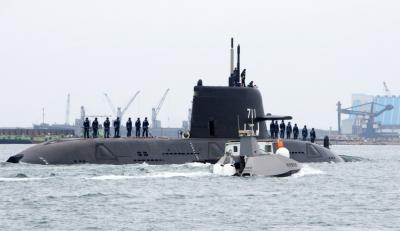
Taiwan's first indigenous defense submarine, the SS-711 Hai Kun (海鯤, or Narwhal), departed for its 13th sea trial at 7am today, marking its seventh submerged test, with delivery to the navy scheduled for July. The outing also marked its first sea deployment since President William Lai (賴清德) boarded the submarine for an inspection on March 19, drawing a crowd of military enthusiasts who gathered to show support. The submarine this morning departed port accompanied by CSBC Corp’s Endeavor Manta (奮進魔鬼魚號) uncrewed surface vessel and a navy M109 assault boat. Amid public interest in key milestones such as torpedo-launching operations and overnight submerged trials,
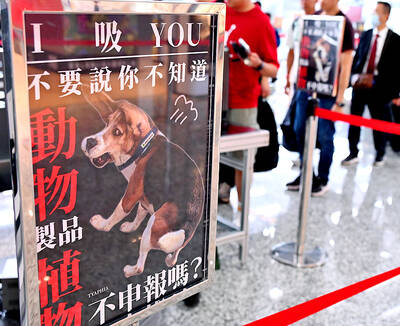
Quarantine awareness posters at Taiwan Taoyuan International Airport have gone viral for their use of wordplay. Issued by the airport branch of the Animal and Plant Health Inspection Agency, the posters feature sniffer dogs making a range of facial expressions, paired with advisory messages built around homophones. “We update the messages for holidays and campaign needs, periodically refreshing materials to attract people’s attention,” quarantine officials said. “The aim is to use the dogs’ appeal to draw focus to quarantine regulations.” A Japanese traveler visiting Taiwan has posted a photo on X of a poster showing a quarantine dog with a


 RSS
RSS