


A week into a hunger strike by laid-off workers who were forced to repay their retirement payouts outside the Council of Labor Affairs (CLA) building in Taipei that has seen two protesters hospitalized, the council still refuses to meet and negotiate with the demonstrators.
“I’ve been sitting here for 24 hours a day since April 28, but no CLA official has been willing to come out and meet with us. This is how indifferent the government is when facing the people,” said Chen Man-ping (陳滿屏), a laid-off worker from Dong-ling Electronics Co who has been on hunger strike with about a dozen of her peers for a week.
“The government only sees the rich, and ignores the workers and the disadvantaged people,” she said.
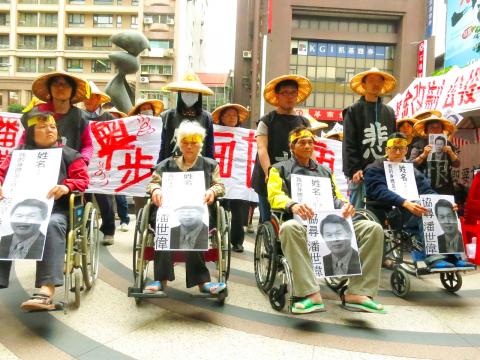
Photo: Yang Chiu-ying, Taipei Times
As of yesterday, three of the hunger strikers have been rushed to hospital after passing out, yet the CLA did not respond.
The story began 16 years ago, when several companies declared bankruptcy and left their workers with no retirement payouts, though the Labor Standards Act (勞動基準法) required their employers to deposit employee retirement funds.
The laid-off workers launched a series of demonstrations and in the end, the CLA decided to provide retirement payouts to these workers in the form of loans, but promised that it would ask the employers, not the employees, to repay the debts.
“We workers from Dong-ling were the last to accept the deal, because we were worried that we would become indebted,” Chen said. “The CLA minister at the time, Hsu Chieh-kui (許介圭), told us not to worry, saying that the council would ask the employers to repay the loans. I remember very clearly that he said: ‘The government is here to help the workers, why would the government sue you?’”
However, because the CLA failed to secure repayment of the debts from the employers, “bringing a lawsuit against us is exactly what the government is doing to us now,” Chen said.
Although the “solution” that the CLA proposed at the time turned out not to have solved the problem at all, Chen said CLA officials at the time at least appeared to be more concerned.
“Hsu came out to see us after we were 28 hours into our hunger strike in front of the CLA building 16 years ago, but current CLA Minister Pan Shih-wei [潘世偉] simply ignores us,” she said.
Taiwan International Workers’ Association secretary-general Chen Hsiu-lien (陳秀蓮) said the laid-off workers had urged the council to negotiate with them long before starting their hunger strike.
“We’ve prepared a list of 16 negotiators and have called on the CLA several times since April 9, but the council never responds. It goes on with its discounted repayment plan instead,” Chen Hsiu-lien said, referring to presentation sessions organized by the council about a plan it proposed to give 70 percent, 80 percent, or 90 percent discounts on workers’ debts depending on the age, health and finances of each worker.
“We would not accept the plan because we are entitled to what we got. Why should we give it back?” 61-year-old laid-off Dong-ling employee Chien Su-ching (簡素卿) said. “It’s the CLA’s job to make sure that our employer has prepared retirement money for us. The problem occurred because the CLA failed to do its job, so why should we shoulder the consequences of the CLA’s mistake?”
“I’ve never owed a penny in taxes or even on a traffic ticket. It is ironic that the first time I have to go to court in my life is because I am being sued by the CLA, which is supposed to protect us laborers,” she added.
Speaking on condition of anonymity, a CLA official said the council has no plan so far to change its policy or to meet with demonstrating workers.
“I’m sure the workers wouldn’t want us to just show up and say hi and would want some actual change in our policy,” the official said. “If that’s the case, I don’t think there’s a need for us to meet with them.”

FUKUOKA SITUATION: Japanese media reported that the pathogen is expected to be identified by the summer, while the CDC downplayed the idea that it was hMPV A “mysterious cold-like illness” reported in Japan’s Fukuoka Prefecture does not seem to be a new disease, but Japanese authorities have been asked about the situation, the Centers for Disease Control (CDC) said yesterday. The Fukuoka Prefectural Medical Association on Wednesday told a news conference that a “mystery cold” that has become a hot topic on social media is “highly likely to be caused by some kind of viral infection,” Japan’s KBC News reported. “Many people are experiencing symptoms starting with a sore throat, followed by a runny nose, phlegm and a severe cough,” KBC News reported, citing association officials. Health authorities are

Nvidia Corp CEO Jensen Huang (黃仁勳) arrived in Taiwan yesterday ahead of upcoming AI and technology events, saying he plans to meet with clients and Taiwan Semiconductor Manufacturing Co Chairman C.C. Wei (魏哲家) during his visit. After landing at Taipei Songshan Airport, Huang posed for photos with fans and handed out Yakult drinks to reporters and supporters waiting at the scene, saying he has “a lot to do” during the trip. Asked about reports that Nvidia’s planned headquarters site in Taipei’s Beitou Shilin Technology Park could break ground on May 27, Huang said that if the company holds an event, he would

The Ministry of Finance this afternoon announced the winning numbers for the March-April uniform invoice lottery. The winning number for the NT$10 million (US$318,060) special prize is 19531471, and the winning number for the NT$2 million grand prize is 85941329. Three numbers were drawn for the NT$200,000 first prize: 07225810, 20231230 and 83518781. Those with receipts matching the last seven digits of any of the first-prize numbers will win the NT$40,000 second prize, while those matching the last six digits will win the NT$10,000 third prize. Those whose receipts match the last five digits of the first-prize numbers can claim the NT$4,000 fourth prize,
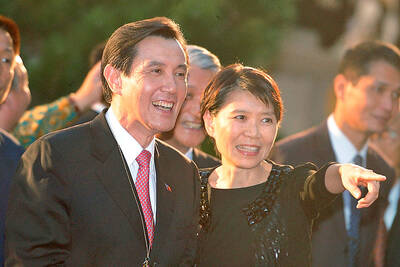
Former president Ma Ying-jeou (馬英九) yesterday expressed “shock and regret” over a statement issued by his wife without his consent, and rejected her assertion that his eldest sister, Ma Yi-nan (馬以南), would manage his medical care or act as his spokesperson amid an ongoing embezzlement probe into his foundation. Ma Ying-jeou in a statement said he was shocked by a statement by his wife, Chou Mei-ching (周美青), regarding his affairs. Ma Yi-nan “must not” be in charge of his healthcare and other personal affairs, nor can she be allowed to represent the Ma family, the former president said. He said he was also


 RSS
RSS