


Losing his right hand in an accident at work more than three decades ago has not stopped Liu Ching-yi (劉慶儀) becoming a seal-engraving master.
Liu, 65, frequently takes part in seal-engraving exhibits and is affectionately called “Lefty Knife” (左刀) by famed calligraphy master Chen Ming-hsien (陳銘顯).
“Before losing my right hand, I was just muddling through life without a purpose,” Liu said. “After [the accident] left me with only one hand to work with, I started to think more about my life and make plans for the future.”
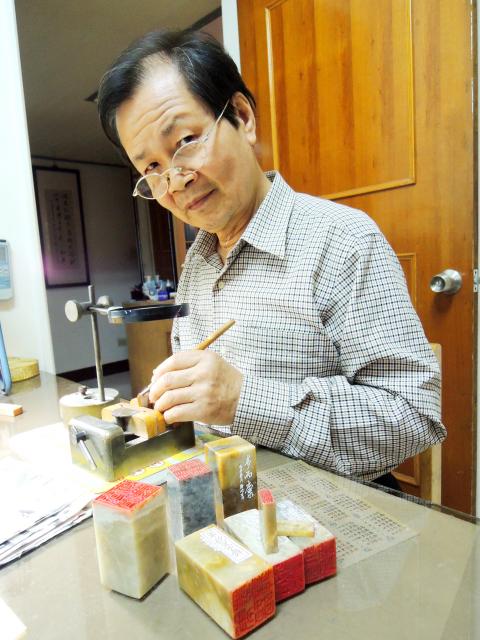
Photo: Tsai Shu-yuan, Taipei Times
“The accident also opened up the beautiful world of painting and engraving to me,” he added.
Liu was 30 and working as a section head on an assembly line for a printing equipment manufacturer when the accident happened.
His right arm was pulled into a machine and had to be amputated from the elbow down. He also broke his lower jaw.
“At first, I couldn’t accept what life had dealt me,” he said.
Married with a child, Liu had to earn a living and after six months of recuperation, he knew he had to pick himself up.
He returned to the factory and worked for another 28 years before retiring.
While he was working at the factory, Liu rediscovered his childhood passion: painting.
“Painting was good therapy after losing my right hand,” he said. “I found a new direction in life and it opened up new opportunities.”
Liu was right-handed, but trained himself to hold a pen and paint brush with his left hand after the accident.
“In the beginning, I could not hold a pen steadily. It took me half a year just to learn how to draw a plum blossom,” Liu said.
He also took up calligraphy to be able to sign his paintings in the traditional manner.
Being able to draw with “one continuous brush stroke” shows your skill as a calligrapher, he said.
After mastering calligraphy, he moved on to seal engraving.
Working with an engraving knife instead of a paint brush was physically challenging. To help him with his work, Liu made his own light-weight engraving knife for left-handers.
However, with the loss of his right arm, his body is out of balance, Liu said.
“When working, I had to exert more strength to keep my balance,” he said. “It sometimes causes back pain, so it takes me longer to finish a product compared with other people.”
As he became more dexterous, Liu was able to express his style of calligraphy on a square seal chop.
Chen said that Liu’s engravings are beautiful, praising the characters, balance of strokes and lines, and spacing.
Liu also teaches his craft to students and often gives them words of encouragement, telling them: “I can do it with only one hand, so you can do it [with two].”
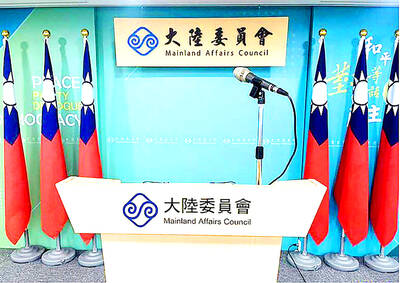
ENTERTAINERS IN CHINA: Taiwanese generally back the government being firm on infiltration and ‘united front’ work,’ the Asia-Pacific Elite Interchange Association said Most people support the government probing Taiwanese entertainers for allegedly “amplifying” the Chinese Communist Party’s propaganda, a survey conducted by the Asia-Pacific Elite Interchange Association showed on Friday. Public support stood at 56.4 percent for action by the Mainland Affairs Council and the Ministry of Culture to enhance scrutiny on Taiwanese performers and artists who have developed careers in China while allegedly adhering to the narrative of Beijing’s propaganda that denigrates or harms Taiwanese sovereignty, the poll showed. Thirty-three percent did not support the action, it showed. The poll showed that 51.5 percent of respondents supported the government’s investigation into Taiwanese who have

South Korean K-pop girl group Blackpink are to make Kaohsiung the first stop on their Asia tour when they perform at Kaohsiung National Stadium on Oct. 18 and 19, the event organizer said yesterday. The upcoming performances will also make Blackpink the first girl group ever to perform twice at the stadium. It will be the group’s third visit to Taiwan to stage a concert. The last time Blackpink held a concert in the city was in March 2023. Their first concert in Taiwan was on March 3, 2019, at NTSU Arena (Linkou Arena). The group’s 2022-2023 “Born Pink” tour set a
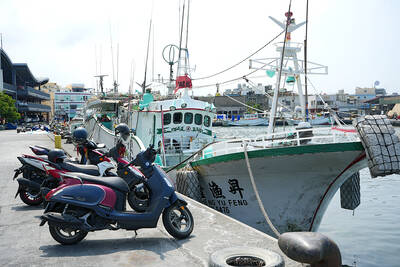
A Philippine official has denied allegations of mistreatment of crew members during Philippine authorities’ boarding of a Taiwanese fishing vessel on Monday. Philippine Bureau of Fisheries and Aquatic Resources (BFAR) spokesman Nazario Briguera on Friday said that BFAR law enforcement officers “observed the proper boarding protocols” when they boarded the Taiwanese vessel Sheng Yu Feng (昇漁豐號) and towed it to Basco Port in the Philippines. Briguera’s comments came a day after the Taiwanese captain of the Sheng Yu Feng, Chen Tsung-tun (陳宗頓), held a news conference in Pingtung County and accused the Philippine authorities of mistreatment during the boarding of

88.2 PERCENT INCREASE: The variants driving the current outbreak are not causing more severe symptoms, but are ‘more contagious’ than previous variants, an expert said Number of COVID-19 cases in the nation is surging, with the Centers for Disease Control (CDC) describing the ongoing wave of infections as “rapid and intense,” and projecting that the outbreak would continue through the end of July. A total of 19,097 outpatient and emergency visits related to COVID-19 were reported from May 11 to Saturday last week, an 88.2 percent increase from the previous week’s 10,149 visits, CDC data showed. The nearly 90 percent surge in case numbers also marks the sixth consecutive weekly increase, although the total remains below the 23,778 recorded during the same period last year,


 RSS
RSS