


One night in July 2011, Kiki was nearing the end of her life. The 10-year-old Chihuahua was diagnosed with fibroids.
“Kiki was hospitalized and medicated, but her condition kept deteriorating,” said her owner, Jessie Chou, 51.
“It was heartbreaking for us to see Kiki suffer, so we decided to stop all medical procedures and have her put down,” Chou said. “It happened so suddenly that we had no idea what to do next.”
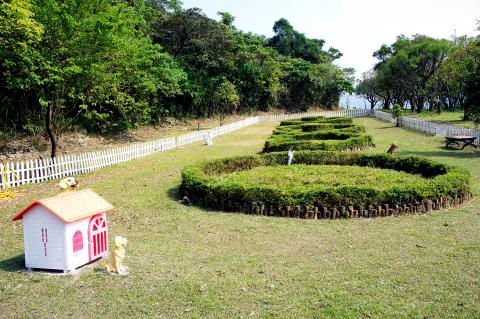
Photo: CNA
Chou thought about burying Kiki near her home, under a bridge in New Taipei City’s (新北市) Yonghe District (永和), but her children opposed the idea, mainly over concerns that the carcass could be dug up by stray animals.
Trying to give Kiki a better final resting place, Chou’s children searched the Internet that night and found the “Secret Garden” — a pet cemetery run by the Taipei City Government.
The cemetery is a 1,650m2 landscaped garden adjacent to the Fu Te Public Cemetery in Taipei.
The Secret Garden was established in November 2007 as the country’s first public repository for pet remains. Since then, the ashes of 2,074 dogs, 644 cats, 100 rabbits and 27 other pets such as birds, turtles and lizards have been sprinkled in the garden, according to the Taipei Mortuary Services Office.
The service is free, but the owners are responsible for having their pets cremated elsewhere, the office said.
Taipei Mortuary Services Office deputy superintendent Yang Yi-lin (楊薏霖) said the garden serves a good purpose, in addition to being a final resting place for pets.
Some pet owners have told Yang that they feel at ease when they come to the garden to remember their animal friends, as they can sit and “imagine the way that their dogs or cats would have run across the garden’s lawn.”
She also suggested that the government set up regulations or laws governing pet funerals rather than applying existing funeral laws designed for human burials, as part of efforts to offer a legal basis for pet funeral service providers.
Some pet owners choose to go further afield to find a more formal burial ground.
Chang Yu-hsing, a bereaved pet owner, drove for more than an hour from Taipei to a graveyard called Pet Paradise near the national scenic area along the north coast.
“We wanted to bury Luku under a tree, somewhere near the sea,” she said, referring to her dog, who died at the age of 15.
Pet Paradise owner Chen Tsai-fu, whose privately run graveyard has been serving as a final destination for about 1,000 pets since 2002, said that more people are starting to pay attention to the details of how their pets are handled after death.
“They simply treat their pets like family members,” Chen said.
Not to be outdone by competitors, Lung Yen Life Service Co (龍巖集團), one of the nation’s largest funeral service companies, has established a pet memorial hall in New Taipei City, providing professional funeral services similar to those for humans.
The memorial hall has had about 30 urns of pets interred since its opening in July last year. It costs about NT$50,000 for a funeral package and an additional NT$55,000 to leave an urn in the hall for three years, the company said.
People are spending more time and money on their pets, said Vonda Lu, a manager in Lung Yen’s research and development department.
“We find that the average age of pet owners is rising and that the money they spend on their pets is increasing,” she said. “For some pet owners, losing a pet is like losing a family member. We hope that grieving owners can find comfort through our services.”

Alain Robert, known as the "French Spider-Man," praised Alex Honnold as exceptionally well-prepared after the US climber completed a free solo ascent of Taipei 101 yesterday. Robert said Honnold's ascent of the 508m-tall skyscraper in just more than one-and-a-half hours without using safety ropes or equipment was a remarkable achievement. "This is my life," he said in an interview conducted in French, adding that he liked the feeling of being "on the edge of danger." The 63-year-old Frenchman climbed Taipei 101 using ropes in December 2004, taking about four hours to reach the top. On a one-to-10 scale of difficulty, Robert said Taipei 101

Taiwanese and US defense groups are collaborating to introduce deployable, semi-autonomous manufacturing systems for drones and components in a boost to the nation’s supply chain resilience. Taiwan’s G-Tech Optroelectronics Corp subsidiary GTOC and the US’ Aerkomm Inc on Friday announced an agreement with fellow US-based Firestorm Lab to adopt the latter’s xCell, a technology featuring 3D printers fitted in 6.1m container units. The systems enable aerial platforms and parts to be produced in high volumes from dispersed nodes capable of rapid redeployment, to minimize the risk of enemy strikes and to meet field requirements, they said. Firestorm chief technology officer Ian Muceus said

MORE FALL: An investigation into one of Xi’s key cronies, part of a broader ‘anti-corruption’ drive, indicates that he might have a deep distrust in the military, an expert said China’s latest military purge underscores systemic risks in its shift from collective leadership to sole rule under Chinese President Xi Jinping (習近平), and could disrupt its chain of command and military capabilities, a national security official said yesterday. If decisionmaking within the Chinese Communist Party has become “irrational” under one-man rule, the Taiwan Strait and the regional situation must be approached with extreme caution, given unforeseen risks, they added. The anonymous official made the remarks as China’s Central Military Commission Vice Chairman Zhang Youxia (張又俠) and Joint Staff Department Chief of Staff Liu Zhenli (劉振立) were reportedly being investigated for suspected “serious
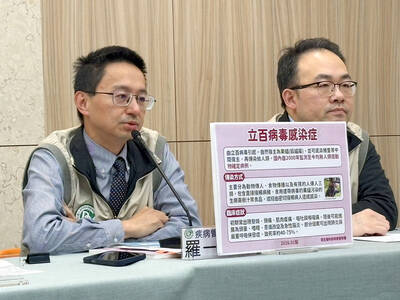
Nipah virus infection is to be officially listed as a category 5 notifiable infectious disease in Taiwan in March, while clinical treatment guidelines are being formulated, the Centers for Disease Control (CDC) said yesterday. With Nipah infections being reported in other countries and considering its relatively high fatality rate, the centers on Jan. 16 announced that it would be listed as a notifiable infectious disease to bolster the nation’s systematic early warning system and increase public awareness, the CDC said. Bangladesh reported four fatal cases last year in separate districts, with three linked to raw date palm sap consumption, CDC Epidemic Intelligence


 RSS
RSS