


Former Democratic Progressive Party chairman Lin I-hsiung (林義雄) and his wife, Fang Su-min (方素敏), yesterday attended a service to commemorate their twin daughters and Lin’s mother, who were murdered during the White Terror era.
Around noon on Feb. 28, 1980, a person whose identity remains unknown broke into Lin’s house in Taipei and attacked Lin’s 60-year-old mother, Lin Yu A-mei (林游阿妹), his seven-year-old twin daughters, Lin Huan-chun (林奐均) and Lin Liang-chun (林亮均), and eldest daughter, Lin Ting-chun (林亭均), who was nine-years old at the time.
At the time of the incident, Lin I-hsiung was in jail awaiting trial for his participation in the Kao-hsiung Incident the previous year, and his wife was visiting him.

Photo: Hu Chien-sen, Taipei Times
Lin I-hsiung’s mother, Lin Liang-chun and Lin Ting-chun died after being stabbed.
His eldest daughter Lin Huan-chun survived after being stabbed six times.
As the Lins’ house at the time was under close surveillance by the police and secret service agents, some believe that the murder was arranged by the government as a warning to those involved in the pro-democracy movement.
However, the actual course of events remains unknown.
The Lins’ residence on Xinyi Road in Taipei later became the Gikong Presbyterian Church, which holds a memorial service each year for the family.
About 100 people attended yesterday’s memorial service.
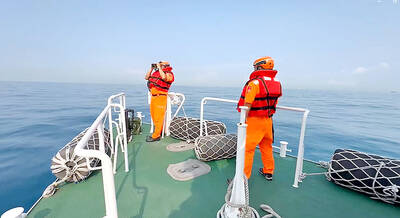
An increase in Taiwanese boats using China-made automatic identification systems (AIS) could confuse coast guards patrolling waters off Taiwan’s southwest coast and become a loophole in the national security system, sources familiar with the matter said yesterday. Taiwan ADIZ, a Facebook page created by enthusiasts who monitor Chinese military activities in airspace and waters off Taiwan’s southwest coast, on Saturday identified what seemed to be a Chinese cargo container ship near Penghu County. The Coast Guard Administration went to the location after receiving the tip and found that it was a Taiwanese yacht, which had a Chinese AIS installed. Similar instances had also

GOOD DIPLOMACY: The KMT has maintained close contact with representative offices in Taiwan and had extended an invitation to Russia as well, the KMT said The Chinese Nationalist Party (KMT) would “appropriately handle” the fallout from an invitation it had extended to Russia’s representative to Taipei to attend its international banquet last month, KMT Chairman Eric Chu (朱立倫) said yesterday. US and EU representatives in Taiwan boycotted the event, and only later agreed to attend after the KMT rescinded its invitation to the Russian representative. The KMT has maintained long-term close contact with all representative offices and embassies in Taiwan, and had extended the invitation as a practice of good diplomacy, Chu said. “Some EU countries have expressed their opinions of Russia, and the KMT respects that,” he

VIGILANCE: The military is paying close attention to actions that might damage peace and stability in the region, the deputy minister of national defense said The People’s Republic of China (PRC) might consider initiating a hack on Taiwanese networks on May 20, the day of the inauguration ceremony of president-elect William Lai (賴清德), sources familiar with cross-strait issues said. While US Secretary of State Anthony Blinken’s statement of the US expectation “that all sides will conduct themselves with restraint and prudence in the period ahead” would prevent military actions by China, Beijing could still try to sabotage Taiwan’s inauguration ceremony, the source said. China might gain access to the video screens outside of the Presidential Office Building and display embarrassing messages from Beijing, such as congratulating Lai
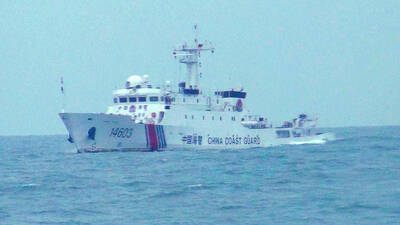
Four China Coast Guard ships briefly sailed through prohibited waters near Kinmen County, Taipei said, urging Beijing to stop actions that endanger navigation safety. The Chinese ships entered waters south of Kinmen, 5km from the Chinese city of Xiamen, at about 3:30pm on Monday, the Coast Guard Administration said in a statement later the same day. The ships “sailed out of our prohibited and restricted waters” about an hour later, the agency said, urging Beijing to immediately stop “behavior that endangers navigation safety.” Ministry of National Defense spokesman Sun Li-fang (孫立方) yesterday told reporters that Taiwan would boost support to the Coast Guard


 RSS
RSS