


While catgut embedding helps people to lose weight, careful consideration should be given to determine who is suitable for the treatment, National Union Association of Chinese Medical Doctors director-general Chen Wang-chuan (陳旺全) said yesterday.
Invited by the Consumers’ Foundation to share his knowledge of catgut embedding after a woman in Greater Taichung almost died after receiving the treatment, Chen said the method was usually more effective in people whose weight problems stem from an accumulation of subcutaneous fat, rather than visceral obesity, which would indicate other physical problems.
A woman in Greater Taichung had about 1,500 strings of catgut embedded in her body over a period of 15 months, leading recently to her nearly losing her life from the suppuration of about 10 wounds and cellulite complications.
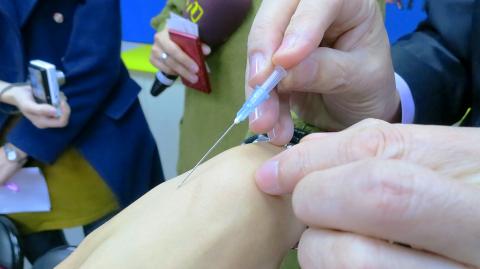
Photo: Yang Chiu-ying, Taipei Times
The incident should never have happened, or should not have been life-threatening, as any responsible and licensed Chinese medicine doctors would have paid attention to disinfecting their equipment and whether their medicines had expired, Chen said.
They would have also taken note of any diseases their patients had, or if wounds exhibited red sores, he added.
Embedding catgut strings in pressure points is an ages-old technique, with a history as old as that of acupuncture, Chen said, adding that the procedure originally was intended to cure people with weak constitutions, not for people to lose weight.
In times gone by doctors did not have the thin needles used today, nor did they have hollow tubes with which to insert the catgut threads into a patient’s body, Chen said.
He added that the threads historically were usually placed in a patient’s body through microsurgery, after which they were sewn shut.
Though not the intended purpose, it was discovered that the procedure helped people lose weight, Chen said.
He said that the modern process of making catgut string differs greatly from the process used in the old days as practitioners are now able to fabricate the string through protein magnetization.
Once inserted, the proteins in the string provide the human body with energy, causing it to burn subcutaneous fat while absorbing the string, Chen said, and this caused weight loss.
However, it is an effect that would be more noticeable in and applicable to patients who suffer from an accumulation of subcutaneous fat, as they have either endocrine disorders or problems with their metabolism, Chen said.
Chen stressed that while the method might also be useful for patients suffering from visceral obesity, it is most probable that those patients already have some sort of disease.
Those with visceral obesity wishing to try catgut embedding should have their diseases — if they have any — cured before attempting the procedure, he said.
Chen said that people with subcutaneous fat can lose weight by exercising, going on a diet or adhering to a normal lifestyle, but some people like to take shortcuts and that is why they undergo radical procedures like catgut embedding.


UPGRADE: The Kang Ding-class frigate is replacing its Chaparall missiles with Tien Chien II and Hua Yang VLS, which would provide it with long-range, 360° air defense Taiwan plans to produce 1,200 to 1,376 Hai Chien II missiles (海劍二, Sea Sword II) — also known as TC-2N — to serve as the standard air defense system of the navy’s surface combatant fleet, a source said yesterday. Last week, the Hai Chien II, the naval version of the Tien Kung II missile (天劍二, Sky Sword II), completed a live-fire test in waters off the National Chungshan Institute of Science and Technology’s Jiupeng facility (九鵬) in Pingtung County’s Manjhou Township (滿州). The MIM72 Chaparral and other dated air defense missiles that currently arm Taiwanese ships have inadequate range to combat Chinese

REASONS FOR TRAVEL: An assistant professor said that proposed amendments to penalize drivers if they used drugs overseas would not deter people from traveling People who operate a motor vehicle under the influence of marijuana would have their driver’s license revoked, even if they used the substance while overseas, the Ministry of Transportation and Communications said yesterday, citing proposed amendments to the Road Traffic Management and Penalty Act (道路交通管理處罰條例). The amendments would also authorize the government to revoke the licenses of people determined to have used Category 1 or Category 2 narcotics, even if they were not operating a vehicle while under the influence of drugs, as well as ban them from taking the license test for three years, the ministry said. People aged 18 or
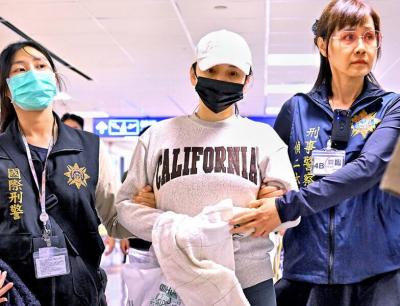
Johanne Liou (劉喬安), a Taiwanese woman who shot to unwanted fame during the Sunflower movement protests in 2014, returned to Taiwan last night after being deported from the US. She is to stand trial in Taiwan for charges involving embezzlement, fraud and drug crimes. The Criminal Investigation Bureau (CIB) said it took her into custody at Taiwan Taoyuan International Airport and would first question her before transferring her to the New Taipei District Prosecutors’ Office. She was arrested upon disembarking a flight from San Francisco that landed shortly before 7pm. Liou absconded to the US in 2019 after jumping bail
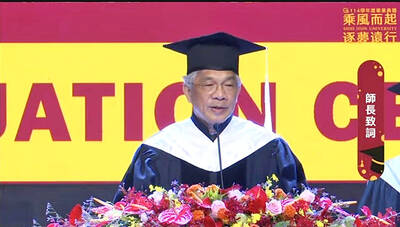
Shih Hsin University President Chen Ching-he (陳清河) yesterday issued a public apology for comments made in his commencement speech last week, stating that he has asked the school to suspend his duties and halt his wages for two months as a show of contrition. At the commencement ceremony on May 30, Chen said, “If you don’t manage your time well, or your own emotions, or your health, then I am telling every one of you — put a quick end to ‘you,’ because the world has no need for ‘you.’” The comments have sparked significant controversy online, and Chen through an open


 RSS
RSS