


People around the world seem to take Friday night as a cue to go clubbing, sing in KTVs or dine out. However, where does one go if one is looking for something a little more cerebral?
In comes “Cafe Philo a Taiwan,” a forum hosted at Cafe Philo every Friday night, supported and continued by the dedication of the speakers and staff recording and editing a range of philosophical talks.
The forum was started by Fu Jen Catholic University philosophy professor Shen Ching-kai (沈清楷). The 42-year-old Shen said it began when the owner of Cafe Philo and Democratic Progressive Party (DPP) Legislator Cheng Li-chun (鄭麗君), wanted to promote a forum in which the voice of the common people may be heard.
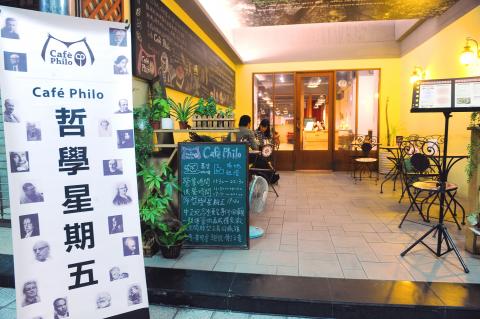
Photo: Chu Pei-hsiung, Taipei Times
Shen and Cheng, a former head of the National Youth Commission (NYC), met in Belgium when Shen was studying for his doctorate. Cheng later became the director of the Youth Synergy Foundation, where Shen had started working on his return to Taiwan.
“[Cheng’s idea] made me think of Gabriel Marcel’s ‘Friday Evenings’ philosophical discussion groups,” Shen said.
That gave birth on Aug. 13, 2010, to the Taiwanese version of Marcel’s “Friday Evenings,” choosing suicide as the first topic of discussion.
Shen has continued to host the forums after switching to teaching at Fu Jen.
“There are a lot of people in other foundations that are very curious as to how we are able to maintain a forum for two years without pause or break aside from the short period when Cafe Philo closes for the Lunar New Year,” Shen said with a small laugh, saying there were not really any special tricks.
It is just a group of volunteers sitting around to chat in their spare time, Shen said, adding: “There isn’t any pressure, and we don’t even have to score ourselves on effectiveness.”
Pointing to about 10 volunteers who play the role of hosts, camerapeople, record keepers, editors and even accountants, Shen said that some of the volunteers were his younger classmates, and some were frequent visitors to “Friday Evenings” and had simply come to help.
There are still people in Taiwan who are a bit naive and still think simply, Shen said, describing the volunteers.
When asked if he included himself in that group, Shen laughed and said: “Of course.”
Shen said that funding for the forum came from friends who gave small sums of between NT$1,000 and NT$3,000, adding that he sometimes put in a little himself.
Someone donated more than NT$20,000 a while ago, and that was enough to tide the forum over for two or three months, Shen said, adding that although others had promised they would pay for whatever the forum did, “we didn’t really dare do anything on such a grand scale; we just needed a tiny bit of funding.”
Commenting on the forum’s style, Shen said he usually started the discussions with the phrase: “What’s interesting is that ...”
However, Shen’s forums usually avoid popular topics. He said the forum was not an elite gathering, but rather a place where average people could express their thoughts, citing a discussion the forum had on the months-long strike by workers at Hualon Corp that started in June.
Some talked about the process of the strike, and some talked about their personal experiences — of how family members were unable to receive their pensions upon retirement, Shen said.
To put it simply, Cafe Philo a Taiwan is simply a gathering place for those who want to get things off their chest and for people looking for something different to do on Friday evenings, Shen said.
“We are able to pool our minds and keep things simple, which is why it works,” Shen said, adding that the forum has gained enough momentum to start making a voice for itself outside the cafe, on the streets in opposition to certain policies, such as the Kuokuang chemical plant, monopolization of the media and the Miramar Resort Village project.
And it keeps on growing stronger, Shen said.

Considering that most countries issue more than five denominations of banknotes, the central bank has decided to redesign all five denominations, the bank said as it prepares for the first major overhaul of the banknotes in more than 24 years. Central bank Governor Yang Chin-lung (楊金龍) is expected to report to the Legislative Yuan today on the bank’s operations and the redesign’s progress. The bank in a report sent to the legislature ahead of today’s meeting said it had commissioned a survey on the public’s preferences. Survey results showed that NT$100 and NT$1,000 banknotes are the most commonly used, while NT$200 and NT$2,000

The Centers for Disease Control (CDC) yesterday reported the first case of a new COVID-19 subvariant — BA.3.2 — in a 10-year-old Singaporean girl who had a fever upon arrival in Taiwan and tested positive for the disease. The girl left Taiwan on March 20 and the case did not have a direct impact on the local community, it said. The WHO added the BA.3.2 strain to its list of Variants Under Monitoring in December last year, but this was the first imported case of the COVID-19 variant in Taiwan, CDC Deputy Director-General Lin Ming-cheng (林明誠) said. The girl arrived in Taiwan on

South Korea is planning to revise its controversial electronic arrival card, a step Taiwanese officials said prompted them to hold off on planned retaliatory measures, a South Korean media report said yesterday. A Yonhap News Agency report said that the South Korean Ministry of Foreign Affairs is planning to remove the “previous departure place” and “next destination” fields from its e-arrival card system. The plan, reached after interagency consultations, is under review and aims to simplify entry procedures and align the electronic form with the paper version, a South Korean ministry official said. The fields — which appeared only on the electronic form

The Ministry of Foreign Affairs (MOFA) is suspending retaliation measures against South Korea that were set to take effect tomorrow, after Seoul said it is updating its e-arrival system, MOFA said today. The measures were to be a new round of retaliation after Taiwan on March 1 changed South Korea's designation on government-issued alien resident certificates held by South Korean nationals to "South Korea” from the "Republic of Korea," the country’s official name. The move came after months of protests to Seoul over its listing of Taiwan as "China (Taiwan)" in dropdown menus on its new online immigration entry system. MOFA last week


 RSS
RSS