


Central Election Commission (CEC) Chairperson Chang Po-ya (張博雅) yesterday admitted there was no institutionalized emergency response plan to deal with unexpected events — such as natural disasters — during an election campaign period or on election day and promised to come up with a plan within one month.
Chang made the remarks while responding to questions raised by Chinese Nationalist Party (KMT) Legislator Johnny Chiang (江啟臣) during a question-and-answer session at an Internal Administration Committee meeting to review the commission’s budgets for the next fiscal year.
“Hurricane Sandy hit the US right before the US presidential election, and many had worried that the disaster could have some impact on the election,” Chiang said.
“Taiwan is also a country that often faces challenges from natural disasters, such as earthquakes. Do we have an emergency response plan that could be enacted immediately when a disaster hits during the campaign period or on the election day?” he said.
Chang said that there is not a systemic emergency response plan specifically aimed at handling disasters that may effect an election.
“But I think it’s a good idea to draft such a plan,” she said.
The commission is to look into how the electoral authorities in the US reacted to the hurricane and intends to formulate a plan within one month, Chang said.
Chang also commented on recent controversies surrounding special allowance funds for heads of government agencies before the meeting began.
“Whether the special allowance fund should be cut or how much it should be cut by are decisions to be made by the Cabinet,” she said.
“There should not be different standards and different actions in different ministries,” she said.
Chang added that it is hard to say whether her special allowance fund is sufficient because it depends on the number of events and meetings she is scheduled to attend.
“Sometimes it’s enough, sometimes it’s not, but most of time it’s not enough,” Chang said.
The special allowance funds are usually spent by heads of government agencies to purchase gifts for visiting guests, or used for cash gifts at weddings or funerals.

SECURITY: Starlink owner Elon Musk has taken pro-Beijing positions, and allowing pro-China companies to control Taiwan’s critical infrastructure is risky, a legislator said Starlink was reluctant to offer services in Taiwan because of the nation’s extremely high penetration rates in 4G and 5G services, the Ministry of Digital Affairs said yesterday. The ministry made the comments at a meeting of the legislature’s Transportation Committee, which reviewed amendments to Article 36 of the Telecommunications Management Act (電信管理法). Article 36 bans foreigners from holding more than 49 percent of shares in public telecommunications networks, while shares foreigners directly and indirectly hold are also capped at 60 percent of the total, unless specified otherwise by law. The amendments, sponsored by Chinese Nationalist Party (KMT) Legislator Ko

The military has spotted two Chinese warships operating in waters near Penghu County in the Taiwan Strait and sent its own naval and air forces to monitor the vessels, the Ministry of National Defense (MND) said. Beijing sends warships and warplanes into the waters and skies around Taiwan on an almost daily basis, drawing condemnation from Taipei. While the ministry offers daily updates on the locations of Chinese military aircraft, it only rarely gives details of where Chinese warships are operating, generally only when it detects aircraft carriers, as happened last week. A Chinese destroyer and a frigate entered waters to the southwest
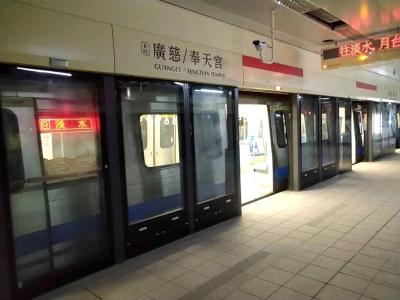
The eastern extension of the Taipei MRT Red Line could begin operations as early as late June, the Taipei Department of Rapid Transit Systems said yesterday. Taipei Rapid Transit Corp said it is considering offering one month of free rides on the new section to mark its opening. Construction progress on the 1.4km extension, which is to run from the current terminal Xiangshan Station to a new eastern terminal, Guangci/Fengtian Temple Station, was 90.6 percent complete by the end of last month, the department said in a report to the Taipei City Council's Transportation Committee. While construction began in October 2016 with an
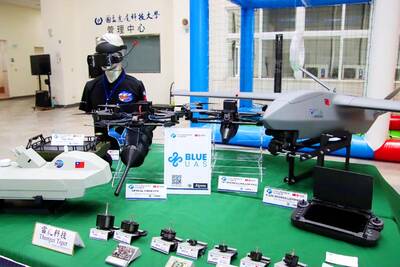
NON-RED SUPPLY: Boosting the nation’s drone industry is becoming increasingly urgent as China’s UAV dominance could become an issue in a crisis, an analyst said Taiwan’s drone exports to Europe grew 41.7-fold from 2024 to last year, with demand from Ukraine’s fight against Russian aggression the most likely driver of growth, a study showed. The Institute for Democracy, Society and Emerging Technology (DSET) in a statement on Wednesday said it found that many of Taiwan’s uncrewed aerial vehicle (UAV) sales were from Poland and the Czech Republic. These countries likely transferred the drones to Ukraine to aid it in its fight against the Russian invasion that started in 2022, it said. Despite the gains, Taiwan is not the dominant drone exporter to these markets, ranking second and fourth


 RSS
RSS