


The legislature’s Joint Education and Transportation Committee yesterday decided to submit the nominations of four prospective National Communications Commission (NCC) members to a vote of the full legislature, provided that the position of Democratic Progressive Party (DPP) lawmakers that the nominees are unqualified for the position be included as a “reference” in the committee’s report for other legislators to consider.
Some lawmakers told reporters that the decision was a win-win compromise between the DPP and the Chinese Nationalist Party (KMT). The DPP succeeded in having its opinions included in the committee’s review report, while the KMT can use its majority in the legislature to have the nominations passed at a full session.
The nominations are scheduled to be voted on tomorrow morning.
The four nominees are National Dong Hwa University professor Howard Shyr (石世豪), National Chiao Tung University professor Yu Hsiao-cheng (虞孝成), National Tsing Hua University professor Peng Shin-yi (彭心儀) and Integral Investment Holdings Group general manager Chen Yuan-ling (陳元玲).
They were nominated to replace NCC chairperson Su Herng (蘇蘅) and NCC vice chairperson Chen Jeng-chang (陳正倉), as well as NCC commissioners Weng Hsiao-ling (翁曉玲) and Chung Chi-hui (鍾起惠), who are scheduled to step down by the end of this month.
Shyr was nominated as the new commission chairperson and Yu as the new vice chairperson.
Prior to yesterday’s ruling, the joint committee had held three sessions to review the qualifications of the nominees.
However, DPP lawmakers boycotted the sessions twice, asking the Executive Yuan to provide more information on the nominees before they could properly review their qualifications.
Chen Yuan-ling and Peng once again came under attack at the review session.
Some DPP lawmakers said their investigations showed that Chen Yuan-ling provided false information on her work experience.
They also said that her husband runs a private equity firm that has a huge stake in China, which would be a major conflict of interest if she becomes a commissioner. They also said that Peng violated academic ethics by plagiarizing work as well as submitting the same report to multiple institutions and asking for funding.
DPP legislators Yeh Yi-jin (葉宜津) and Kuan Bi-ling (管碧玲) asked Peng if she was willing to step down if the National Science Council later finds her to have violated academic ethics.
“I am certain I have not violated any academic ethics,” Peng said. “But I will know what to do if an investigation by an academic institutions finds me guilty.”
In related news, Want Want Group chairman Tsai Eng-meng (蔡衍明) is scheduled to be interviewed by NCC commissioners today, as the commission seeks to clarify several remaining issues related to Want Want’s bid for the 11 cable TV stations owned by China Network System.
The commission also confirmed that Tsai’s son, Want Want China-Broadband chairman Tsai Shao-chung (蔡紹中), came to the commission yesterday and was informed about the administrative procedures for today’s interview.
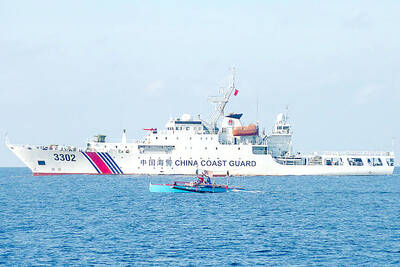
EXPANSIONIST: China deploys an average of 40 to 50 warships and coast guard vessels daily in the South China Sea, despite pledges not to militarize the region, an official said China is attempting to expand its influence across the First Island Chain and increase pressure on Japan by sending coast guard vessels into waters off of Taiwan under the pretext of maritime negotiations with Japan and the Philippines, a national security official said yesterday. China’s recent actions in the waters east of Taiwan and Japan and the Philippines’ exclusive economic zones (EEZ) are attempts to establish dominance in First Island Chain waters, said the official who declined to be named, adding that this is “expansion disguised as law enforcement.” Framing China’s actions solely as a cross-strait issue is a serious misjudgment that
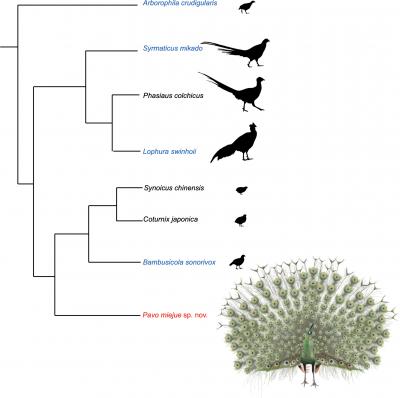
Through analyzing fossil evidence, a research team at National Taiwan University (NTU) discovered the largest endemic bird to have lived in Taiwan, naming it Pavo miejue, or extinct peafowl (滅絕孔雀). The Mikado pheasant, which is printed on the back of the NT$1,000 bank note, was previously believed to be the biggest endemic bird to Taiwan. The research team’s findings suggest that Pavo miejue lived during the Pleistocene epoch tens of thousands of years ago. It is the first endemic extinct bird species discovered and formally named in Taiwan. The study was coauthored by NTU Institute of Ecology and Evolutionary Biology professor Tsai Cheng-hsiu (蔡政修),
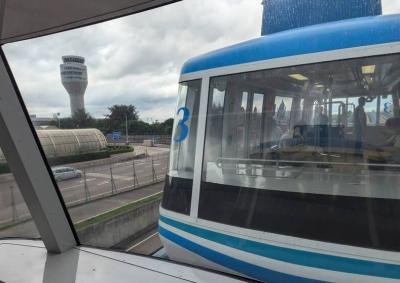
Taiwan Taoyuan International Airport is to suspend its automated Skytrain service connecting Terminal 1 and Terminal 2 starting on July 1 to facilitate connection works for the upcoming Terminal 3, the airport operator said today. Passengers and staff who need to travel between the two terminals after the suspension can instead use the Taoyuan MRT or the airport's 24-hour shuttle bus service, Taoyuan International Airport Corp said. The Taoyuan MRT Airport Line directly links the two terminals, while the shuttle buses are to operate around the clock, the company added. The Skytrain provides free transportation between the airport’s two terminals for travelers and
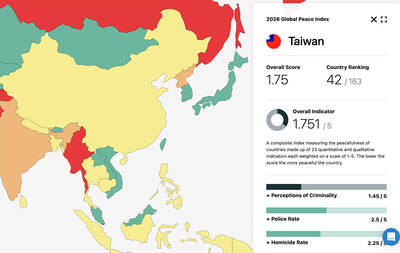
Taiwan ranked 42nd in terms of peacefulness among 163 countries, down five places from last year, according to this year’s Global Peace Index. With an overall score of 1.751, Taiwan dropped from 37th last year, the report published by the global Institute for Economics and Peace showed. The overall score measures a country’s level of peacefulness using 23 quantitative and qualitative indicators across three domains — ongoing domestic and international conflict, societal safety and security, and militarization. While Taiwan ranked 42nd worldwide, it was listed in ninth place among the 19 Asian-Pacific countries in the report, after New Zealand, Singapore, Japan, Malaysia,


 RSS
RSS