


Trash from China that washes up on the beaches of Taiwanese islands such as Kinmen and Matsu has long created headaches for cleanup workers.
The state of one Matsu beach, covered with plastic bottles and food packaging from popular Chinese brands, shocked and embarrassed a group of Chinese exchange students who recently took part in a beach cleanup activity there.
Just over 100 students from Minjiang University in China’s Fujian Province have studied at the Chinese Culture University in an exchange program in the past year.
They recently concluded their studies and, before departing, helped clean up a beach in Matsu’s Chuluo (珠螺) coastal region arranged by the Tourism Bureau.
Many of the students were surprised to see the large amounts of garbage drifting along the shoreline and strewn on the beach.
The waste included packaging of consumer goods ubiquitous in their daily lives, including plastic packs of Master Kong instant noodles and the famous Fuzhou fish balls, as well as plastic bottles of brand-name soft drinks from China.
Lee Chien-hsun (李建勳), a Matsu National Scenic Area Administration official, said many of the Chinese students expressed sorrow about the beach pollution caused by litter from China, which is less than a kilometer away from some of the islets of the Matsu group.
Some of the students sang the TV commercial theme songs of products familiar to them when they spotted items they recognized, Lee said.
One of the students, Bi Baibai (畢白白), wrote in a post on a Chinese microblogging site that she would have been unable to imagine the extent of the litter if she had not seen it with her own eyes.
She also wrote that she felt ashamed that her compatriots’ behavior had caused so much cross-border environmental pollution.
“Although the cleanup program has ended, the shocking feeling I felt [when seeing the litter] remains fresh in my mind. With a feeling of shame, I picked up trash that had floated across the Taiwan Strait to Matsu from my home province,” Bi wrote.
“Seeing all this familiar trash, I could not help but think that Matsu residents have been forced to find out about popular consumer brands on the mainland by having it strewn on their land ... I really feel sorry for this littering by the people in my home,” she added.
Bi’s posting immediately drew an enthusiastic response. Some bloggers said they felt the cleanup activity was very meaningful and inspiring, while others said they hope China would devote more energy to proper garbage disposal and be more strict in implementing garbage classification.
A Chinese Culture University professor said he hopes the program would promote ecological education, environmental protection, eco-tourism and eco-friendly lifestyles.
Matsu officials said litter from China has been becoming an increasingly serious problem as China continues its rapid economic development.
The quantity of waste has been rising, causing huge damage to Matsu’s coastal scenery, the officials said, adding that more than 1,000 tonnes is removed manually per year.
Similar problems have also troubled the Penghu Islands, tourism officials said, adding that the archipelago’s northern coastlines are the most seriously polluted and that even its uninhabited islets such as Yuanbeiyu (員貝嶼) and Jishanyu (雞善嶼) have also been affected.

NATIONAL SECURITY: Authorities are working to confirm the identities of the military personnel involved and investigating possible illegal conduct and regulatory violations Authorities are probing possible national security implications after Kinmen police and immigration officers on Sunday found a Chinese woman allegedly posing as a tourist while engaging in prostitution involving more than 10 military personnel. The woman, surnamed Chen (陳), has since been deported, authorities said, adding that investigators are still working to confirm the identities of those implicated, as the records only listed code names and aliases. The case stemmed from a report received by the Kinmen District Prosecutors’ Office on Friday last week from the Jinhu Precinct of the Kinmen County Police Bureau. On Sunday, police, along with the National Immigration

GLOBALGIVING: ‘ Caving to external pressure is not acceptable for an organization that has cultivated justice reform and human rights for 30 years,’ one NGO said A slew of non-government organizations (NGOs) have withdrawn from the GlobalGiving fundraising platform after it announced it would use “Chinese Taipei” instead of “Taiwan” from next month. The Taiwan Good Rice Association wrote on Facebook on Friday that it was informed on April 28 via a teleconference call of the change, which was made because the platform wanted to operate in China. Taiwan Good Rice is to terminate all cooperative relationships with GlobalGiving in response to the platform’s “unilateral and non-negotiable” decision to remove references to Taiwan, the NGO said. “Taiwan is in the official name of Taiwan Good Rice Association and the

HEAVY WEATHER: Typhoon Jangmi is due to crash straight into the Ryukyus as airlines look to shift flights to larger aircraft or cancel flights to Okinawa entirely Taiwan’s international air carriers announced flight adjustments over the weekend as Typhoon Jangmi is forecast to hit the Ryukyu Islands today and tomorrow. The Central Weather Administration (CWA) upgraded Jangmi from a tropical storm to a typhoon at 8am yesterday, with the eye located 580km south of Naha city. It was moving north at 19kph. Today, China Airlines’ CI-120, CI-121, CI-122 and CI-123 flights between Taoyuan and Naha, Okinawa, have been canceled as well as CI-132 and CI-133 between Kaohsiung and Naha. EVA Air’s BR-112, BR-113, BR-186 and BR-185 flights between Taoyuan and Naha are also canceled. Low-cost carrier Tigerair Taiwan canceled IT-230,
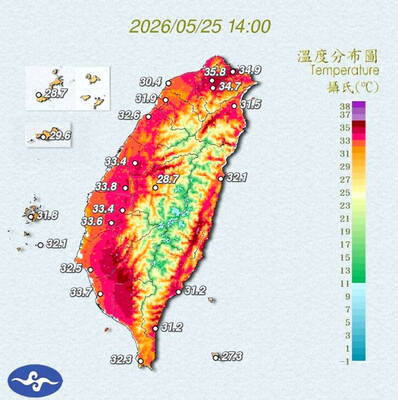
STAY COOL: The HPA recommended that people stay hydrated, use air-conditioning or fans while indoors, wear loose-fitting clothes and walk in the shade while outdoors Employers must implement measures such as installing cooling equipment, and providing drinking water and rest breaks for outdoor workers starting from Monday next week, the Taipei Department of Labor said on Sunday. Employers who fail to comply could face fines of NT$30,000 to NT$300,000 under the Occupational Safety and Health Act (職業安全衛生法), the department said. Businesses in Taipei employing fewer than 100 workers, as well as registered self-employed workers with labor insurance coverage, could receive on-site assessments and guidance from occupational safety consultants to help them apply for central government subsidies to implement or improve heat-protection measures, it said. Under the Ministry of


 RSS
RSS