


“We all get old, but the infirmities of old age are less important to me because the puppies and swallows I create travel the world on my behalf,” said 87-year-old Huang Tu Yu-yan (黃杜玉燕), who was hospitalized at Ditmansion Medical Foundation Chia-yi Christian Hospital a decade ago when she exhibited complications due to diabetes that made it difficult for her to walk.
Six years ago doctors amputated her left leg.
Despite the physical difficulties Huang has had to endure as a result of her illness, she also discovered the art of Chinese knotting while at the hospital.
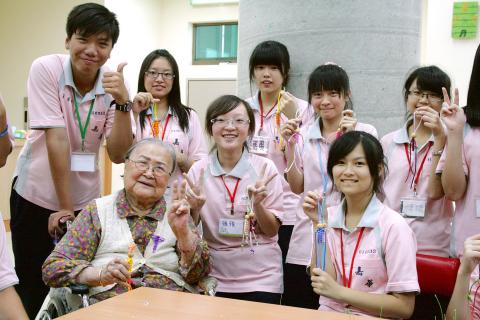
Photo: Yu Hsueh-lan, Taipei Times
Having always been handy with a needle and having started her own sewing shop, Huang quickly mastered the art and soon started producing works in the form of puppies, bunnies and dolls.
Chinese knotting is the art of creating shapes, using one piece of string, that are identical whether viewed from the front or back. Traditionally, they are believed to ward off evil spirits and serve as lucky charms for a happy marriage.
Among the pieces she has created, the most popular have been doll-shaped and puppy-shaped knots, Huang said.
She has even named them using characters from her own name, calling the puppies “Hsiao Yu” (小玉) and the dolls “Hsiao Yan” (小燕).
Huang’s ornamental pieces are one of the most common gifts given by the Chiayi Presbyterian Church to members in South Korea, the US, Japan and the Philippines.
Recently, a church member from Myanmar asked Huang for nearly 100 of her dolls as gifts for the poor in that country.
Huang was delighted to learn that her works bring joy to others.
Huang says she spends at least two hours a day creating Chinese knotting works and over the past decade estimates she has made about 10,000 pieces that she has given away.
“I like to learn, to travel and share,” Huang said, adding that when she was young she paid for her college tuition with the money she made from weaving.
“By the time I graduated from the English department at college, I had already visited 17 countries,” she said.
Maintaining her positive outlook despite her health problems, Huang found herself teaching more than 40 students at Chia Hwa Senior-High School last week. She hoped they would learn not only the art of Chinese knotting, but that some of her tireless optimism would rub off.
Translated by Jake Chung, staff writer

The Centers for Disease Control (CDC) yesterday reported the first case of a new COVID-19 subvariant — BA.3.2 — in a 10-year-old Singaporean girl who had a fever upon arrival in Taiwan and tested positive for the disease. The girl left Taiwan on March 20 and the case did not have a direct impact on the local community, it said. The WHO added the BA.3.2 strain to its list of Variants Under Monitoring in December last year, but this was the first imported case of the COVID-19 variant in Taiwan, CDC Deputy Director-General Lin Ming-cheng (林明誠) said. The girl arrived in Taiwan on

South Korea is planning to revise its controversial electronic arrival card, a step Taiwanese officials said prompted them to hold off on planned retaliatory measures, a South Korean media report said yesterday. A Yonhap News Agency report said that the South Korean Ministry of Foreign Affairs is planning to remove the “previous departure place” and “next destination” fields from its e-arrival card system. The plan, reached after interagency consultations, is under review and aims to simplify entry procedures and align the electronic form with the paper version, a South Korean ministry official said. The fields — which appeared only on the electronic form

The Ministry of Foreign Affairs (MOFA) is suspending retaliation measures against South Korea that were set to take effect tomorrow, after Seoul said it is updating its e-arrival system, MOFA said today. The measures were to be a new round of retaliation after Taiwan on March 1 changed South Korea's designation on government-issued alien resident certificates held by South Korean nationals to "South Korea” from the "Republic of Korea," the country’s official name. The move came after months of protests to Seoul over its listing of Taiwan as "China (Taiwan)" in dropdown menus on its new online immigration entry system. MOFA last week

A bipartisan group of US senators has introduced a bill to enhance cooperation with Taiwan on drone development and to reduce reliance on supply chains linked to China. The proposed Blue Skies for Taiwan Act of 2026 was introduced by Republican US senators Ted Cruz and John Curtis, and Democratic US senators Jeff Merkley and Andy Kim. The legislation seeks to ease constraints on Taiwan-US cooperation in uncrewed aerial systems (UAS), including dependence on China-sourced components, limited access to capital and regulatory barriers under US export controls, a news release issued by Cruz on Wednesday said. The bill would establish a "Blue UAS


 RSS
RSS