


An exhibition of antique bikes opened on Tuesday in Greater Taichung’s Da Ya International Flower Market, featuring an array of old bicycles ranging from classics that were used to peddle green-pea soup to the engine-propelled bicycle that was billed as a “must have” for the O Gau Hiann (黑狗兄) in the 1950s for picking up girls.
O Gau Hiann, a term in Hoklo (commonly known as Taiwanese), was used to describe young men who were popular or stylish.
According to bicycle collector Chen Chih-lung (陳志龍), the bicycle was at one time the most popular mode of transport in the nation and saw its heyday span from the 1940s to the 1970s.
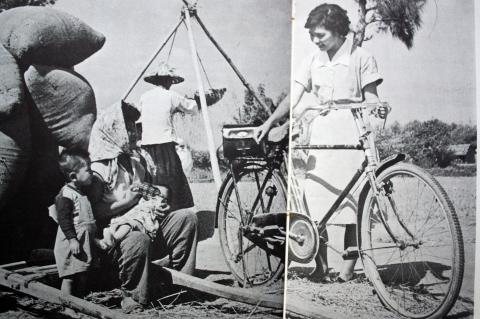
Photo: Chang Juei-chen, Taipei Times
It was only in the 1980s that the bicycle began to be gradually replaced by scooters and cars, Chen said, adding that the bicycles on exhibition had witnessed the development and trasnformation of the nation’s economy.
There were a multitude of trades and businesses that relied on the of use bicycles or tricycles. Tricycles were the most common way to ferry passengers around, public officials used bicycles to get to work and postmen and grocers used them to transport mail, groceries and beverages, Chen said.
He also said that because people in that era often raised chickens or ducks at home, some bicycles had been specifically made for peddling young chicks and ducklings around.
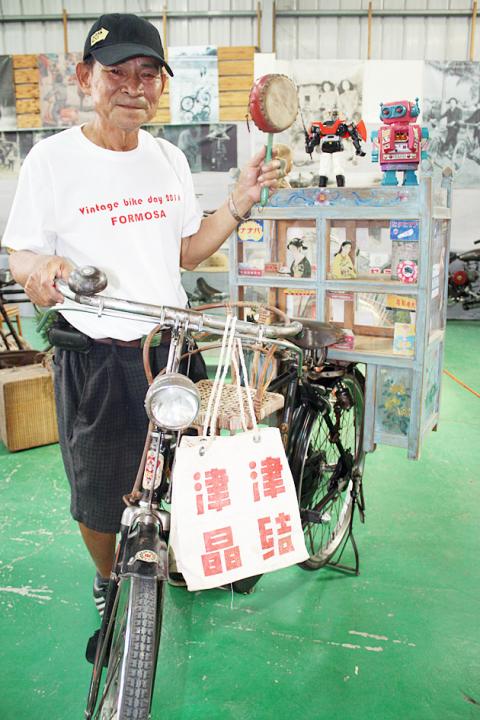
Photo: Chang Juei-chen, Taipei Times
Among the many bicycles used by businesses and government agencies in the past, only the bikes for postmen and delivery of Yakult drinks had specific colors — green or blue respectively — Chen said.
Yakult is the brand name for a Japanese probiotic beverage created in 1930 by fermenting skimmed milk with a special strain of Lactobacillus casei Shirota.
In addition to their coloring, the bikes had other common characteristics, such as the postal bikes’ top tube being reinforced with metal plating to better bear the weight of mail bags, while the Yakult delivery bikes usually had step-through frames because most deliveries of Yakult were made by women.
Bicycles used by the military, civil servants and teachers were the least decorated, but also had the strongest frames and were the most expensive, Chen said.
Chen said it was very interesting to note that in the 1950s, bicycles were actually considered a luxury item. Bike dealers offered payment installment plans and worked with the government to promote low-cost purchases of bicycles.
The exhibition displayed a public notice issued in 1957 which stated that the Taiwan Provincial Government’s Bureau of Supplies was selling bicycles made by the Fulu Bicycle Company for NT$940 (US$31) if purchased outright and for NT$960 if the buyer chose to buy the bike in six installments. The notice limited the offer to civil servants, teachers and workers at public or private companies.
However, wages at the time for elementary-school teachers stood at only NT$300 per month.
One of the people visiting the exhibition was 66-year-old Cheng Chi-lin (鄭啟林), who pointed to a bicycle used by green-pea soup vendors and said it was one of the sights from the old days he missed the most.
Cheng said that in 1960, a bowl of green pea soup cost about one or two jiao (角), a currency unit of the time that was roughly equivalent to one-tenth of NT$1.
Peddlers at the time used to place the green pea soup in drums attached to their bicycles that were separated into two compartments. The inner compartment contained ice to cool the soup, and just as the ice was about to melt the peddler would add some salt to it to lower its temperature, Cheng said.
The exhibition also displayed a 1953 engine-propelled bicycle that was assembled in Japan using an engine fabricated by the Toyo Company that would have cost nearly NT$100,000 in today’s currency, Chen said.
To put the amount into context, the bike’s price was three to four times a civil servant’s annual wages, Chen said, adding that such a bicycle was usually owned by the affluent, or ridden by stylish playboys to catch the attention of women.
Translated by Jake Chung, staff writer
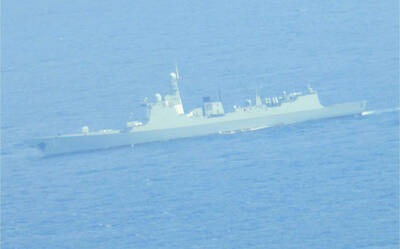
The military has spotted two Chinese warships operating in waters near Penghu County in the Taiwan Strait and sent its own naval and air forces to monitor the vessels, the Ministry of National Defense (MND) said. Beijing sends warships and warplanes into the waters and skies around Taiwan on an almost daily basis, drawing condemnation from Taipei. While the ministry offers daily updates on the locations of Chinese military aircraft, it only rarely gives details of where Chinese warships are operating, generally only when it detects aircraft carriers, as happened last week. A Chinese destroyer and a frigate entered waters to the southwest
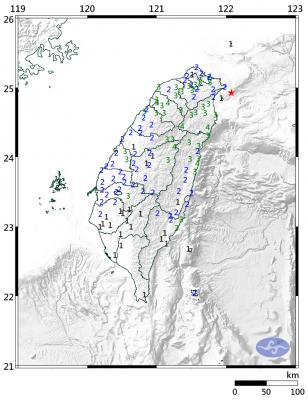
A magnitude 6.1 earthquake struck off the coast of Yilan County at 8:39pm tonight, the Central Weather Administration (CWA) said, with no immediate reports of damage or injuries. The epicenter was 38.7km east-northeast of Yilan County Hall at a focal depth of 98.3km, the CWA’s Seismological Center said. The quake’s maximum intensity, which gauges the actual physical effect of a seismic event, was a level 4 on Taiwan’s 7-tier intensity scale, the center said. That intensity level was recorded in Yilan County’s Nanao Township (南澳), Hsinchu County’s Guansi Township (關西), Nantou County’s Hehuanshan (合歡山) and Hualien County’s Yanliao (鹽寮). An intensity of 3 was

Japanese Prime Minister Sanae Takaichi’s comment last year on Tokyo’s potential reaction to a Taiwan-China conflict has forced Beijing to rewrite its invasion plans, a retired Japanese general said. Takaichi told the Diet on Nov. 7 last year that a Chinese naval blockade or military attack on Taiwan could constitute a “survival-threatening situation” for Japan, potentially allowing Tokyo to exercise its right to collective self-defense. Former Japan Ground Self-Defense Force general Kiyofumi Ogawa said in a recent speech that the remark has been interpreted as meaning Japan could intervene in the early stages of a Taiwan Strait conflict, undermining China’s previous assumptions
Taiwan Railways Corp (TRC) today announced that Shin Kong Mitsukoshi has been selected as the preferred bidder to operate the Taipei Railway Station shopping mall, replacing the current operator, Breeze Development Co Ltd. Among eight qualified firms that delivered presentations and were evaluated by a review committee, Shin Kong Mitsukoshi was ranked first, while Breeze was named the runner-up, the rail company said in a statement. Contract negotiations are to proceed in accordance with regulations, it said, adding that if negotiations with the top bidder fail, it could invite the second-ranked applicant to enter talks. Breeze in a statement today expressed doubts over


 RSS
RSS