


Want Want China Times Group Chairman Tsai Eng-meng (蔡衍明) yesterday attended a public hearing on Want Want China Broadband’s bid for cable TV services owned by China Network Systems (CNS) and said he did not take any funds from China.
Prior to the hearing, Tsai had said he would only attend it if the National Communications Commission (NCC) promised to make a decision on the deal within two weeks of the hearing.
Over the weekend, an assistant of Tsai said would not attend the hearing. Tsai said he changed his mind because he could not sleep at night and he heard that Next TV would have a live broadcast of the entire hearing.
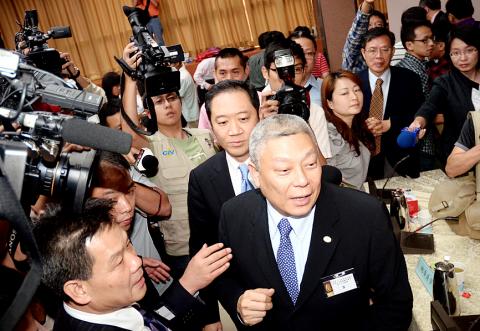
Photo: CNA
“My shareholders did not want me to come because I am only an investor, having 50 percent of the shares in Want Want China Broadband,” Tsai said.
Tsai described the hearing as “a fight to defend his dignity” and added that he attended the meeting to have his thoughts and ideas examined by all.
“I knew before I came that 80 to 90 percent of the questions at the hearing would be directed at me,” he said. “So I propose we have a question-and-answer session, and I would answer all the questions from those who oppose or hate me and let them decide if I love Taiwan or not. Otherwise, it would be pointless for me to be here.”
NCC Chairperson Su Herng (蘇蘅), who presided over the hearing, did not grant Tsai his wish.
She said he could speak when the meeting was opened for different parties to express their opinions.
Experts opposing the deal, including Academia Sinica assistant research fellow Huang Kuo-chang (黃國昌), as well as National Taiwan University professors Ivy Chang (張錦華) and Jang Show-lin (鄭秀玲), said the commission should reject the bid immediately because it would result in a concentration of media ownership.
Chang said the Chinese--language China Times was paid to give extensive coverage of visits by Chinese officials.
Democratic Progressive Party (DPP) Legislator Yeh Yi-jin (葉宜津) said she became a target of criticism on CTi TV — a TV network of the Want Want China Times Group — after she denied a special assistant dispatched by Tsai to speak at a meeting in the legislature last month.
Yeh said CTi launched a three-day intensive attack against her.
Shih Hsin University professor Kuan Shan-ren (關尚仁), who has been neutral on the issue, said it has become really difficult for him to approve the bid after he watched the midday news on CTi TV yesterday.
“I was late for the hearing this afternoon because I was monitoring the news on TV at home,” Kuan said. “It was understandable that you [CTi TV] decided to have a live broadcast of the hearing, which is newsworthy, but do you need to have pundits in the program critical of every comment at the hearing?”
“I have never taken any specific position on the case, but you did something that was -unprofessional. I do not know how I can still support you under such circumstances,” Kuan said.
Kuan asked how Want Want China Broadband intends to uphold freedom of speech after it acquires CNS and whether the company would allow channels with opposing points of view to be included in their services.
Representatives from CNS and its major investor partner, as well as the cable service industry, have urged the commission to quickly rule on the case, which has been under review for 16 months.
Tsai denied taking any money from China to purchase the media.
He said he did not know any government official in China and Taiwan, nor did he attend any meeting sponsored by the Chinese government.
He said he did not meddle with the operations of the China Times and knew fewer than 20 people at the newspaper.
He admitted being “reckless” when he published the photographs of three NCC commissioners in the China Times for giving the Want Want Group a hard time when it tried to purchase the China Times Group in 2009.
Commenting on the fact that Want Want China Times was fined for illegally running advertisements from China, Tsai asked why they could not earn money from China “fair and square” when Taiwan has spent so much marketing in China.
He also said he had been advocating cross-strait peace and had never done anything to betray Taiwan.
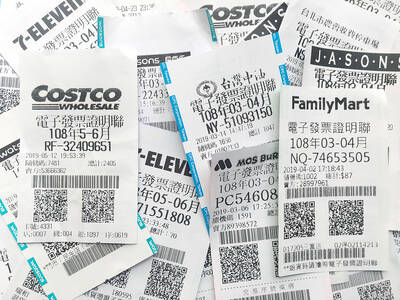
A NT$39 receipt for two bottles of tea at a FamilyMart was among the NT$10 million (US $312,969) special prize winners in the January-February uniform invoice lottery. FamilyMart said that two NT$10 million-winning receipts were issued at its stores, as well as two NT$2 million grand prizes and three NT$200,000 first prizes. The two NT$10 million receipts were issued at stores in Pingtung County and Yilan County’s Dongshan Township (冬山). One winner spent just NT$39 on two bottles of tea, while another spent NT$80 on water, tea and coffee, the company said. Meanwhile, 7-Eleven reported three NT$10 million winners — in New Taipei

Considering that most countries issue more than five denominations of banknotes, the central bank has decided to redesign all five denominations, the bank said as it prepares for the first major overhaul of the banknotes in more than 24 years. Central bank Governor Yang Chin-lung (楊金龍) is expected to report to the Legislative Yuan today on the bank’s operations and the redesign’s progress. The bank in a report sent to the legislature ahead of today’s meeting said it had commissioned a survey on the public’s preferences. Survey results showed that NT$100 and NT$1,000 banknotes are the most commonly used, while NT$200 and NT$2,000

ANNUAL EVENT: Two massive Pokemon balloons are to be set up in Daan Park, with an event zone operating from 10am to 6pm This year’s Taipei Floral Picnic is to be held at Daan Park today and tomorrow, featuring an exclusive Pokemon Go event, a themed food market, a coffee rave picnic area and stage performances, the Taipei Department of Information and Tourism said yesterday. Two massive Pokemon balloons are to be set up in the park as attractions, with an exclusive event zone operating from 10am to 6pm, it said. Participants who complete designated tasks on-site would have a chance to receive limited-edition souvenirs, it added. People could also try the newly launched game Pokemon Pokopia in the trial area, the department said. Three PokeStops are

Taiwan is concerned that China could exploit the US’ war in the Middle East, with state media citing examples from the conflict to cast doubt on the efficiency of US weapons Taiwan would use to repel an invasion. Taiwanese officials said the resumption of Beijing’s large-scale air force incursions near Taiwan after an unusual decline show that China wants to take advantage of the redeployment of US forces from East Asia to the Middle East. “This is a moment for China to exercise influence,” a senior Taiwanese security official said, speaking on condition of anonymity. “What China is trying to create is a


 RSS
RSS