


While many couples opt for a church wedding and wedding party with lots of music and fanfare, a Japanese groom and Taiwanese bride yesterday tied the knot in a traditional Confucian wedding in Taipei, calling for a revival of the centuries-old Chinese practice.
The groom, Takuju Minakuchi, is an associate professor specializing in the history of Chinese philosophy at Musashi University in Japan.
Having participated in ceremonies and published articles on the issue, it made sense when the 38-year-old Confucian enthusiast decided to marry his Taiwanese bride in a wedding that followed traditional Confucian rituals.
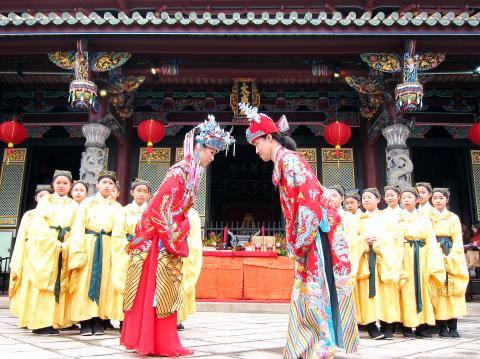
Photo: Lin Hsiang-mei, Taipei Times
“Minakuchi begged us to help make his dream come true,” said Huang Lu Ching-ju (黃呂錦茹), commissioner of Taipei City Government’s Department of Civil Affairs.
This was the second time such a wedding was staged at the Taipei Confucius Temple since its establishment in 1925, with the first one held about 70 years ago, Huang said.
Few such weddings are held these days because they require a lot of preparation and participation by many people, but the government decided to make an exception for the Japanese -academic, Huang Lu said.
The wedding ceremony involved the efforts of local students and community members, who together prepared offerings, performed traditional Confucian dances and cooked sweet glutinous rice balls for participants, the commissioner said.
The interaction between the community and the Confucian temple has thus become more frequent and meaningful, an outcome Minakuchi said is beneficial to the preservation of culture and tradition.
“Confucianism is not only about memorization, but application in everyday life,” Minakuchi said.
Spectators seemed to agree.
“Taiwanese people now prefer Westernized weddings, so we don’t see this as often. I think it helps us understand more about our ancestors and where we come from,” a spectator surnamed Chen (陳) said.
However, asked if she would opt for the one-hour wedding with complicated rites and rituals, Chen said she thought the simpler the wedding, the better.
The Confucian wedding, costing NT$90,000 (US$2,810), was subsidized by the city government. Officials said the wedding was so successful that the government will draft plans to make the wedding available to all citizens in the near future.

Considering that most countries issue more than five denominations of banknotes, the central bank has decided to redesign all five denominations, the bank said as it prepares for the first major overhaul of the banknotes in more than 24 years. Central bank Governor Yang Chin-lung (楊金龍) is expected to report to the Legislative Yuan today on the bank’s operations and the redesign’s progress. The bank in a report sent to the legislature ahead of today’s meeting said it had commissioned a survey on the public’s preferences. Survey results showed that NT$100 and NT$1,000 banknotes are the most commonly used, while NT$200 and NT$2,000

The Centers for Disease Control (CDC) yesterday reported the first case of a new COVID-19 subvariant — BA.3.2 — in a 10-year-old Singaporean girl who had a fever upon arrival in Taiwan and tested positive for the disease. The girl left Taiwan on March 20 and the case did not have a direct impact on the local community, it said. The WHO added the BA.3.2 strain to its list of Variants Under Monitoring in December last year, but this was the first imported case of the COVID-19 variant in Taiwan, CDC Deputy Director-General Lin Ming-cheng (林明誠) said. The girl arrived in Taiwan on

South Korea is planning to revise its controversial electronic arrival card, a step Taiwanese officials said prompted them to hold off on planned retaliatory measures, a South Korean media report said yesterday. A Yonhap News Agency report said that the South Korean Ministry of Foreign Affairs is planning to remove the “previous departure place” and “next destination” fields from its e-arrival card system. The plan, reached after interagency consultations, is under review and aims to simplify entry procedures and align the electronic form with the paper version, a South Korean ministry official said. The fields — which appeared only on the electronic form

The Ministry of Foreign Affairs (MOFA) is suspending retaliation measures against South Korea that were set to take effect tomorrow, after Seoul said it is updating its e-arrival system, MOFA said today. The measures were to be a new round of retaliation after Taiwan on March 1 changed South Korea's designation on government-issued alien resident certificates held by South Korean nationals to "South Korea” from the "Republic of Korea," the country’s official name. The move came after months of protests to Seoul over its listing of Taiwan as "China (Taiwan)" in dropdown menus on its new online immigration entry system. MOFA last week


 RSS
RSS