


Taiwan has “silently launched a revolution in East Asia” through the formation of the “Northeast Asia Golden Aviation Circle” forging direct links between Taipei and airports in Tokyo in Japan, Shanghai in China and Seoul in South Korea, President Ma Ying-jeou (馬英九) said yesterday.
During an inspection visit at the renovated Terminal One and Terminal Two at Taipei International Airport (Songshan), Ma said direct flights between the airport and Shanghai Hongqiao Airport were launched in June last year, while direct flights to Haneda International Airport in Japan began in October last year.
Direct flights between Taipei airport and Gimpo Airport in Seoul — “the last piece of the puzzle,” as Ma called it — in the Northeast Asia Golden Aviation Circle are scheduled to be launched in March.
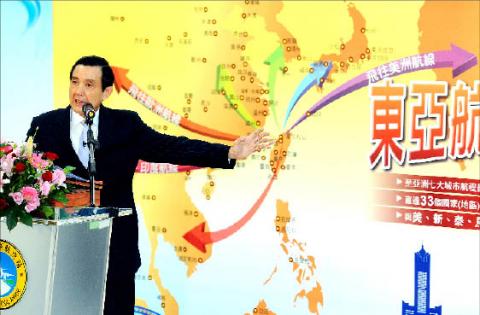
Photo: Chang Chia-ming, Taipei Times
“The number of cross-strait flights has increased to 558 per week and the service now covers 41 cities in China,” Ma said. “We have also signed an open-skies agreement with Japan, allowing the nation to dispatch flights to any airport in Japan, except Tokyo, which still restricts the number of flights arriving at the city’s airports.”
“Taiwan has silently launched a revolution in the aviation industry in East Asia. Taiwan will draw many Chinese passengers to transfer via Taiwan to North America or other regions if the revolution continues, which will solidify the status of Taiwan in this region,” he said.
The establishment of direct flights between Taipei, Shanghai, Tokyo and Seoul was one of the main promises Ma made during his presidential election campaign in 2008.
Ma said the government set a clear division of labor between Taipei International Airport and Taiwan Taoyuan International Airport, in which the former serves as the backup airport for the latter and functions as a “small yet beautiful” business airport in the nation’s capital.
The average flight time from Taiwan to any major city in the Asia-Pacific region is 2 hours and 55 minutes, which is shorter than from any other country in the region, Ma said.
This geographical advantage, coupled with direct flights to the three East-Asian cities, is set to make Taiwan the flight hub of Northeast Asia, he said.
“Previously, Taiwan Taoyuan International Airport was the only airport in Taiwan that generated a profit,” Ma said. “However, now Taipei [International Airport], Kaohsiung Hsiaogang and Taichung Cingcyuangang airports have begun to turn a profit as well.”
An increase in the number of international tourists arriving in Taiwan helped boost the development of the aviation industry, he said, adding that the number could reach 6 million this year. He said that the nation attracted 600,000 international tourists last month, which was the highest number of international visitors in a single month so far.
The Civil Aeronautics Administration (CAA) last year began renovating the Taipei International Airport, which has been in operation since 1951. Aside from new facilities, several businesses have opened retail stores at the airport, including Starbucks and Chunshuitang Cultural Tea House.
In related news, the legislature’s Transportation Committee gave its preliminary approval to an amendment to the Civil Aviation Act (民用航空法) that would allow owners of personal jet to fly their aircraft to any airport in Taiwan.
However, the bill needs further negotiation in the legislature.
At present, owners of personal jet are only allowed to arrive at and leave from the same airport in Taiwan. They are also banned from traveling with their jets during their stay in Taiwan.

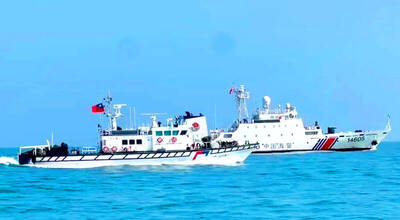
The military has spotted two Chinese warships operating in waters near Penghu County in the Taiwan Strait and sent its own naval and air forces to monitor the vessels, the Ministry of National Defense (MND) said. Beijing sends warships and warplanes into the waters and skies around Taiwan on an almost daily basis, drawing condemnation from Taipei. While the ministry offers daily updates on the locations of Chinese military aircraft, it only rarely gives details of where Chinese warships are operating, generally only when it detects aircraft carriers, as happened last week. A Chinese destroyer and a frigate entered waters to the southwest
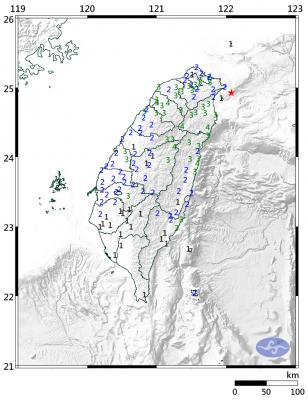
A magnitude 6.1 earthquake struck off the coast of Yilan County at 8:39pm tonight, the Central Weather Administration (CWA) said, with no immediate reports of damage or injuries. The epicenter was 38.7km east-northeast of Yilan County Hall at a focal depth of 98.3km, the CWA’s Seismological Center said. The quake’s maximum intensity, which gauges the actual physical effect of a seismic event, was a level 4 on Taiwan’s 7-tier intensity scale, the center said. That intensity level was recorded in Yilan County’s Nanao Township (南澳), Hsinchu County’s Guansi Township (關西), Nantou County’s Hehuanshan (合歡山) and Hualien County’s Yanliao (鹽寮). An intensity of 3 was
Instead of focusing solely on the threat of a full-scale military invasion, the US and its allies must prepare for a potential Chinese “quarantine” of Taiwan enforced through customs inspections, Stanford University Hoover fellow Eyck Freymann said in a Foreign Affairs article published on Wednesday. China could use various “gray zone” tactics in “reconfiguring the regional and ultimately the global economic order without a war,” said Freymann, who is also a nonresident research fellow at the US Naval War College. China might seize control of Taiwan’s links to the outside world by requiring all flights and ships entering or leaving Taiwan
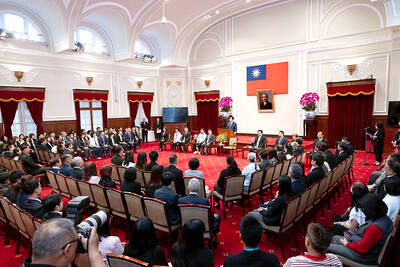
The next minimum wage hike is expected to exceed NT$30,000, President William Lai (賴清德) said yesterday during an award ceremony honoring “model workers,” including migrant workers, at the Presidential Office ahead of Workers’ Day today. Lai said he wished to thank the awardees on behalf of the nation and extend his most sincere respect for their hard work, on which Taiwan’s prosperity has been built. Lai specifically thanked 10 migrant workers selected for the award, saying that although they left their home countries to further their own goals, their efforts have benefited Taiwan as well. The nation’s industrial sector and small businesses lay


 RSS
RSS