


State-own Taiwan Power Co (Taipower) faces a fine of NT$15 million (US$498,000) from the Atomic Energy Council (AEC) for altering the construction design of the Fourth Nuclear Power Plant in Gongliao District (貢寮), New Taipei City (新北市), without authorization.
The council said this was not the first time Taipower had been fined for making design changes without permission from the original designer, General Electric Co (GE), thus the council decided to increase the penalty for repeated violations.
In 2008, Taipower was fined NT$4 million, but this time the fine was the highest possible amount stipulated in the Nuclear Reactor Facilities Control Act (核子反應器設施管制法).
According to the act, alterations to the design must receive approval from the original designer before proceeding.
According to the council’s Department of Nuclear Regulation Director Chen Yi-pin (陳宜彬), there was disagreement between Taipower and GE because of the periodic suspensions and resumptions of construction work on the plant, so the council had allowed Taipower to amend the design first, but required the state-owned utility to promise to get permission from GE afterwards.
“Since Taipower and GE solved the problem in early 2009 and GE has started its work again, we feel the alternative measures should no longer have been carried out and Taipower should have returned to the normal procedure of getting GE’s permission before continuing with construction,” Chen said.
Chen said the council received a document from the Control Yuan’s National Audit Office late last year that said Taipower had continued to make changes without obtaining GE’s permission in advance and so it decided to slap Taipower with a heavy fine.
The council finished its investigation, submitted its report to higher-level authorities, communicated with Taipower and also gave it one last chance to explain the violations late last month. Saying Taipower had failed to offer a convincing explanation, the council’s screening committee, during a meeting on Oct. 30, meted out a fine of NT$15 million for the design changes it deemed a second-level violation of the law and other regulations.
At the Legislative Yuan yesterday, Taipower vice president Hsu Hwai-chiung (徐懷瓊) said: “We acknowledge there have been some imperfections in procedure on our part ... as for the penalty, we think it’s a little too heavy.”
According to Taipower spokesman Roger Lee (李鴻洲), the utility explained the design alterations to the council during a meeting last month and provided data to prove it had obtained the necessary approval from GE.
Saying the utility asked the council for an extension of the measure, but had received no response, Lee said Taipower’s decision to proceed with the changes without an answer was certainly an “administrative flaw,” but not one that constitutes a major violation.
Additional reporting by CNA
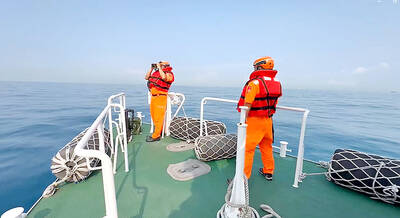
An increase in Taiwanese boats using China-made automatic identification systems (AIS) could confuse coast guards patrolling waters off Taiwan’s southwest coast and become a loophole in the national security system, sources familiar with the matter said yesterday. Taiwan ADIZ, a Facebook page created by enthusiasts who monitor Chinese military activities in airspace and waters off Taiwan’s southwest coast, on Saturday identified what seemed to be a Chinese cargo container ship near Penghu County. The Coast Guard Administration went to the location after receiving the tip and found that it was a Taiwanese yacht, which had a Chinese AIS installed. Similar instances had also

GOOD DIPLOMACY: The KMT has maintained close contact with representative offices in Taiwan and had extended an invitation to Russia as well, the KMT said The Chinese Nationalist Party (KMT) would “appropriately handle” the fallout from an invitation it had extended to Russia’s representative to Taipei to attend its international banquet last month, KMT Chairman Eric Chu (朱立倫) said yesterday. US and EU representatives in Taiwan boycotted the event, and only later agreed to attend after the KMT rescinded its invitation to the Russian representative. The KMT has maintained long-term close contact with all representative offices and embassies in Taiwan, and had extended the invitation as a practice of good diplomacy, Chu said. “Some EU countries have expressed their opinions of Russia, and the KMT respects that,” he
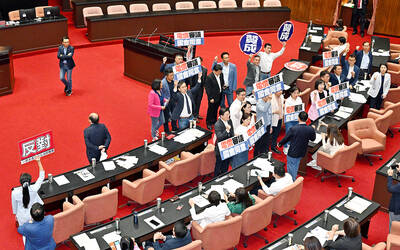
AMENDMENT: Contact with certain individuals in China, Hong Kong and Macau must be reported, and failure to comply could result in a prison sentence, the proposal stated The Chinese Nationalist Party (KMT) and the Taiwan People’s Party (TPP) yesterday voted against a proposed bill by Democratic Progressive Party (DPP) lawmakers that would require elected officials to seek approval before visiting China. DPP Legislator Puma Shen’s (沈伯洋) proposed amendments to the Act Governing Relations Between the People of the Taiwan Area and the Mainland Area (臺灣地區與大陸地區人民關係條例), stipulate that contact with certain individuals in China, Hong Kong and Macau should be reported, while failure to comply would be punishable by prison sentences of up to three years, alongside a fine of NT$10 million (US$309,041). Fifty-six voted with the TPP in opposition
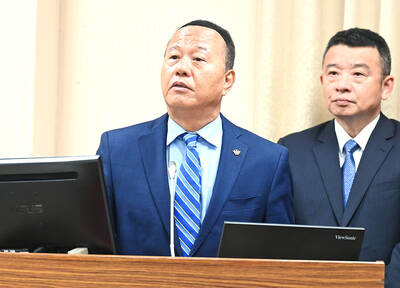
VIGILANCE: The military is paying close attention to actions that might damage peace and stability in the region, the deputy minister of national defense said The People’s Republic of China (PRC) might consider initiating a hack on Taiwanese networks on May 20, the day of the inauguration ceremony of president-elect William Lai (賴清德), sources familiar with cross-strait issues said. While US Secretary of State Anthony Blinken’s statement of the US expectation “that all sides will conduct themselves with restraint and prudence in the period ahead” would prevent military actions by China, Beijing could still try to sabotage Taiwan’s inauguration ceremony, the source said. China might gain access to the video screens outside of the Presidential Office Building and display embarrassing messages from Beijing, such as congratulating Lai


 RSS
RSS