


Chin-sheng’s voice rises with emotion when asked whether he feels Taiwanese or Chinese. Then he utters the response that Beijing fears most.
“Of course I’m pure Taiwanese. I’m not Chinese. We are not a province of China. We are our own country,” Tsai said.
“We have democracy and human rights here. What the hell does China have to offer?” said Tsai, an enthusiastic supporter of the Democratic Progressive Party (DPP), which hopes to unseat the Chinese Nationalist Party (KMT) in presidential elections on Jan. 14.
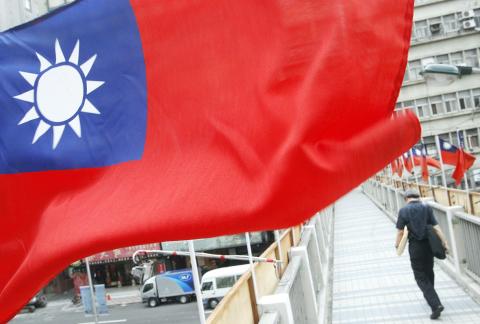
Photo: Pichi Chuang, Reuters
“Maybe the Chinese tourists who come here now can learn a thing or two from us and apply it when they go home,” said the businessman, a resident of Greater Kaohsiung, a DPP stronghold.
Decades of dictatorship and repression followed by a gusty uptaking of democracy have engendered not only pride at Taiwan’s generally smooth transition to rule by the ballot box, but also a growing feeling of distance and difference from China.
Many Taiwanese look with nervousness, if not fear, at China, where the Chinese Communist Party remains unmoved by calls for political liberalization.
Taiwan’s free-wheeling press covers the nation’s politics in a critical way unthinkable for China’s stodgy state-controlled media and giving ink to Chinese dissidents and unrest in China that would never make it past Beijing’s censors.
This open debate helps reinforce the deep unwillingness in Taiwan to be absorbed politically by China and the popular feeling that Taiwan is very different from China and this is something to be cherished and protected.
The sentiment is felt particularly keenly in Greater Kaohsiung, one of the main heartlands of Taiwanese cultural identity and where, in 1979, rights activists held a landmark rally which helped spark Taiwan’s eventual democratic transition.
“We can talk to China, but it must be on the basis of equality, as nation-to-nation,” said Hsiao Chuang, a supporter of DPP Chairperson Tsai Ing-wen (蔡英文), out pressing the flesh on a trendy Kaohsiung shopping street.
“[President] Ma Ying-jeou (馬英九) stinks. He wants to sell us out to China,” he said of the president who signed a series of landmark economic deals with China after taking office in 2008.
China has recently hinted those deals could be at risk if the DPP does not adopt a more positive policy toward Beijing.
The party has sought a more moderate line. It no longer openly backs independence, which earned former president Chen Shui-bian (陳水扁) such enmity from China.
However, some DPP supporters in Kaohsiung do not seem to have gotten that message or at least do not believe the softer stance.
“I will vote for them because they will make us independent,” taxi driver Chen Wen-ling said. “Native Taiwanese have to vote for the DPP. It is our duty.”
Most Taiwanese, though, say they would rather maintain the “status quo” of de facto independence as the Republic of China, than declare formal independence and risk a Chinese attack.
However, they show little enthusiasm to join up with their ethnic kin across the narrow Taiwan Strait, even if ancestrally many can trace their origins to Chin’s Fujian Province.
Even among KMT supporters, there is little willingness to accept that they are Chinese, apart from culturally or historically.
The KMT, who once tried suppressing Taiwan’s own cultural identity, are also now trying to portray themselves as Taiwanese, hoping to win the voters’ hearts.
Though friendly to China, Ma has resisted any efforts at opening political dialogue with Beijing or committing himself to making a decision on Taiwan’s future status.
He has been successful at identifying himself with Taiwan, learning to speak Hoklo (also known as Taiwanese) and portraying himself as a “new Taiwanese,” despite not being born in Taiwan, a source of suspicion for some.
In Kaohsiung though, most Ma supporters keep a low profile.
One exception is Yang Yu-mei (楊玉梅), who runs a shop selling clothing decorated with Republic of China flags and displaying several pictures of her meeting Ma. Brushes with DPP supporters, whom she says sometimes kick the flags outside her store, have not dampened her ardor.
She is so keen on the KMT that her mobile phone ringtone is former president Chiang Ching-kuo (蔣經國), who fostered Taiwan’s transition to democracy in the 1980s, leading a crowd shouting: “Long live the Republic of China.”
Still, even she is lukewarm on getting any closer to China.
“The current ‘status quo’ is best. We don’t want war with China,” Yang said.
“I am a citizen of the Republic of China who lives on Taiwan,” she said. “We can say and do what we want here without the fear of anyone looking over our shoulder and that is very important.”
China has hoped that with closer economic links and with the series of trade agreements signed by Ma, Taiwan will start to feel more positive about Beijing.
While Taiwan’s airlines, some hotels and major corporations have benefited, many ordinary people say they have felt little impact.
The media has lapped up stories of Chinese tourists being too noisy, cutting lines and generally behaving badly. It is something that plays well in the pro-independence south.
“I’ve seen no benefit from them being here,” said Huang Hsiao-yan, a cook at one of Kaohsiung’s heaving night markets. “The Chinese tourists buy only fruit or trinkets. They don’t eat here. I don’t like them at all.”
The once heavily industrialized Kaohsiung has lost many of its companies and factories to China, drawn away by a massive population and low manufacturing costs.
The effect can be seen on the city’s sleek new subway network, where it is easy to find a seat even at rush hour. Many would-be commuters have long since decamped to China to work.
“Business has not been good in Kaohsiung for many years now. Everyone has gone to China,” bar owner Landy Hsu said.
“The only Chinese tourists we see around here are men asking us if we have any women, if you know what I mean,” Hsu’s friend and colleague, Melody Chin, said.
When it comes to China, the crucial aspect for many Taiwanese is they want the right to decide their own future.
“You can’t choose your relatives, but you can choose whether to spend time with them,” said Kaohsiung gallery curator Jemmy Chu, overseeing an exhibition on 100 years since the fall of China’s last emperor and establishment of the Republic of China.
One day, perhaps, China could have a democratic revolution too, he said.
“At the moment China is like a bad grandmother who you would not want to have anything to do with. That could change. People complain about China, but the Taiwanese have short memories. We were once exactly like them and we were able to change,” Chu said.

The Centers for Disease Control (CDC) yesterday reported the first case of a new COVID-19 subvariant — BA.3.2 — in a 10-year-old Singaporean girl who had a fever upon arrival in Taiwan and tested positive for the disease. The girl left Taiwan on March 20 and the case did not have a direct impact on the local community, it said. The WHO added the BA.3.2 strain to its list of Variants Under Monitoring in December last year, but this was the first imported case of the COVID-19 variant in Taiwan, CDC Deputy Director-General Lin Ming-cheng (林明誠) said. The girl arrived in Taiwan on

South Korea is planning to revise its controversial electronic arrival card, a step Taiwanese officials said prompted them to hold off on planned retaliatory measures, a South Korean media report said yesterday. A Yonhap News Agency report said that the South Korean Ministry of Foreign Affairs is planning to remove the “previous departure place” and “next destination” fields from its e-arrival card system. The plan, reached after interagency consultations, is under review and aims to simplify entry procedures and align the electronic form with the paper version, a South Korean ministry official said. The fields — which appeared only on the electronic form

The Ministry of Foreign Affairs (MOFA) is suspending retaliation measures against South Korea that were set to take effect tomorrow, after Seoul said it is updating its e-arrival system, MOFA said today. The measures were to be a new round of retaliation after Taiwan on March 1 changed South Korea's designation on government-issued alien resident certificates held by South Korean nationals to "South Korea” from the "Republic of Korea," the country’s official name. The move came after months of protests to Seoul over its listing of Taiwan as "China (Taiwan)" in dropdown menus on its new online immigration entry system. MOFA last week

A bipartisan group of US senators has introduced a bill to enhance cooperation with Taiwan on drone development and to reduce reliance on supply chains linked to China. The proposed Blue Skies for Taiwan Act of 2026 was introduced by Republican US senators Ted Cruz and John Curtis, and Democratic US senators Jeff Merkley and Andy Kim. The legislation seeks to ease constraints on Taiwan-US cooperation in uncrewed aerial systems (UAS), including dependence on China-sourced components, limited access to capital and regulatory barriers under US export controls, a news release issued by Cruz on Wednesday said. The bill would establish a "Blue UAS


 RSS
RSS