


The Chinese Nationalist Party (KMT) yesterday dismissed reports that it would yield three legislator-at-large seats to the People First Party (PFP) for the sake of “pan-blue” unity.
KMT Secretary-General Liao Liou-yi (廖了以) was responding to a report by the Chinese-language China Times that after PFP Chairman James Soong (宋楚瑜) announced his intention to run in the Jan. 14 presidential election, tensions between the KMT and the PFP — originally a splinter of the ruling party — had risen.
The KMT has adopted a two-pronged strategy, the report said. On one hand, President Ma Ying-jeou (馬英九) has called on key figures with close ties to the PFP to switch allegiance to the KMT in the upcoming elections. On the other hand, the party has privately extended an olive branch by offering three legislator-at-large seats to the PFP to ensure joint coordination, the reports said.
“The KMT has no such plan and we regret that the newspaper failed to fact-check its news,” Liao said.
He said his party, based on sincerity and goodwill, was willing to co-name suitable regional candidates through public opinion polls, even though KMT nominees have already been named for legislative constituencies.
On legislative at-large seats, Liao said, the KMT welcomes the PFP to select its list of party candidates, after which the two sides could discuss the most acceptable ones.
“The KMT will avoid ‘closed-door’ talks to live up to public expectations,” Liao said, adding that the KMT was still waiting for a response from the PFP.
KMT caucus whip Chao Li-yun (趙麗雲) also said the party could not possibly yield any legislator--at-large seats to the PFP.
“The possibility does not exist and no KMT members will ever accept such an approach,” Chao said.
On the PFP side, spokesman Lee Tung-hao (李桐豪) said if PFP legislators cannot form a caucus in the legislature, they would be unable to formulate policies and monitor the government.
Out of the 113-seat legislature, 73 are direct electoral seats, six seats are reserved for Aborigines, while 34 are for legislators-at-large and overseas Taiwanese. The legislator-at-large seats are awarded in proportion to the number of votes each party garners in the elections and only those parties that collect at least 5 percent of the votes will be awarded those party list seats.

A year-long renovation of Taipei’s Bangka Park (艋舺公園) began yesterday, as city workers fenced off the site and cleared out belongings left by homeless residents who had been living there. Despite protests from displaced residents, a city official defended the government’s relocation efforts, saying transitional housing has been offered. The renovation of the park in Taipei’s Wanhua District (萬華), near Longshan Temple (龍山寺), began at 9am yesterday, as about 20 homeless people packed their belongings and left after being asked to move by city personnel. Among them was a 90-year-old woman surnamed Wang (王), who last week said that she had no plans

TO BE APPEALED: The environment ministry said coal reduction goals had to be reached within two months, which was against the principle of legitimate expectation The Taipei High Administrative Court on Thursday ruled in favor of the Taichung Environmental Protection Bureau in its administrative litigation against the Ministry of Environment for the rescission of a NT$18 million fine (US$609,570) imposed by the bureau on the Taichung Power Plant in 2019 for alleged excess coal power generation. The bureau in November 2019 revised what it said was a “slip of the pen” in the text of the operating permit granted to the plant — which is run by Taiwan Power Co (Taipower) — in October 2017. The permit originally read: “reduce coal use by 40 percent from Jan.
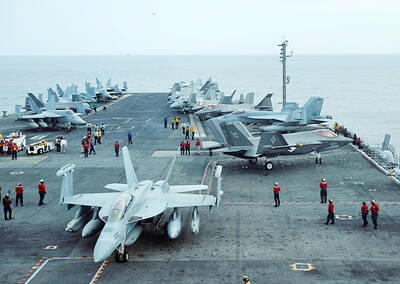
China might accelerate its strategic actions toward Taiwan, the South China Sea and across the first island chain, after the US officially entered a military conflict with Iran, as Beijing would perceive Washington as incapable of fighting a two-front war, a military expert said yesterday. The US’ ongoing conflict with Iran is not merely an act of retaliation or a “delaying tactic,” but a strategic military campaign aimed at dismantling Tehran’s nuclear capabilities and reshaping the regional order in the Middle East, said National Defense University distinguished adjunct lecturer Holmes Liao (廖宏祥), former McDonnell Douglas Aerospace representative in Taiwan. If
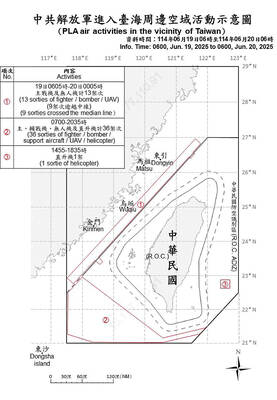
‘SPEY’ REACTION: Beijing said its Eastern Theater Command ‘organized troops to monitor and guard the entire process’ of a Taiwan Strait transit China sent 74 warplanes toward Taiwan between late Thursday and early yesterday, 61 of which crossed the median line in the Taiwan Strait. It was not clear why so many planes were scrambled, said the Ministry of National Defense, which tabulated the flights. The aircraft were sent in two separate tranches, the ministry said. The Ministry of Foreign Affairs on Thursday “confirmed and welcomed” a transit by the British Royal Navy’s HMS Spey, a River-class offshore patrol vessel, through the Taiwan Strait a day earlier. The ship’s transit “once again [reaffirmed the Strait’s] status as international waters,” the foreign ministry said. “Such transits by


 RSS
RSS