


President Ma Ying-jeou (馬英九) yesterday announced a plan to introduce easier repayment terms on government-issued student loans from next year, saying it was part of his administration’s efforts to narrow the gap between rich and poor.
“The government wants to ensure that the needs of the disadvantaged are being met so that children of underprivileged families can have a chance to change their destiny,” Ma said at a news conference.
The revisions to the repayment plans will take effect on Feb. 1 next year, he said.
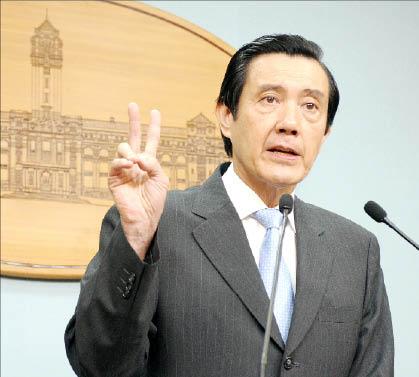
Photo: George Tsorng, Taipei Times
Under the new terms, the maturity period is two years for each semester for which the loan was made in the case of students from low-income or lower-middle--income families, the Ministry of Education said.
At present, the repayment period for government-issued student loans is 1.5 years for every semester of tuition covered, regardless of family income level. Also, the categories of borrowers eligible for three-year extensions of repayment will be widened to include lower-middle-income families and all borrowers who make less than NT$30,000 (US$1,000) a month, the ministry said.
Currently, only students from low-income families or those earning less than NT$25,000 a month are eligible for the maximum three-year extension. In addition, the maximum amount loaned to low-income students to cover cost of living will be increased from NT$6,000 to NT$8,000 per month.
Lower-middle-income students will also become eligible to obtain loans for this purpose, at a maximum of NT$4,000 per month.
Minister of Education Wu Ching--ji (吳清基) said that every year the government receives about 810,000 applications for student loans and spends more than NT$3 billion subsidizing the interest on such loans.
The new program will benefit 200,000 students and graduates and increase government spending by NT$600 million a year, Wu said.
Ho Cho-fei (何卓飛), director-general of the ministry’s Department of Higher Education, said the extension of the maturity period on student loans will help ease the pressure on economically disadvantaged students.
For example, the monthly payments for an undergraduate who borrows NT$400,000 to cover eight semesters of tuition will drop from NT$3,300 to NT$2,400 if the repayment period is extended from 12 years to 16 years, He said.
If a student borrows money through four years of undergraduate study, two years in a master’s program and four years of doctorate study, the loans can be spread over a maximum period of 43 years, including a three-year deferred repayment period, the ministry said.
The plan, however, received a lukewarm response from student organizations.
Lin Sheng-hsiang, spokesman for a group of undergraduates who will become first-time voters next year, said the new repayment terms will not help students much because they will have to repay the loans in any case.
Chen Ting-hao, a member of a group that promotes the rights of university students, said the fundamental way of reducing the financial pressure on students is to ensure that tuition is affordable so that they do not need to take loans out in the first place.
He said the government should provide more funding to universities, especially private ones, so that they would not have to increase tuition to cover their costs.
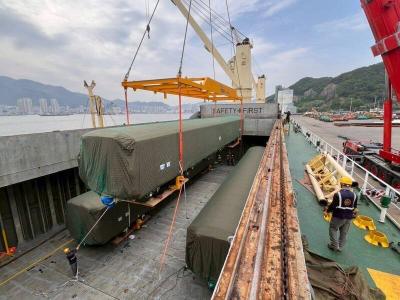
The first of 10 new high-capacity trains purchased from South Korea’s Hyundai Rotem arrived at the Port of Taipei yesterday to meet the demands of an expanding metro network, Taipei Rapid Transit Corp (TRTC) said yesterday. The train completed a three-day, 1,200km voyage from the Port of Masan in South Korea, the company said. Costing NT$590 million (US$18.79 million) each, the new six-carriage trains feature a redesigned interior based on "human-centric" transportation concepts, TRTC said. The design utilizes continuous longitudinal seating to widen the aisles and optimize passenger flow, while also upgrading passenger information displays and driving control systems for a more comfortable

Instead of focusing solely on the threat of a full-scale military invasion, the US and its allies must prepare for a potential Chinese “quarantine” of Taiwan enforced through customs inspections, Stanford University Hoover fellow Eyck Freymann said in a Foreign Affairs article published on Wednesday. China could use various “gray zone” tactics in “reconfiguring the regional and ultimately the global economic order without a war,” said Freymann, who is also a nonresident research fellow at the US Naval War College. China might seize control of Taiwan’s links to the outside world by requiring all flights and ships entering or leaving Taiwan
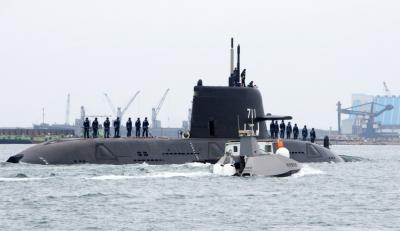
Taiwan's first indigenous defense submarine, the SS-711 Hai Kun (海鯤, or Narwhal), departed for its 13th sea trial at 7am today, marking its seventh submerged test, with delivery to the navy scheduled for July. The outing also marked its first sea deployment since President William Lai (賴清德) boarded the submarine for an inspection on March 19, drawing a crowd of military enthusiasts who gathered to show support. The submarine this morning departed port accompanied by CSBC Corp’s Endeavor Manta (奮進魔鬼魚號) uncrewed surface vessel and a navy M109 assault boat. Amid public interest in key milestones such as torpedo-launching operations and overnight submerged trials,
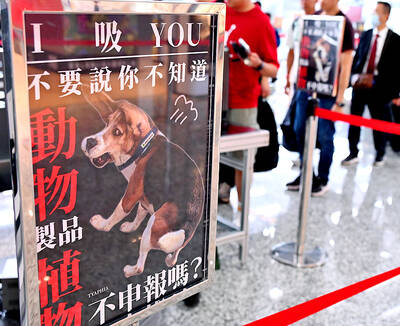
Quarantine awareness posters at Taiwan Taoyuan International Airport have gone viral for their use of wordplay. Issued by the airport branch of the Animal and Plant Health Inspection Agency, the posters feature sniffer dogs making a range of facial expressions, paired with advisory messages built around homophones. “We update the messages for holidays and campaign needs, periodically refreshing materials to attract people’s attention,” quarantine officials said. “The aim is to use the dogs’ appeal to draw focus to quarantine regulations.” A Japanese traveler visiting Taiwan has posted a photo on X of a poster showing a quarantine dog with a


 RSS
RSS