


It will take at least another year for a decommissioned Taiwanese Lockheed F-104G Starfighter sent to the US Classic Aircraft Aviation Museum in Hillsboro, Oregon, in 2006 to take to the skies again.
Unlike most museums that display aircraft models, the nonprofit museum is dedicated to repairing classic military aircraft and emphasizes “dynamic preservation,” which includes restoration.
The museum has restored a MiG-17 fighter, and when the F-104G Starfighter from Taiwan was transported to the US amid great fanfare in 2006, the hope was it would be ready to take off in 2008.
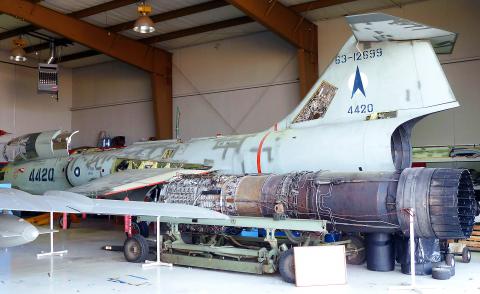
Photo: CNA
However, despite investing more than 1,500 hours in fixing the plane, another 12 to 18 months will be needed before the plane can fly again, museum director Doug Donkel said. It will also have to get permission from the US Federal Aviation Association before resuming flights, he said.
Repairs on the plane are about 90 to 95 percent completed, museum founder Roger Kelsay said.
The aircraft’s hydraulic system, electric power system and landing gear were all overhauled. The restoration project has been hindered by a lack of certain critical components. The museum has not been able to acquire afterburners from Taiwan’s air force and is having difficulty finding experienced maintenance people.
“Our [hope is] that maybe President Ma [Ying-jeou (馬英九)] can support us on this project, too, to help us get the remaining components that we need to get this thing flying,” Kelsay said. “It is hard to find knowledgeable people that know a lot about the F-104.”
“We have a gentleman from Taiwan that’s come over and helped us several times and we’re hoping to get him back again,” he said.
A retired sergeant major from the Taiwanese air force has been assisting with the museum’s F-104G repairs over the past few years, often spending two to six months in Oregon at a time.
Rebuilding planes does not come cheaply. The museum has had to procure aircraft components from around the world and between the US$15,000 that a generator can cost and high freight expenses, the bills add up.
So how much has been spent on the F-104G project?
“More than I want to tell,” Kelsay said with a laugh.
Although restoring planes is an expensive hobby, Kelsay, a retired US Air Force pilot with a special affinity for Starfighters, says preserving aircraft is his passion.
“It’s a passion, so passion doesn’t always make economic sense,” he said.
The F-104G Starfighter in Oregon was designed by the US firm Lockheed and produced by Canadair. It was sold to Denmark and then obtained by Taiwan in 1987 in exchange for an F-5A aircraft.
After being decommissioned, it was handed over to Feng Chia University in Taichung in 1997. The school turned it over to the museum in 2006, according to a press release issued by the school when the transfer was announced.
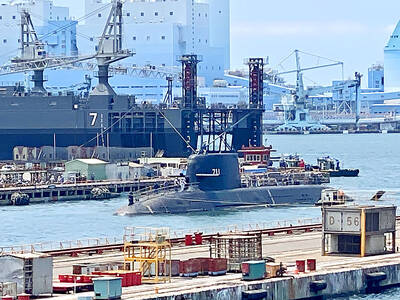
AGING: While Japan has 22 submarines, Taiwan only operates four, two of which were commissioned by the US in 1945 and 1946, and transferred to Taiwan in 1973 Taiwan would need at least 12 submarines to reach modern fleet capabilities, CSBC Corp, Taiwan chairman Chen Cheng-hung (陳政宏) said in an interview broadcast on Friday, citing a US assessment. CSBC is testing the nation’s first indigenous defense submarine, the Hai Kun (海鯤, Narwhal), which is scheduled to be delivered to the navy next month or in July. The Hai Kun has completed torpedo-firing tests and is scheduled to undergo overnight sea trials, Chen said on an SET TV military affairs program. Taiwan would require at least 12 submarines to establish a modern submarine force after assessing the nation’s operational environment and defense

A white king snake that frightened passengers and caused a stir on a Taipei MRT train on Friday evening has been claimed by its owner, who would be fined, Taipei Rapid Transit Corp (TRTC) said yesterday. A person on Threads posted that he thought he was lucky to find an empty row of seats on Friday after boarding a train on the Bannan (Blue) Line, only to spot a white snake with black stripes after sitting down. Startled, he jumped up, he wrote, describing the encounter as “terrifying.” “Taipei’s rat control plan: Release snakes on the metro,” one person wrote in reply, referring
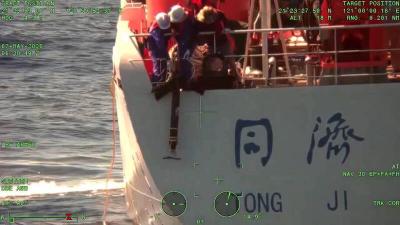
The coast guard today said that it had disrupted "illegal" operations by a Chinese research ship in waters close to the nation and driven it away, part of what Taipei sees a provocative pattern of China's stepped up maritime activities. The coast guard said that it on Thursday last week detected the Chinese ship Tongji (同濟號), which was commissioned only last year, 29 nautical miles (54km) southeast of the southern tip of Taiwan, although just outside restricted waters. The ship was observed lowering ropes into the water, suspected to be the deployment of scientific instruments for "illegal" survey operations, and the coast

Taiwan’s two cases of hantavirus so far this year are on par with previous years’ case numbers, and the government is coordinating rat extermination work, so there should not be any outbreaks, Centers for Disease Control (CDC) Director-General Philip Lo (羅一鈞) said today in an interview with the Liberty Times (the Taipei Times’ sister newspaper). An increase in rat sightings in Taipei and New Taipei City has raised concerns about the spread of hantavirus, as rats can carry the disease. In January, a man in his 70s who lived in Taipei’s Daan District (大安) tested positive posthumously for hantavirus, Taiwan’s


 RSS
RSS