


Former Aboriginal decathlete Ku Chin-shui (古金水) was declared not guilty on Thursday by the Hualien branch of the Taiwan High Court in his fifth retrial in connection with an explosion and fire aboard a Uni Air flight in 1999. The verdict may not be appealed
Ku, a gold medalist in the decathlon at the 1970 Asian Games in Thailand, said he was thankful for the justice he received, even if it was late in coming.
On Aug. 24, 1999, a Uni Air MD90 that had taken off from what was then Songshan Airport in Taipei went up in flames after an onboard explosion as it landed at Hualien Airport.
Ku’s older brother, Ku Jing-chi (古金池), was killed, as was the fetus of Lee Hui-jung (李惠蓉). Twenty-eight others were injured, including Ku Chin-shui’s mother, sister-in-law and nephew, all of whom suffered burns.
Prosecutors indicted Ku Chin-shui for causing the explosion, claiming he had asked his nephew to bring gasoline in bleach and fabric softener bottles aboard the flight. Ku Chin-shui said the bottles he gave his nephew prior to boarding were filled with bleach, detergent and fabric softener.
An Aviation Safety Council (ASC) report said it was thought that the bottles were not sealed correctly and leaked gasoline fumes, which were then ignited when a motorbike battery, in a nearby overhead luggage compartment, was jostled, discharging an electric arc.
The judge in the fifth retrial said that although Ku Chin-shui had asked his nephew to carry a bottle of bleach in his luggage — which later examinations had determined to contain gasoline — the fragments that tested positive for gasoline were not limited to the fragments of the bottle.
The court said the safety council had not provided sufficient evidence to back its claims, and that the ASC-commissioned analysis by Chungshan Institute of Science and Technology into the cause of the explosion showed the environment of the institute’s simulation was different from that of the aircraft explosion.
The judge said a gasoline ignition could not be determined as the main factor for the explosion.
Ku Chin-shui was initially sentenced to a 10-year prison term, which was shortened to seven-and-a-half-years upon appeal.
After a 12-year battle to clear his name, Ku Chin-shui’s legal woes appear over.
Article Eight of the Fair and Speedy Criminal Trials Act (刑事妥速審判法) stipulates that cases maintaining a verdict of not guilty which last through a second retrial, or that have been tried and given two or more not guilty verdicts before a retrial by a court of the same jurisdictional level, or cases where a criminal sentence is not handed down six years from the date of the initial trial and the Supreme Court has asked for a retrial three times, may not be appealed.
Ku Chin-shui said last year that the case had taken an enormous toll on his life.
TRANSLATED BY JAKE CHUNG, STAFF WRITER.
ADDITIONAL REPORTING BY STAFF WRITER
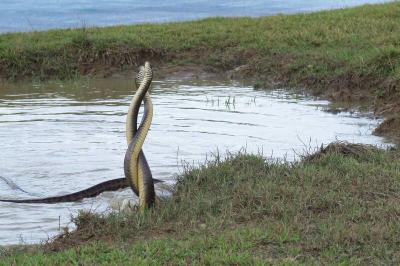
Kenting National Park service technician Yang Jien-fon (楊政峰) won a silver award in World Grand Prix Photography Awards Spring Season for his photograph of two male rat snakes intertwined in combat. Yang’s colleagues at Kenting National Park said he is a master of nature photography who has been held back by his job in civil service. The awards accept entries in all four seasons across six categories: architectural and urban photography, black-and-white and fine art photography, commercial and fashion photography, documentary and people photography, nature and experimental photography, and mobile photography. Awards are ranked according to scores and divided into platinum, gold and
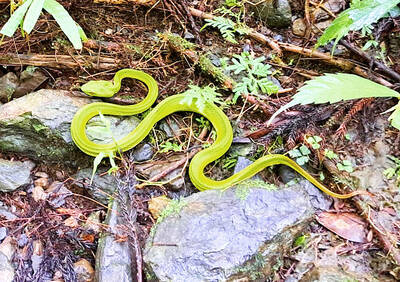
More than half of the bamboo vipers captured in Tainan in the past few years were found in the city’s Sinhua District (新化), while other districts had smaller catches or none at all. Every year, Tainan captures about 6,000 snakes which have made their way into people’s homes. Of the six major venomous snakes in Taiwan, the cobra, the many-banded krait, the brown-spotted pit viper and the bamboo viper are the most frequently captured. The high concentration of bamboo vipers captured in Sinhua District is puzzling. Tainan Agriculture Bureau Forestry and Nature Conservation Division head Chu Chien-ming (朱健明) earlier this week said that the

The Chinese Nationalist Party (KMT) caucus yesterday said it opposes the introduction of migrant workers from India until a mechanism is in place to prevent workers from absconding. Minister of Labor Hung Sun-han (洪申翰) on Thursday told the Legislative Yuan that the first group of migrant workers from India could be introduced as early as this year, as part of a government program. The caucus’ opposition to the policy is based on the assessment that “the risk is too high,” KMT caucus secretary-general Lin Pei-hsiang (林沛祥) said. Taiwan has a serious and long-standing problem of migrant workers absconding from their contracts, indicating that

TRADE-OFF: Beijing seeks to trade a bowl of tempura for a Chinese delicacy, an official said, while another said its promises were attempts to interfere in the polls The government must carefully consider the national security implications of building a bridge connecting Kinmen County and Xiamen, China, the Public Construction Commission (PCC) said yesterday. PCC Commissioner Derek Chen (陳金德), who is also a minister without portfolio, made the remarks in a meeting of the legislature’s Transportation Committee, after Democratic Progressive Party Legislator Hsu Fu-kuei (徐富癸) asked about China’s proposal of new infrastructure projects to further connect Kinmen and Lienchiang (Matsu) counties with Xiamen. China unveiled the bridge plan, along with nine other policies for Taiwan, on Sunday, the last day of Chinese Nationalist Party (KMT) Chairwoman Cheng Li-wun’s (鄭麗文) visit


 RSS
RSS