


The explanations provided by Chunghwa Telecom (CHT) for its decision not to renew the contract of Falun Gong-sponsored New Tang Dynasty Television (NTDTV) contradict information uncovered by the Taipei Times and raise questions about possible pressure from the Chinese or Taiwanese authorities.
Since 1998, CHT has relied on the ST-1 satellite to transmit TV signals to Taiwanese subscribers. With the satellite scheduled to cease operations in August, on Sept. 18, 2008, Chunghwa Telecom Singapore, a fully owned subsidiary of CHT, formed a joint venture with Singapore Telecommunications Ltd (SingTel) to build a new satellite, the ST-2. Information released by CHT showed that its subsidiary would take about a 38 percent stake in the joint venture, with SingTel taking the remaining 62 percent. CHT and SingTel also jointly operate ST-1.
In a press release dated April 5, SingTel announced that the assembly, integration and testing of ST-2 had been completed and that the satellite was being shipped to its launching site, where it is to be launched in the middle of this month.
Responding to criticism over the decision not to renew NTDTV’s contract, meaning its broadcasts will cease in August, CHT said the ST-2 had fewer transponders and therefore had lower bandwidth to ensure a quality service.
Industry sources said ST-1 carries 16 high-power Ku-band transponders and 14 medium-power C-band transponders.
However, CHT’s explanation contradicts what its partner said on April 5.
Bill Chang, executive vice president of the business group at SingTel, said at the time: “With 20 percent more transponder capacity and a wider coverage footprint than ST-1, ST-2 will help increase our capacity to meet growing customer demand for fixed and mobile satellite services in the broadcast, maritime and oil and gas industries.”
A Singaporean source confirmed to the Taipei Times yesterday that while ST-2 has more transponders, CHT’s share in the satellite has shrunk, meaning it may have been allocated less bandwidth than on ST-1.
Although this could explain why CHT will be unable to assign as many stations as it did before, it does not explain the decision to specifically select NTDTV to be dropped.
One possible explanation could be the stronger signal offered by ST-2. Both CHT and SingTel have said ST-2 will have higher transmitting power than ST-1. The wide-ranging footprint of C-band and Ku-band coverage will cover the Middle East, Central Asia, the Indian subcontinent and Southeast Asia.
“ST-2 is almost twice as powerful as our first satellite, which means our customers’ antennas don’t have to work as hard to pick up the signals,” Chang said.
Those comments may have caught Beijing’s attention.
Beijing considers Falun Gong a cult and has made it an illegal entity in China. It has successfully blocked — and sometimes intimidated other countries into doing so — broadcasts from NTDTV.
Although satellites like ST-1 and ST-2 do not service the Chinese market, a technique known as “signal hacking” reportedly allows direct access to channels and programs on any satellite that services the Asia-Pacific region.
In October 2009, Taiwanese lawmakers called for an investigation into ST-1 signal interruptions that began on Sept. 17 and peaked on Oct. 1, when the People’s Republic of China was celebrating its 60th anniversary. On Double Ten Day, NTDTV’s broadcasts were effectively taken off the air for the entire day.
ST-1’s low-band frequency covers all of Taiwan and 80 percent of China. The higher transmitting power of ST-2 could ostensibly make it more difficult for China to jam its signals, as it did in the lead-up to the 60th anniversary celebrations.
Although the Taipei Times could not confirm this information, Beijing may have pressured CHT or SingTel not to renew NTDTV’s contract.
Earlier this week, CHT denied there was any political reason behind its decision.
The incident occurs at a time when CHT is seeking to expand its operations in China. On March 28, the company announced the establishment of a wholly owned subsidiary, Chunghwa Telecom (China), in Shanghai, to promote its information and communications technology. This includes CHT’s intelligent energy-saving solutions iEN, which will be initially promoted in Fujian Province through cooperation with a provincial branch of state-owned China Mobile. CHT has also made a number of investments and joint ventures in China and is in negotiations with state-owned China Telecom Corp to enter the Chinese market.
ST-2 departed Kamakura, Japan, at the end of March and arrived in French Guiana on an Antonov An-124 cargo aircraft on April 5, Mitsubishi Electric Corp of Japan, the manufacturer of the satellite, said in a press release on April 6.
Industry watchers said ST-2 is to be launched at the Guiana Space Center in Kourou on an Ariane 5 orbital launch vehicle.
The satellite, which has an expected 15-year lifespan, will be in orbit at 88 degrees east longitude, Mitsubishi Electric said.
Contacted for further comment, Mitsubishi Electric said it could not provide specific details about ST-2, stating a non-disclosure agreement with its customer.
According to the CHT Web site, the Ministry of Transportation and Communications owns 35.41 percent of its shares.

NATIONAL SECURITY: Authorities are working to confirm the identities of the military personnel involved and investigating possible illegal conduct and regulatory violations Authorities are probing possible national security implications after Kinmen police and immigration officers on Sunday found a Chinese woman allegedly posing as a tourist while engaging in prostitution involving more than 10 military personnel. The woman, surnamed Chen (陳), has since been deported, authorities said, adding that investigators are still working to confirm the identities of those implicated, as the records only listed code names and aliases. The case stemmed from a report received by the Kinmen District Prosecutors’ Office on Friday last week from the Jinhu Precinct of the Kinmen County Police Bureau. On Sunday, police, along with the National Immigration

GLOBALGIVING: ‘ Caving to external pressure is not acceptable for an organization that has cultivated justice reform and human rights for 30 years,’ one NGO said A slew of non-government organizations (NGOs) have withdrawn from the GlobalGiving fundraising platform after it announced it would use “Chinese Taipei” instead of “Taiwan” from next month. The Taiwan Good Rice Association wrote on Facebook on Friday that it was informed on April 28 via a teleconference call of the change, which was made because the platform wanted to operate in China. Taiwan Good Rice is to terminate all cooperative relationships with GlobalGiving in response to the platform’s “unilateral and non-negotiable” decision to remove references to Taiwan, the NGO said. “Taiwan is in the official name of Taiwan Good Rice Association and the
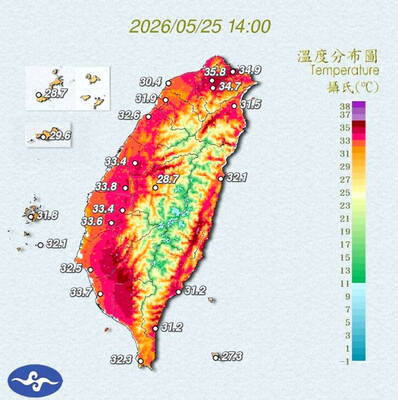
STAY COOL: The HPA recommended that people stay hydrated, use air-conditioning or fans while indoors, wear loose-fitting clothes and walk in the shade while outdoors Employers must implement measures such as installing cooling equipment, and providing drinking water and rest breaks for outdoor workers starting from Monday next week, the Taipei Department of Labor said on Sunday. Employers who fail to comply could face fines of NT$30,000 to NT$300,000 under the Occupational Safety and Health Act (職業安全衛生法), the department said. Businesses in Taipei employing fewer than 100 workers, as well as registered self-employed workers with labor insurance coverage, could receive on-site assessments and guidance from occupational safety consultants to help them apply for central government subsidies to implement or improve heat-protection measures, it said. Under the Ministry of

Chinese Nationalist Party (KMT) Chairwoman Cheng Li-wun (鄭麗文) yesterday briefed her party’s Central Standing Committee regarding her scheduled visit to the US between Monday next week and June 16, saying that her purpose would be to persuade the US that the Republic of China (ROC) Constitution was a “one China” constitution that would foster stable and peaceful cross-strait relations. The ROC Constitution is the most important defense for all Taiwanese citizens, as it upholds our democracy and has contributed to our robust economy, which aligns with international and US interests, she said. “We would not be troublemakers and drag the US under,”


 RSS
RSS