


The nation’s Aboriginal population has increased by 90,000 in the past 10 years, from more than 420,000 in 2001 to the more than 510,000 last year, according to latest statistics released by the Ministry of the Interior.
Among the increases, 120,000 more children between the age of 15 and 19 registered their Aboriginal identity last year, compared with 10 years ago, which is a 33.66 percent increase, the data showed.
Commenting on the phenomenon, Association of Taiwan Indigenous Peoples’ Policies member Pasang Hsiao (蕭世暉) said the increase in Aboriginal identity registration among adults shows that identifying oneself as Aborigine is rising, however, the increase among students could mean that those Aboriginal students want to take advantage of bonus points allocated for Aboriginal students in school entrance exams.
Mayaw Biho, a documentary director from the Amis tribe, agreed with Hsiao’s interpretation, saying that many students are changing their ethnic identity out of practical considerations, but added that many people are also doing so for “ethnic justice.”
Council of Indigenous Peoples Minister Sun Ta-chuan (孫大川) said the increase in the Aboriginal population is related to welfare incentives, but he believes that increased harmony among ethnic groups and less ethnic discrimination have also continued to increase the self-identity of Aborigines.
Currently, Aborigines enjoy benefits such as bonus points on entrance exams, as well as subsidies for pre-school education, study abroad, tuition, better old-age pensions and the right to buy or sell Aboriginal reserve lands to make up for the disadvantages experienced by Aborigines in the economy, education and employment.
However, Sun said that, based on the concept of equality as stated in the Constitution and the improvements in education and gaps in resources as many Aborigines move into cities, he has asked officials to look into setting up a threshold to exclude wealthier Aborigines from enjoying the benefits and welfare reserved for Aborigines.
The minister said the new measure is to avoid making non--Aborigines feel that they are deprived of certain rights due to ethnicity and thus prevent ethnic conflicts that such feelings could trigger, and leave the limited resources of the state to those who are most in need.

More than half of the bamboo vipers captured in Tainan in the past few years were found in the city’s Sinhua District (新化), while other districts had smaller catches or none at all. Every year, Tainan captures about 6,000 snakes which have made their way into people’s homes. Of the six major venomous snakes in Taiwan, the cobra, the many-banded krait, the brown-spotted pit viper and the bamboo viper are the most frequently captured. The high concentration of bamboo vipers captured in Sinhua District is puzzling. Tainan Agriculture Bureau Forestry and Nature Conservation Division head Chu Chien-ming (朱健明) earlier this week said that the

NAMING SPAT: The foreign ministry called on Denmark to propose an acceptable solution to the erroneous nationality used for Taiwanese on residence permits Taiwan has revoked some privileges for Danish diplomatic staff over a Danish permit that lists “Taiwan” as “China,” Eric Huang (黃鈞耀), head of the Ministry of Foreign Affairs’ Department of European Affairs, told a news conference in Taipei yesterday. Reporters asked Huang whether the Danish government had responded to the ministry’s request that it correct the nationality on Danish residence permits of Taiwanese, which has been listed as “China” since 2024. Taiwan’s representative office in Denmark continues to communicate with the Danish government, and the ministry has revoked some privileges previously granted to Danish representatives in Taiwan and would continue to review
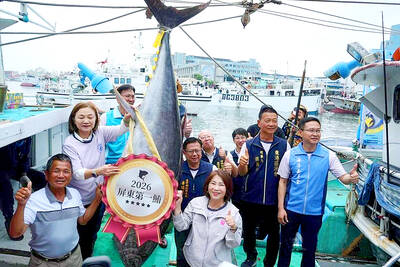
The first bluefin tuna of the season, brought to shore in Pingtung County and weighing 190kg, was yesterday auctioned for NT$10,600 (US$333.5) per kilogram, setting a record high for the local market. The auction was held at the fish market in Donggang Fishing Harbor, where the Siaoliouciou Island-registered fishing vessel Fu Yu Ching No. 2 delivered the “Pingtung First Tuna” it had caught for bidding. Bidding was intense, and the tuna was ultimately jointly purchased by a local restaurant and a local company for NT$10,600 per kilogram — NT$300 ,more than last year — for a total of NT$2.014 million. The 67-year-old skipper
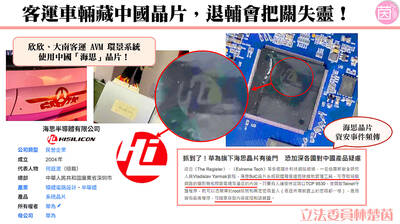
BREACH OF CONTRACT: The bus operators would seek compensation and have demanded that the manufacturer replace the chips with ones that meet regulations Two bus operators found to be using buses with China-made chips are to demand that the original manufacturers replace the systems and provide compensation for breach of contract, the Veterans Affairs Council said yesterday. Democratic Progressive Party Legislator Michelle Lin (林楚茵) yesterday said that Da Nan Bus Co and Shin-Shin Bus Co Ltd have fielded a total of 82 buses that are using Chinese chips. The bus models were made by Tron-E, while the systems provider was CYE Electronics, Lin said. Lin alleged that the buses were using chips manufactured by Huawei subsidiary HiSilicon Co, which presents a national security risk if the


 RSS
RSS