


Quick and easy loans offered by more than 2,000 pawnshops throughout the country are set to be subject to greater regulation after the legislature yesterday passed a bill that will effectively cap interest rates at 30 percent.
With support from lawmakers from both parties, the bill passed by the legislature will also set limits on the number of times a person can be charged a fee associated with borrowing money from a pawnshop.
Under the revision to the Pawnshop Management Act (當舖業法), maximum interest rates will be lowered from 48 percent, or 4 percent a month — which was called excessive — by 18 percent, to 30 percent annually.
In addition, pawnshop operators will only be allowed to charge a 5 percent borrowing fee once per year, fixing a regulatory loophole that saw large numbers of operators charging the fee every month, effectively pushing annual interest rates above 100 percent.
The limits prescribed by the final bill are more strict than the original proposal raised by Democratic Progressive Party (DPP) Legislator Huang Wei-cher (黃偉哲), which would have capped rates at 36 percent.
His proposal attracted controversy last month after it was revealed that Huang and some Chinese Nationalist Party (KMT) lawmakers who expressed support for the bill had received threatening telephone calls urging them to reconsider.
It also followed a report in the Chinese-language Next Magazine that alleged up to 33 former lawmakers had received bribes from pawnshops in 2001.
The Nov. 16 article said the group of lawmakers had originally agreed to work on a proposal that would have cut pawnshop interest rates to about 24 percent over three years. However, when the final bill was passed, interest rates stayed at 48 percent.
The magazine said that this was because pawnshop owners had pooled up to NT$18 million (US$602,000) in payments for the 33 lawmakers, with one prominent legislator receiving up to NT$4 million in bribes. Police have since opened an investigation into the allegations.
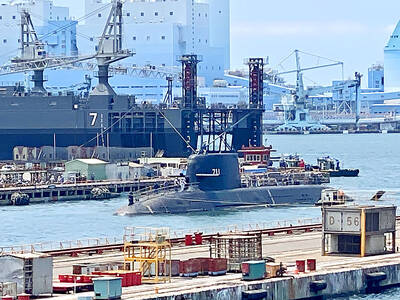
AGING: While Japan has 22 submarines, Taiwan only operates four, two of which were commissioned by the US in 1945 and 1946, and transferred to Taiwan in 1973 Taiwan would need at least 12 submarines to reach modern fleet capabilities, CSBC Corp, Taiwan chairman Chen Cheng-hung (陳政宏) said in an interview broadcast on Friday, citing a US assessment. CSBC is testing the nation’s first indigenous defense submarine, the Hai Kun (海鯤, Narwhal), which is scheduled to be delivered to the navy next month or in July. The Hai Kun has completed torpedo-firing tests and is scheduled to undergo overnight sea trials, Chen said on an SET TV military affairs program. Taiwan would require at least 12 submarines to establish a modern submarine force after assessing the nation’s operational environment and defense

Yangmingshan National Park authorities yesterday urged visitors to respect public spaces and obey the law after a couple was caught on a camera livestream having sex at the park’s Qingtiangang (擎天崗) earlier in the day. The Shilin Police Precinct in Taipei said it has identified a suspect and his vehicle registration number, and would summon him for questioning. The case would be handled in accordance with public indecency charges, it added. The couple entered the park at about 11pm on Thursday and began fooling around by 1am yesterday, the police said, adding that the two were unaware of the park’s all-day live
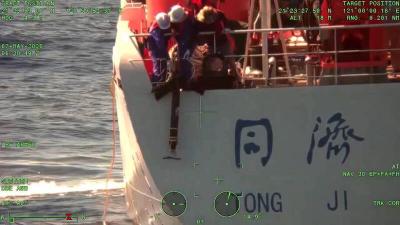
The coast guard today said that it had disrupted "illegal" operations by a Chinese research ship in waters close to the nation and driven it away, part of what Taipei sees a provocative pattern of China's stepped up maritime activities. The coast guard said that it on Thursday last week detected the Chinese ship Tongji (同濟號), which was commissioned only last year, 29 nautical miles (54km) southeast of the southern tip of Taiwan, although just outside restricted waters. The ship was observed lowering ropes into the water, suspected to be the deployment of scientific instruments for "illegal" survey operations, and the coast

A former soldier and an active-duty army officer were yesterday indicted for allegedly selling classified military training materials to a Chinese intelligence operative for a total of NT$79,440. The Taipei District Prosecutors’ Office indicted Chen Tai-yin (陳泰尹) and Lee Chun-ta (李俊達) for contravening the National Security Act (國家安全法) and the Anti-Corruption Act (貪污治罪條例). Chen left the military in September 2013 after serving alongside then-staff sergeant Lee, now an army lieutenant, at the 21st Artillery Command of the army’s Sixth Corps from 2011 to 2013, according to the indictment. Chen met a Chinese intelligence operative identified as “Wang” (王) through a friend in November


 RSS
RSS