


Known as “Mami” to hundreds of girls, Triveni Balkrishna Acharya, president of India’s Rescue Foundation, has only one biological child, a son.
The girls, who were at one time victims of human trafficking from India, Nepal and Bangladesh before being rescued by the foundation, are now like daughters to her.
Freed from enslavement and abuse by pimps, some of the girls have integrated well society, while others struggle to return to a normal life.
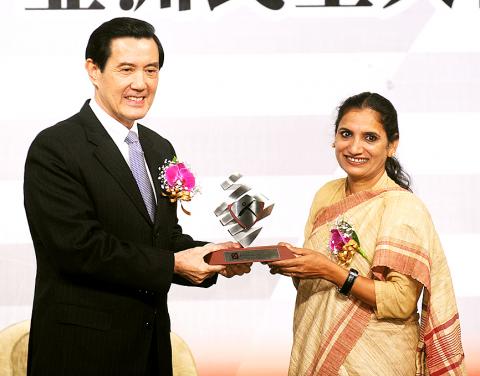
PHOTO: FANG PIN-CHAO, TAIPEI TIMES
The Rescue Foundation, established in 2000 by Triveni’s husband Balkrishna Acharya, is the only non-governmental organization in India that assists victims of forced prostitution through rescue, rehabilitation, repatriation and reintegration efforts.
Triveni was elected president of the foundation in 2005. Before that, she was a senior journalist with the Mumbai Samachar newspaper from 1991 to 2005.
Her decision to change her career and bring succor to exploited and underprivileged girls occurred in 1993 when she came across a 10-year-old girl crying in desperation at a brothel.
“I affectionately asked the girl the reason she was so sad,” Triveni said. “She narrated the terrible inhuman torture she had to undergo. Her narration touched my heart and I realized that so many girls were being trafficked and their human rights denied.”
Triveni was in Taipei to receive this year’s Asia Democracy and Human Rights Award from the Taiwan Foundation for Democracy in recognition of her efforts to rescue girls trafficked between countries and forced into prostitution in Mumbai and neighboring cities.
Asked during an interview with the Taipei Times on Friday to comment on the Social Maintenance Act (社會秩序維護法), Triveni said “it was very wrong” for the legal system in Taiwan to arrest and fine sex workers while their clients are untouchable.
“In India, we never punish prostitutes, voluntarily or forcefully. They all are victims,” she said.
Triveni was also skeptical about a policy under consideration in Taiwan whereby the government would set up red-light zones where the sex industry would be decriminalized.
“If the sex trade is legal in Taiwan, will it be able to rescue immigrant workers forced into the sex industry?” she asked. “Will police have the right to raid brothels and rescue immigrant girls coming from India to Taiwan if prostitution is legalized?”
Whether prostitution is legalized or not, human trafficking in the sex industry will continue as it is a profitable business, much like drugs and arms smuggling, she said.
However, the decision to legalize or decriminalize prostitution — one of the root causes of trafficking for the sex industry — would “complicate efforts to combat the crime,” she said, adding that “the policy should be stopped” in its tracks.
India had its own debate on whether to decriminalize prostitution, Triveni said, but it never made it through parliament.
“It will be girls suffering if the sex trade is legalized,” she said.
Nisha Malwat, manager of department and resources at the Mumbai-based foundation, said that every year, about 2,000 girls from Nepal, 1,000 from Bangladesh and 6,000 from within India were trafficked and sent to red-light districts in Indian cities.
The Rescue Foundation rescues about 300 girls annually and has a rehab center in a suburban area of Mumbai where various services, from treatment for drug addiction, HIV/AIDS checkups, basic education, psychological counseling and vocational training are provided to help victims recover mentally and spiritually.
“When we rescue the girls, they are very much traumatized. After counseling and training, they slowly become normal again,” Triveni said.
Some girls who are forced into prostitution — sometimes after being sold by their family — end up hating everyone and have lost all faith in humanity, she said.
“I talk to them and try to assure them of a bright future. To prove this, I even help them get them married in suitable families as well as place them in good jobs so that they can sustain themselves and forget their past,” she said.
Triveni said courage, faith, endurance and dogged determination have helped her surmount the many obstacles associated with her vocation.
“There are many obstacles. Every day new challenges appear. Trafficking is done by gangs. They often threaten and sometimes try to harm me and my rescue team,” she said.
Triveni said she would not have the moral courage and physical strength to work day and night were it not for the fact that she was “totally determined and committed.”
Every girl at the rehab center, home to about 300 at any given time, has a different mentality and she always counsels and deals with them separately.
In a booklet published by the foundation, Triveni asks the question: “Five frogs are sitting on a log. Four decide to jump off. How many are left?” Her answer is: “There are still five, because there is a difference between deciding and doing.”
“With no freedom of choice and no options for a life with dignity, these girls are forced to lead a life [where they are] crippled by social stigma, debt bondage and a host of ailments. Those who are at risk need to be protected and those who have suffered need support to reshape their lives. Each girl deserves a better tomorrow,” Triveni said.

REASONS FOR TRAVEL: An assistant professor said that proposed amendments to penalize drivers if they used drugs overseas would not deter people from traveling People who operate a motor vehicle under the influence of marijuana would have their driver’s license revoked, even if they used the substance while overseas, the Ministry of Transportation and Communications said yesterday, citing proposed amendments to the Road Traffic Management and Penalty Act (道路交通管理處罰條例). The amendments would also authorize the government to revoke the licenses of people determined to have used Category 1 or Category 2 narcotics, even if they were not operating a vehicle while under the influence of drugs, as well as ban them from taking the license test for three years, the ministry said. People aged 18 or

GLOBALGIVING: ‘ Caving to external pressure is not acceptable for an organization that has cultivated justice reform and human rights for 30 years,’ one NGO said A slew of non-government organizations (NGOs) have withdrawn from the GlobalGiving fundraising platform after it announced it would use “Chinese Taipei” instead of “Taiwan” from next month. The Taiwan Good Rice Association wrote on Facebook on Friday that it was informed on April 28 via a teleconference call of the change, which was made because the platform wanted to operate in China. Taiwan Good Rice is to terminate all cooperative relationships with GlobalGiving in response to the platform’s “unilateral and non-negotiable” decision to remove references to Taiwan, the NGO said. “Taiwan is in the official name of Taiwan Good Rice Association and the

HEAVY WEATHER: Typhoon Jangmi is due to crash straight into the Ryukyus as airlines look to shift flights to larger aircraft or cancel flights to Okinawa entirely Taiwan’s international air carriers announced flight adjustments over the weekend as Typhoon Jangmi is forecast to hit the Ryukyu Islands today and tomorrow. The Central Weather Administration (CWA) upgraded Jangmi from a tropical storm to a typhoon at 8am yesterday, with the eye located 580km south of Naha city. It was moving north at 19kph. Today, China Airlines’ CI-120, CI-121, CI-122 and CI-123 flights between Taoyuan and Naha, Okinawa, have been canceled as well as CI-132 and CI-133 between Kaohsiung and Naha. EVA Air’s BR-112, BR-113, BR-186 and BR-185 flights between Taoyuan and Naha are also canceled. Low-cost carrier Tigerair Taiwan canceled IT-230,
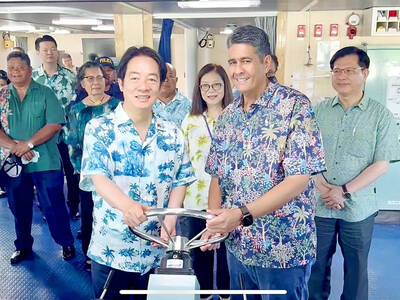
MULTIPRONGED APPROACH: China has sought to pressure Palau across a number of fronts, but the island nation has staunchly resisted overtures to ditch Taiwan Palau has been firm in backing Taiwan despite Chinese pressure that uses tourism economics, cyberattacks and criminal infiltration as tools to threaten the Pacific ally into renouncing its recognition of Taiwan as a sovereign state. The Presidential Office yesterday announced that Vice President Hsiao Bi-khim (蕭美琴) would visit Palau from Saturday to Wednesday next week at the invitation of Palauan President Surangel Whipps Jr. Whipps in April said in an interview that China had outspokenly asked Palau to “denounce Taiwan.” “And we have said: ‘We have no enemies, but nobody tells us who our friends are,’” he said. Whipps has told reporters multiple times


 RSS
RSS