


He was a non-Western doctor who helped give a Eurocentric, introspective field of medicine a global presence that it sorely lacked. He all but built the mental health system from the ground up in Taiwan, later helping governments in other developing nations do the same.
And he pushed for research that would, for the first time, rigorously document the prevalence of mental disorders worldwide, demonstrating that people from far-flung lands had many emotional struggles in common, whatever their cultural or economic differences.
Lin Tsung-yi (林宗義), a psychiatrist who rose to become the director of mental health at the WHO, died on July 20 at 89, his daughter Elizabeth said, adding that the family had not made the death public until this month.
For decades, Lin was one of the world’s most persuasive and effective advocates for psychiatry as a centerpiece of public health, on par with infectious diseases and chronic medical conditions.
“It all makes sense today, but in the 1960s and 1970s the whole idea of doing epidemiology in psychiatry was outre, out there; it just didn’t seem logical to people,” said Arthur Kleinman, a psychiatrist and medical anthropologist at Harvard.
Lin changed that.
“He saw that psychiatry could not develop on a global stage without a presence in public health, and he was one of the early leaders who really framed that presence,” Kleinman said.
Lin was not long out of medical training when, in 1953, he published a scientific survey of mental disorders in Taiwan, the first of its kind. Later, at the WHO, he began a far more extensive effort, the International Pilot Study of Schizophrenia, an inventory of that mental disorder in developing as well as Western countries.
The study showed striking similarities in the symptoms and prevalence of schizophrenia among many countries and revealed differences in quality of care. It set a standard for psychiatric epidemiology and led to decades of subsequent research into other disorders, like depression and anxiety, as well as interventions for treatment.
Lin continued to develop research methods throughout most of his career, at universities in Europe, the US and finally, Canada, at the University of British Columbia.
In Taiwan, where in the 1950s and 1960s he devised and helped establish a modern mental healthcare system, Lin was seen as more than a medical figure. His father, a prominent intellectual, was killed in the 228 Incident, in which Chinese Nationalist Party (KMT) troops fired on Taiwanese protesters in 1947, setting off a wave of violence that left thousands of Taiwanese dead.
In 1998, Lin edited a book, An Introduction to the 2-28 Tragedy in Taiwan: For World Citizens, which in part laid out a blueprint for reconciliation between the Taiwanese and Mainlanders who moved to Taiwan from China following the KMT’s loss to the Chinese Communist Party in the Chinese Civil War.
Then president Lee Teng-hui (李登輝) “basically implemented the plan that Tsung-yi proposed,” said Robert Solomon, president of the US Institute of Peace. “It was a seminal contribution to a society that was deeply wounded and divided.”
Lin was born on Sept. 19, 1920, in Tainan. Both his father, Lin Mo-sheng (林茂生), a professor, and his mother, Wang Chai-hwang (王采蘩), received higher education in Japan, as did their son.
Lin Tsung-yi graduated from Tokyo Imperial University School of Medicine, now the University of Tokyo, in 1943, and his postgraduate training included stints in the 1950s at Harvard Medical School and later at the Maudsley Institute of Psychiatry in London.
He was director of mental health at the WHO from 1964 to 1969, then moved to the University of Michigan, where he stayed through 1973 before joining the faculty at the University of British Columbia, retiring from his full-time position in 1985. He served as president of the World Federation of Mental Health from 1974 to 1979.
Lin Tsung-yi was the author, co-author or editor of a number of influential books, including Mental Health Planning for One Billion People: A Chinese Perspective, with Leon Eisenberg, and Normal and Abnormal Behavior in Chinese Culture, with Kleinman. He founded the psychiatry department at National Taiwan University and trained many of its leading graduates.
The loss of his father was a defining event in Lin Tsung-yi’s life, those who knew him said. However, it was not politics or conflict that animated his later work.
“He was not insensitive” to looking at cultural differences in psychiatry, Kleinman said. “But he was asking a bigger question: What is similar in mental illness around the world? What is it that we all have in common?”

Actor Darren Wang (王大陸) was sentenced to six months in prison, commutable to a fine, by the New Taipei District Court today for contravening the Personal Data Protection Act (個人資料保護法) in a case linked to an alleged draft-dodging scheme. Wang allegedly paid NT$3.6 million (US$114,380) to an illegal group to help him evade mandatory military service through falsified medical documents, prosecutors said. He transferred the funds to Chen Chih-ming (陳志明), the alleged mastermind of a draft-evasion ring, although he lost contact with him as he was already in detention on fraud charges, they said. Chen is accused of helping a

SECURITY: Starlink owner Elon Musk has taken pro-Beijing positions, and allowing pro-China companies to control Taiwan’s critical infrastructure is risky, a legislator said Starlink was reluctant to offer services in Taiwan because of the nation’s extremely high penetration rates in 4G and 5G services, the Ministry of Digital Affairs said yesterday. The ministry made the comments at a meeting of the legislature’s Transportation Committee, which reviewed amendments to Article 36 of the Telecommunications Management Act (電信管理法). Article 36 bans foreigners from holding more than 49 percent of shares in public telecommunications networks, while shares foreigners directly and indirectly hold are also capped at 60 percent of the total, unless specified otherwise by law. The amendments, sponsored by Chinese Nationalist Party (KMT) Legislator Ko

The eastern extension of the Taipei MRT Red Line could begin operations as early as late June, the Taipei Department of Rapid Transit Systems said yesterday. Taipei Rapid Transit Corp said it is considering offering one month of free rides on the new section to mark its opening. Construction progress on the 1.4km extension, which is to run from the current terminal Xiangshan Station to a new eastern terminal, Guangci/Fengtian Temple Station, was 90.6 percent complete by the end of last month, the department said in a report to the Taipei City Council's Transportation Committee. While construction began in October 2016 with an
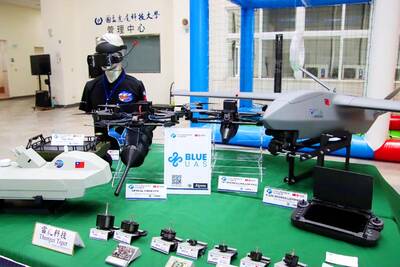
NON-RED SUPPLY: Boosting the nation’s drone industry is becoming increasingly urgent as China’s UAV dominance could become an issue in a crisis, an analyst said Taiwan’s drone exports to Europe grew 41.7-fold from 2024 to last year, with demand from Ukraine’s fight against Russian aggression the most likely driver of growth, a study showed. The Institute for Democracy, Society and Emerging Technology (DSET) in a statement on Wednesday said it found that many of Taiwan’s uncrewed aerial vehicle (UAV) sales were from Poland and the Czech Republic. These countries likely transferred the drones to Ukraine to aid it in its fight against the Russian invasion that started in 2022, it said. Despite the gains, Taiwan is not the dominant drone exporter to these markets, ranking second and fourth


 RSS
RSS