


Next Media’s (壹傳媒) plan to venture into the TV industry in Taiwan yesterday suffered a major setback after the National Communications Commission (NCC) again rejected its applications to establish news, information and entertainment channels.
NCC Spokesperson Chen Jeng-chang (陳正倉) said the commission continued to have doubts on Next TV’s plans to present animated news as well as how it would protect the interests of youth in its news content.
“The commission listed four main reasons why it turned down [Next TV’s] applications last year,” Chen said. “While it has made some improvements, its efforts failed to convince members of the independent committee who reviewed the applications that it would do anything different from what they can see in the [Chinese-language] Apple Daily and Next Magazine.”
Chen said the committee opposed the applications because the network had failed to address two of the four main issues.
For one, the network’s animated news presented events in a “docudrama” format, which does not meet professional standards of journalism and truthful reporting.
Also, its guidelines for animated news production contravened Article 13 of the Regulations Governing the Classification of Television Programs (電視節目分級處理辦法), which states that “images in news broadcasting programs shall be subject to classified G [General rating] regulations, without classification labeling.”
Aside from the two main issues, Chen said the programs the network intended to present on its three channels were more or less the same, which spawned questions about the necessity of having three channels.
Chen said the committee’s decision was submitted to the commissioners’ meeting yesterday where it won unanimous support from commissioners, who deliberated the case for about an hour before making a final decision.
Chu Wen-bin (朱文彬), chief of the commission’s satellite communication division, said members of the committee reviewed sample tapes and operational plans for the three channels submitted by Next Media. As Next Television launched its TV service online in July, commission officials recorded content and handed it to committee members for reference.
Chu said Next’s news production guidelines showed that the network “completely misunderstood” the Regulations Governing the Classification of Television Programs.
“It [Next TV] said it would not explicitly present the sexual organs of people appearing in Next programs,” Chu said. “However, not showing sexual organs does not mean the news has a General rating.”
“[Next] also said it would be careful when handling live news broadcasts involving violence, sexual assault and suicides. However, these types of news should not be aired live in the first place,” Chu said.
Next TV chairman Chu Wai-hui (朱華煦) said the company protested against the commission for “undermining freedom of expression and stifling creativity.”
“Why does the NCC keep rejecting our applications?” Chu asked in a statement. “The NCC owes us an explanation.”
Meanwhile, the commission also rejected applications by China Television Co (CTV) for four new channels, saying they violated the Television and Broadcasting Act (廣電法), which bars investment from political parties, the government and the military.
The investigation showed that the Taipei City Government indirectly owns 0.2175 percent of the shares in the CTV’s Cultural Enterprise Co, which owns four channels.

FUKUOKA SITUATION: Japanese media reported that the pathogen is expected to be identified by the summer, while the CDC downplayed the idea that it was hMPV A “mysterious cold-like illness” reported in Japan’s Fukuoka Prefecture does not seem to be a new disease, but Japanese authorities have been asked about the situation, the Centers for Disease Control (CDC) said yesterday. The Fukuoka Prefectural Medical Association on Wednesday told a news conference that a “mystery cold” that has become a hot topic on social media is “highly likely to be caused by some kind of viral infection,” Japan’s KBC News reported. “Many people are experiencing symptoms starting with a sore throat, followed by a runny nose, phlegm and a severe cough,” KBC News reported, citing association officials. Health authorities are

Nvidia Corp CEO Jensen Huang (黃仁勳) arrived in Taiwan yesterday ahead of upcoming AI and technology events, saying he plans to meet with clients and Taiwan Semiconductor Manufacturing Co Chairman C.C. Wei (魏哲家) during his visit. After landing at Taipei Songshan Airport, Huang posed for photos with fans and handed out Yakult drinks to reporters and supporters waiting at the scene, saying he has “a lot to do” during the trip. Asked about reports that Nvidia’s planned headquarters site in Taipei’s Beitou Shilin Technology Park could break ground on May 27, Huang said that if the company holds an event, he would

The Ministry of Finance this afternoon announced the winning numbers for the March-April uniform invoice lottery. The winning number for the NT$10 million (US$318,060) special prize is 19531471, and the winning number for the NT$2 million grand prize is 85941329. Three numbers were drawn for the NT$200,000 first prize: 07225810, 20231230 and 83518781. Those with receipts matching the last seven digits of any of the first-prize numbers will win the NT$40,000 second prize, while those matching the last six digits will win the NT$10,000 third prize. Those whose receipts match the last five digits of the first-prize numbers can claim the NT$4,000 fourth prize,
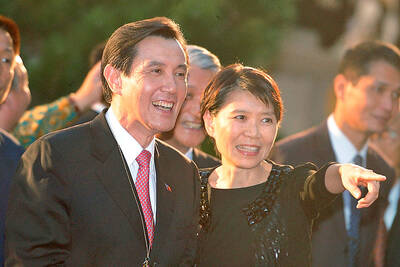
Former president Ma Ying-jeou (馬英九) yesterday expressed “shock and regret” over a statement issued by his wife without his consent, and rejected her assertion that his eldest sister, Ma Yi-nan (馬以南), would manage his medical care or act as his spokesperson amid an ongoing embezzlement probe into his foundation. Ma Ying-jeou in a statement said he was shocked by a statement by his wife, Chou Mei-ching (周美青), regarding his affairs. Ma Yi-nan “must not” be in charge of his healthcare and other personal affairs, nor can she be allowed to represent the Ma family, the former president said. He said he was also


 RSS
RSS