


In a country with scarce medical resources, an electric drill designed for construction can be put to very different uses — including brain surgery.
Such a situation actually happened about two years ago in Swaziland, which back then didn’t have a single craniotomy drill. A neurosurgeon’s ingenuity saved many people’s lives, but it also brought the issue of the lack of medical equipment to light and forced the government to make it a priority.
The operations were performed by Tu Chi-cheng (杜繼誠), a neurosurgeon who had to come up with imaginative ways to open skulls quickly when the only instruments to hand were primitive — a cranial hand drill and a hand jigsaw he had brought with him from Taiwan.
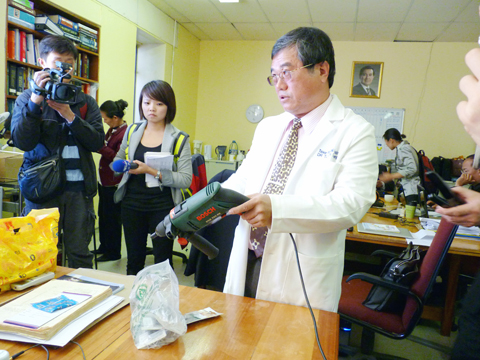
PHOTO: SHIH HSIU-CHUAN, TAIPEI TIMES
His first surgery using the crude instruments took him close to five hours — far too long when patients with brain injuries are often in critical condition, he said.
“I thought an electric drill might do the job and reduce time,” Tu said.
Tu practiced drilling holes on thin layers of wood, but the idea of drilling a hole in someone’s skull with the instrument made many people uncomfortable.
PHOTO: SHIH HSIU-CHUAN, TAIPEI TIMES
One man was scared away when Tu, walking down a street with the electric drill, told him he was not a carpenter, but a surgeon.
“The man thought I was nuts,” he said.
Convincing nurses that the practice was safe also required some work, especially over concerns of infection.
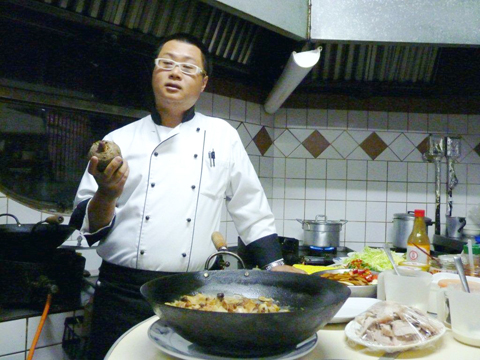
PHOTO: SHIH HSIU-CHUAN, TAIPEI TIMES
Since then, Tu has performed more than 20 surgeries using the electric drill out of a total of more than 200 surgeries he has performed since he became head of the Taiwanese medical team in Swaziland in July 2008.
Swaziland now has a craniotomy drill, at a cost of 1.5 million Lilangeni (US$202,000) — one for the entire country.
The medical mission, which is led by Taipei Medical University (TMU), is the latest addition to Taiwan’s aid projects in Swaziland. It arrived in the country about two years ago and already it has received much acclaim for its contribution.
On Monday last week, when receiving Taiwanese volunteers and reporters, Swazi Prime Minister Barnabas Sibusiso Dlamini praised the medical team for “doing a very good job.”
“Dr Tu has saved a number of patients who would be in another world if he had not done the work,” Dlamini said.
He said that “all [other] missions that Taiwan has sent to Swaziland have had a positive effect in raising the standard of living of its people.”
A nurse in charge of the casualty department at the Mbabane Government Hospital — Swaziland’s biggest, where the TMU medical mission is stationed — told Taiwanese reporters: “We are so grateful to the Taiwanese.”
“They send doctors to help us, receiving a lot of patients. Before that, we used to transfer our patients to South Africa, but now we no longer need to transfer, especially for neurology treatment. Taiwanese missions have helped us improve our equipment,” the nurse said.
Since Taiwan’s medical mission arrived in Swaziland, its government has maintained the budget for medical care despite a dire fiscal situation that is only getting worse.
“This development is a testament to [the Swazi government’s] recognition of the contribution made by Taiwanese medical teams in the country,” Taiwanese Ambassador to Swaziland Peter Tsai (蔡明耀) said.
Taiwan began dispatching agricultural missions to Africa in 1960, to help modernize the agricultural sector and to garner support for the country’s representation at the UN.
The first mission to Swaziland was in 1969, a year after the two countries established diplomatic relations. The same day, Swaziland gained independence from Britain.
The agricultural missions assisted smallholders, allowing them to expand corn and sweet potato production and to introduce other staple foods, such as fruit and vegetables. The missions have also provided vocational training in handicrafts, sawing, plumbing and electrical skills, computers, and have helped improve sanitation and access to drinking water.
Aside from the public welfare programs, which Taiwanese technical missions perform in 28 countries, another project, specific to Swaziland — the last absolute monarchy in Africa, ruled by King Mswati III — is the “Royal Project.”
The project “was set up with the purpose of consolidating diplomatic relations,” Yeh Chang-ching (葉常青), leader of the Taiwan Technical Mission in Swaziland, told reporters.
Under the program, several specialists from the Technical Mission have been stationed in three farms owned by the Swazi royal family, helping them introduce new crops, improve cultivation techniques and train farm and husbandry specialists.
“It’s a roaring success ... we have turned the royal family’s estates from cattle farms to profitable farms on which various crops are grown,” Yeh said.
Having served in technical missions for 19 years in various countries, Yeh said helping smallholder farmers in developing countries boost agricultural production alone was not enough to contribute to poverty alleviation and food security.
“Because of a lack of irrigation water, almost all of Swaziland’s land is rain-fed. There have been cases where efforts made to increase crop production over a number of years turned to nothing overnight because of droughts that hit Swaziland every few years,” he said.
Last year, to combat the problem, the mission experimented with planting strawberries and tried to establish distribution channels in South African markets in collaboration with Taiwanese businesspeople based there.
“If we manage to plant strawberries and have a sufficient number of marketing channels, we will encourage local farmers to turn to cash-crop cultivation. That would significantly boost their incomes,” Yeh said while showing reporters around a strawberry field at a farm in Manzini, Swaziland’s largest city and its commercial hub.
The role played by the missions in Swaziland is a means for Taiwan to demonstrate its value to the world in the face of Chinese repression of its international space.
“Diplomatic relations [between the two counties] is not just at a political level,” Dlamini said. “The friendship has been strengthened, widened and deepened by the missions.”
Aside from the missions that are stationed permanently in Swaziland, various groups of students and teachers volunteer in the country.
This month alone, a group of students and teachers from TMU, National Taiwan University and National Changhua Senior High School arrived to teach a one-week course on parasitology and nutrition to students at the University of Swaziland’s Faculty of Health Science.
A team from Changhua Senior High School, organized by Lewis Lu (呂興忠), the school’s library director, also volunteered for a third consecutive year.
At an event on Friday initiated by Heart for Africa, a Canada Revenue Agency-registered charity working for orphans and vulnerable children in Kenya and Swaziland, students donated a blanket to each of the 15,000 orphans invited.
The students also participated in a project funded by an American to build an orphanage on a 100,000km² patch of land that would be able to accommodate 2,000 orphans, Lu said.
“There’s an estimated 200,000 orphans in Swaziland because of the highest prevalence rate of HIV in the world. We were there mowing the lawn, planting trees and painting ... we hope that all the orphans can be taken care of in an orphanage one day,” he said.
Diplomacy with Swaziland also comes in the form of gourmet food.
About two months ago, Camby Lee (李承軒), who graduated from National Kaohsiung Hospitality College (KHC) a few years ago, started working as a chef for King Mswati III.
The king has a culinary team of between 20 and 30 people, and Lee is the only one cooking Chinese food. Before Lee, other former KHC students filled the position.
Originally working in a Chinese restaurant in Taichung, Lee said he had adjusted his flavors in Swaziland so that his dishes meet the king’s tastes.
“[The king] prefers heavy flavors, more salty, more sweet and more sour. Usually, I add an additional two or three spoons of salt, more than I put in back home,” Lee said.
The 27-year-old said he really “appreciated the rare opportunity” to serve as a chef to the king, as “there are not many monarchs left today.”
The best way to win hearts and minds, Lee said, is through the stomach.

Considering that most countries issue more than five denominations of banknotes, the central bank has decided to redesign all five denominations, the bank said as it prepares for the first major overhaul of the banknotes in more than 24 years. Central bank Governor Yang Chin-lung (楊金龍) is expected to report to the Legislative Yuan today on the bank’s operations and the redesign’s progress. The bank in a report sent to the legislature ahead of today’s meeting said it had commissioned a survey on the public’s preferences. Survey results showed that NT$100 and NT$1,000 banknotes are the most commonly used, while NT$200 and NT$2,000

The Centers for Disease Control (CDC) yesterday reported the first case of a new COVID-19 subvariant — BA.3.2 — in a 10-year-old Singaporean girl who had a fever upon arrival in Taiwan and tested positive for the disease. The girl left Taiwan on March 20 and the case did not have a direct impact on the local community, it said. The WHO added the BA.3.2 strain to its list of Variants Under Monitoring in December last year, but this was the first imported case of the COVID-19 variant in Taiwan, CDC Deputy Director-General Lin Ming-cheng (林明誠) said. The girl arrived in Taiwan on

ANNUAL EVENT: Two massive Pokemon balloons are to be set up in Daan Park, with an event zone operating from 10am to 6pm This year’s Taipei Floral Picnic is to be held at Daan Park today and tomorrow, featuring an exclusive Pokemon Go event, a themed food market, a coffee rave picnic area and stage performances, the Taipei Department of Information and Tourism said yesterday. Two massive Pokemon balloons are to be set up in the park as attractions, with an exclusive event zone operating from 10am to 6pm, it said. Participants who complete designated tasks on-site would have a chance to receive limited-edition souvenirs, it added. People could also try the newly launched game Pokemon Pokopia in the trial area, the department said. Three PokeStops are

South Korea is planning to revise its controversial electronic arrival card, a step Taiwanese officials said prompted them to hold off on planned retaliatory measures, a South Korean media report said yesterday. A Yonhap News Agency report said that the South Korean Ministry of Foreign Affairs is planning to remove the “previous departure place” and “next destination” fields from its e-arrival card system. The plan, reached after interagency consultations, is under review and aims to simplify entry procedures and align the electronic form with the paper version, a South Korean ministry official said. The fields — which appeared only on the electronic form


 RSS
RSS