


Taiwanese magician Lu Chen (劉謙) has cast a spell over millions of television viewers in China, breaking into the big time with a mix of classic illusions and modern trickery.
China’s vast showbiz market is the focus of a growing number of Taiwanese entertainers hoping to take their name recognition and moneymaking potential to a whole new level — and Lu has charmed his way onto the charts.
He ranks 13th on the list of Chinese celebrities produced by Forbes magazine, which also lists him as the seventh most searched for on the Internet and puts his annual income at 43 million yuan (US$6.3 million).
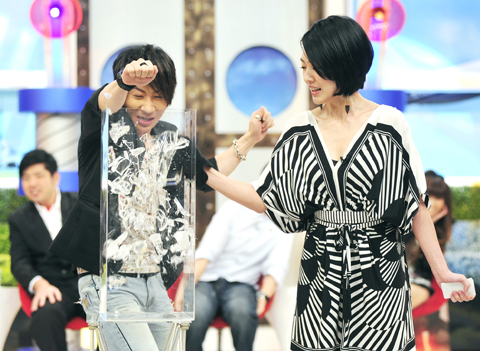
PHOTO: CHEN YI-CHUAN, TAIPEI TIMES
Lu’s big break came last year when he joined the elite list of entertainers to appear on China’s most-watched program — the Lunar New Year evening show, which boasts a billion viewers.
“For many performers it’s a top honor and a lifelong goal to get on the show,” Lu told reporters after performing recently in Taipei. “I didn’t expect my chance to come so fast.”
His eight-minute gig was voted one of the most popular segments of the show, ensuring a spot for the following year while bringing him lucrative performing and endorsement deals.
Lu, slim and eloquent, attributed his success to giving a modern look to his profession, a relatively overlooked area in Chinese-language entertainment.
“In China, there is a stereotype that a magician must either wear a tuxedo to pull rabbits from a hat or don a long Chinese robe to produce a goldfish tank out of thin air. They perform in silence over classical music,” he says.
In contrast, Lu talks to the audience and uses common items that can be seen everywhere every day so that “the impact of the magic trick is stronger,” he said.
One of his popular close-up tricks is to appear to put a ring that he borrows from a member of the audience into an egg, which he then breaks to take it out. Lu said the illusion is his original idea and the result of three years of work.
Since last year, Lu has staged over 50 shows in China and other countries, also performing classic illusions such as escaping after being chained and locked in a box, or “levitating” members of the audience.
It has been a dream come true for a boy who fell in love with magic at first sight.
“I saw a coin trick at a department store when I was 7 years old and I thought it was fascinating. I couldn’t help thinking about it every day and wondering how it was done.”
Lu went on to win a young magicians’ championship five years later in Taiwan, receiving the trophy from his idol, US illusionist David Copperfield, who was hugely popular in Taiwan in his heyday in the 1980s and 1990s.
While the award encouraged him to continue studying magic, Lu admitted he had doubts about earning a living as a magician as “it’s not a normal steady job.”
“But I decided to give it a try because I liked entertaining myself and others. Besides, I didn’t want to be stuck in a boring office job,” Lu said.
However, Lu’s speedy rise to fame in China has its costs, as he is constantly forced to fend off criticism from viewers who claim to have cracked his tricks or fellow magicians who challenge his skills, he said.
Even his appearance on a Japanese variety show sparked a controversy in China, where anti-Japan sentiment remains strong over Japanese wartime aggression.
“Some people think magicians are all liars and magic is trickery, so they get disappointed and angry, but this is not the right attitude for watching a magic performance.” Lu said. “Magic is about creating a dream world and realizing people’s desires, such as being able to make people fly or predict future events ... Magic is about surprising the audience and making them laugh.”
Lu is now also planning to take his talents in a new direction and open a magic school in Beijing in addition to performing.
“Magic is also an art of talking, so it will help people be more successful at their jobs by enhancing their speech and communication skills. It can even help young men court girlfriends,” he said.

UPGRADE: The Kang Ding-class frigate is replacing its Chaparall missiles with Tien Chien II and Hua Yang VLS, which would provide it with long-range, 360° air defense Taiwan plans to produce 1,200 to 1,376 Hai Chien II missiles (海劍二, Sea Sword II) — also known as TC-2N — to serve as the standard air defense system of the navy’s surface combatant fleet, a source said yesterday. Last week, the Hai Chien II, the naval version of the Tien Kung II missile (天劍二, Sky Sword II), completed a live-fire test in waters off the National Chungshan Institute of Science and Technology’s Jiupeng facility (九鵬) in Pingtung County’s Manjhou Township (滿州). The MIM72 Chaparral and other dated air defense missiles that currently arm Taiwanese ships have inadequate range to combat Chinese

REASONS FOR TRAVEL: An assistant professor said that proposed amendments to penalize drivers if they used drugs overseas would not deter people from traveling People who operate a motor vehicle under the influence of marijuana would have their driver’s license revoked, even if they used the substance while overseas, the Ministry of Transportation and Communications said yesterday, citing proposed amendments to the Road Traffic Management and Penalty Act (道路交通管理處罰條例). The amendments would also authorize the government to revoke the licenses of people determined to have used Category 1 or Category 2 narcotics, even if they were not operating a vehicle while under the influence of drugs, as well as ban them from taking the license test for three years, the ministry said. People aged 18 or

GLOBALGIVING: ‘ Caving to external pressure is not acceptable for an organization that has cultivated justice reform and human rights for 30 years,’ one NGO said A slew of non-government organizations (NGOs) have withdrawn from the GlobalGiving fundraising platform after it announced it would use “Chinese Taipei” instead of “Taiwan” from next month. The Taiwan Good Rice Association wrote on Facebook on Friday that it was informed on April 28 via a teleconference call of the change, which was made because the platform wanted to operate in China. Taiwan Good Rice is to terminate all cooperative relationships with GlobalGiving in response to the platform’s “unilateral and non-negotiable” decision to remove references to Taiwan, the NGO said. “Taiwan is in the official name of Taiwan Good Rice Association and the

HEAVY WEATHER: Typhoon Jangmi is due to crash straight into the Ryukyus as airlines look to shift flights to larger aircraft or cancel flights to Okinawa entirely Taiwan’s international air carriers announced flight adjustments over the weekend as Typhoon Jangmi is forecast to hit the Ryukyu Islands today and tomorrow. The Central Weather Administration (CWA) upgraded Jangmi from a tropical storm to a typhoon at 8am yesterday, with the eye located 580km south of Naha city. It was moving north at 19kph. Today, China Airlines’ CI-120, CI-121, CI-122 and CI-123 flights between Taoyuan and Naha, Okinawa, have been canceled as well as CI-132 and CI-133 between Kaohsiung and Naha. EVA Air’s BR-112, BR-113, BR-186 and BR-185 flights between Taoyuan and Naha are also canceled. Low-cost carrier Tigerair Taiwan canceled IT-230,


 RSS
RSS