


Communist or Taiwan independence advocate; ethnic Taiwanese native or Mainlander.
It didn't matter. If the authoritarian government of dictator Chiang Kai-shek (蔣介石) believed you were a dissident, you could be locked up for decades or even executed.
“We're good buddies, we're brothers,” 84-year-old Huang Kuang-hai (黃廣海) said, putting his arm around 85-year-old Kue Chin-sun (郭振純), both of them smiling.

PHOTO: LOA IOK-SIN, TAIPEI TIMES
The two men — along with dozens of other former political prisoners incarcerated on Green Island — returned to the island recently, decades after their release to attend the inauguration of a reconstructed New Life Correction Center (新生訓導處).
Taiwan was officially under martial law from 1949 until 1987. From the 1950s thousands of political prisoners were kept first at the New Life Correction Center and then Oasis Village (綠洲山莊).
While it may seem perfectly normal for two former political prisoners to call each other friends, the relationship is more surprising when one learns about their backgrounds.
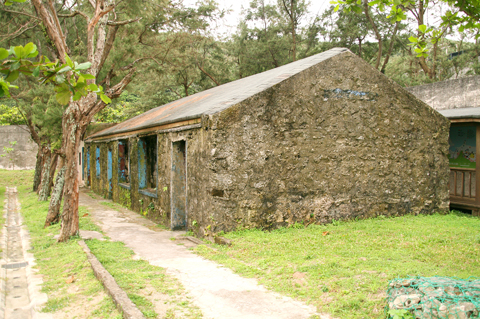
PHOTO: LOA IOK-SIN, TAIPEI TIMES
Huang was born in Guangzhou, China, in 1926, and came to Taiwan in 1950 as a soldier when the Chinese Nationalist Party (KMT) retreated after losing the civil war against the Chinese Communist Party (CCP). Although he was with KMT troops, Huang had always been fond of communism and to this date, the unification of Taiwan and China is still his biggest dream.
On the other hand, Kue is an ethnic Taiwanese born in 1925 and a diehard advocate of Taiwan independence.
“We're good buddies because we were both jailed for more than 20 years and for the most part, we were jailed together ... Of course we have different political views, but political views didn't really play a role when we lived together, worked together and helped each other out as political prisoners,” Huang said.
“We knew we disagreed with each other on ideology, so we never talked too much about it,” he added.
Although Huang was a CCP sympathizer, he never actually participated in any organization or political activities related to the party.
“I was sentenced to life in prison for complaining about Chiang Kai-shek in letters to friends in Hong Kong ... In those letters, I complained that Chiang was a dictator and the KMT regime was an authoritarian one,” he said.
“I was in the military at the time and they always checked what we wrote in letters — especially if the letters were going abroad — so they decided to charge me with 'repeatedly spreading false rumors' and sentenced me to life in prison,” he said.
Huang was sent to prison in 1954 and did not get out until 1975 when an amnesty was declared after Chiang passed away on April 5 that year.
During those 21 years, he was incarcerated in six prisons — two different Taiwan Garrison Command detention centers in Taipei City; the Ankeng Military Prison (安坑軍人監獄) in Sindian City (新店), Taipei County; the New Life Correction Center and the Oasis Village on Green Island; and Taiyuan Prison (泰源監獄) in Donghe Township (東河), Taitung County.
It was at Taiyuan and on Green Island that Huang met Kue.
Although Kue, was one of the many young Taiwanese who took up arms to fight the KMT following the 228 Incident in 1947, he escaped the mass arrests and executions that followed. He was less fortunate during the Martial Law Era.
In 1951, Kue campaigned for non-KMT candidate Yeh Ting-kuei (葉廷珪) in his victorious bid for Tainan City mayor. After the election, someone reported to the secret service that Yeh was connected to Thomas Liao (廖文毅), a Taiwan independence movement leader who formed the Provisional Government of the Republic of Formosa in Japan.
Kue said he was a supporter of Taiwan independence, but did not play a role in any advocacy organizations.
“They tortured me, trying to get me to admit to things I did not do, but I refused, so they could only sentence me to life in prison under the charge of 'repeated participation in unlawful assemblies' ... If I gave in, I could've been sentenced to death right away,” he said.
Kue said that when he was first arrested in Tainan, the secret service agents tore the nails off both his thumbs and his toes. He then was put into a big linen bag and dumped into a river for a few seconds.
“The worst thing was when they spilled sugar water all over me, and threw me into a courtyard — ants quickly found their way to the sweet taste, and bit me all over ... My hands had been tied behind me, so I could do nothing but roll on the ground,” Kue said.
Huang and Kue were sent to the New Life Correction Center in the 1950s and transferred to Taiyuan Prison in the 1960s. However, the two, along with all other political prisoners, were sent back to the newly constructed Oasis Village in the 1970s after several pro-independence prisoners, including Kue, organized a failed uprising.
Kue was also released when an amnesty was declared after Chiang's death.
Secret reports and torture were probably key reasons behind that high percentage of political prisoners who were falsely charged.
“During the initial years of the Martial Law Era, you could receive part of a dissident's property if you reported on the person and the person was ‘proven’ guilty,” said Tsao Chin-jung (曹欽榮), an independent researcher of political cases during the Martial Law Era.
“If the accuser wanted the money and the secret service agents needed names to meet their quota, then they tortured the victims into admitting whatever they wanted them to,” Tsao said.
While political prisoners were from all walks of life, another researcher who specializes in mainlander political prisoners, Huang Luo-fei (黃洛斐), said that Mainlanders were more likely to be reported as communists.
“Most Mainlanders in Taiwan had families and friends in China and they would miss their hometowns and their loved ones ... Well, a letter sent back home, a complaint about the KMT or saying that he or she wanted to go home could often be cited as evidence of a ‘connection to the communist bandits,’” Huang said.
According to an estimate from the Compensation Foundation for Victims of Improper Verdicts in the Martial Law Era (財團法人戒嚴時期不當叛亂暨匪諜審判案件補償基金會), more than 90 percent of political prisoners during the Martial Law period were unaware of the accusations made against them.
To date, the foundation has identified about 9,000 political victims from that time.
“But the real number is much higher because many government agencies in charge of handling political prisoners are still either unwilling to publicize lists or have already destroyed them,” a foundation board member, Chiu Rong-jeo (邱榮舉), told the Taipei Times.
“The Martial Law Era has a legacy that still impacts our society today ... For example, the culture of reporting on someone and the mentality of being overly careful in all things to avoid getting into trouble — especially in the government system,” Tsao said.
Issues that still need to be addressed are the unwillingness of public servants and officials who collaborated with the authoritarian regime to publicize all the official records of that period and the continued glorification of Chiang Kai-shek, Tsao said.

REASONS FOR TRAVEL: An assistant professor said that proposed amendments to penalize drivers if they used drugs overseas would not deter people from traveling People who operate a motor vehicle under the influence of marijuana would have their driver’s license revoked, even if they used the substance while overseas, the Ministry of Transportation and Communications said yesterday, citing proposed amendments to the Road Traffic Management and Penalty Act (道路交通管理處罰條例). The amendments would also authorize the government to revoke the licenses of people determined to have used Category 1 or Category 2 narcotics, even if they were not operating a vehicle while under the influence of drugs, as well as ban them from taking the license test for three years, the ministry said. People aged 18 or

GLOBALGIVING: ‘ Caving to external pressure is not acceptable for an organization that has cultivated justice reform and human rights for 30 years,’ one NGO said A slew of non-government organizations (NGOs) have withdrawn from the GlobalGiving fundraising platform after it announced it would use “Chinese Taipei” instead of “Taiwan” from next month. The Taiwan Good Rice Association wrote on Facebook on Friday that it was informed on April 28 via a teleconference call of the change, which was made because the platform wanted to operate in China. Taiwan Good Rice is to terminate all cooperative relationships with GlobalGiving in response to the platform’s “unilateral and non-negotiable” decision to remove references to Taiwan, the NGO said. “Taiwan is in the official name of Taiwan Good Rice Association and the

HEAVY WEATHER: Typhoon Jangmi is due to crash straight into the Ryukyus as airlines look to shift flights to larger aircraft or cancel flights to Okinawa entirely Taiwan’s international air carriers announced flight adjustments over the weekend as Typhoon Jangmi is forecast to hit the Ryukyu Islands today and tomorrow. The Central Weather Administration (CWA) upgraded Jangmi from a tropical storm to a typhoon at 8am yesterday, with the eye located 580km south of Naha city. It was moving north at 19kph. Today, China Airlines’ CI-120, CI-121, CI-122 and CI-123 flights between Taoyuan and Naha, Okinawa, have been canceled as well as CI-132 and CI-133 between Kaohsiung and Naha. EVA Air’s BR-112, BR-113, BR-186 and BR-185 flights between Taoyuan and Naha are also canceled. Low-cost carrier Tigerair Taiwan canceled IT-230,
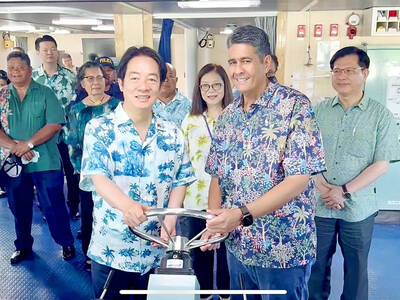
MULTIPRONGED APPROACH: China has sought to pressure Palau across a number of fronts, but the island nation has staunchly resisted overtures to ditch Taiwan Palau has been firm in backing Taiwan despite Chinese pressure that uses tourism economics, cyberattacks and criminal infiltration as tools to threaten the Pacific ally into renouncing its recognition of Taiwan as a sovereign state. The Presidential Office yesterday announced that Vice President Hsiao Bi-khim (蕭美琴) would visit Palau from Saturday to Wednesday next week at the invitation of Palauan President Surangel Whipps Jr. Whipps in April said in an interview that China had outspokenly asked Palau to “denounce Taiwan.” “And we have said: ‘We have no enemies, but nobody tells us who our friends are,’” he said. Whipps has told reporters multiple times


 RSS
RSS