


Taking the audience on a visual tour of Taipei City with a six-minute 3D film on life in Taipei — from Shihlin Night Market to MRT stations — and interactive games promoting the city’s friendliness, the Taipei Pavilion opened yesterday at the Shanghai World Expo, along with 141 pavilions from other countries.
The pavilion, a wooden structure renovated from an old power plant, is among 55 exhibitions at the expo’s Urban Best Practices Area, showcasing Taipei’s ubiquitous wireless Internet access and garbage recycling policies.
More than 100 visitors, mostly from China, lined up in front of the pavilion before it was officially opened at 10am, hoping to gain a better understanding of the city.
“My impression of Taipei is that there are lots of scooters and the Taipei 101 Mall. I want to know more about how people live in Taipei before I have a chance to visit the place,” 20-year-old Shanghai citizen Chang Ximeng (張希濛) said.
Huang Xiaohu (黃小虎), from Wuhan Province, said he was impressed by the “Future Theater” display at the Taipei pavilion, showcasing the city’s wireless development and garbage recycling using virtual holographic images.
“Taipei is not only a city with high technology, but also a highly civilized place. I am particularly impressed by the order in the MRT stations and this is something we have to learn,” he said.
The two-story pavilion includes a 3D theater featuring a six-minute film directed by Hou Hsiao-hsian (侯孝賢), “Future Theater” and an interaction zone.
In the interaction zone, the number “2010” is displayed on an LED touch-screen. The pattern is comprised of 2,010 headshots of Taipei residents, including Taipei Mayor Hau Lung-bin (郝龍斌), representing the friendliness of the city.
Visitors can also take a photo with a Taipei landmark — including Taipei 101 and Dazhi Bridge — as the background, at one of four photo booths and take the finished post-card like photos home as souvenirs.
The Taipei pavilion also attracted a lot of attention because of its “ambassador,” pop singer songwriter Wang Lee-hom (王力宏), whose appearance at the opening ceremony yesterday drew cheers from the crowd.
Addressing the opening ceremony, Taipei Mayor Hau Lung-bin (郝龍斌) expressed his pride in Taipei and said he expected the pavilion to raise awareness and generate new interest in the capital city.
“I come to Shanghai with a smile and hope Taipei’s high-tech and friendly environment demonstrated at the expo will both increase your interest in Taipei and encourage you to visit our city very soon,” he said.
Shanghai Mayor Han Zheng (韓正), Hon Hai Group Chairman Terry Guo (郭台銘), sponsor of the pavilion, former Chinese Nationalist Party (KMT) chairman Lien Chan (連戰) and Wu Poh-hsiung (吳伯雄) also attended the event.
The Taiwan pavilion is a transparent cube with a giant ball at the center. It is mainly made of steel and glass, with the outlines of Yushan and Alishan painted onto the facade.
Staff at the pavilion said only 3,000 visitors would be allowed to visit the exhibition initially, though it would open to more visitors after a large celebratory event on May 11.
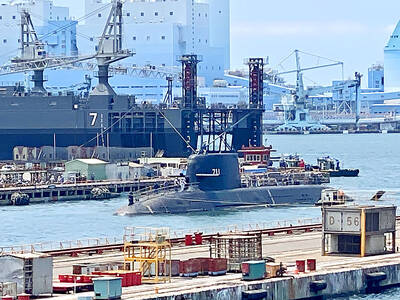
AGING: While Japan has 22 submarines, Taiwan only operates four, two of which were commissioned by the US in 1945 and 1946, and transferred to Taiwan in 1973 Taiwan would need at least 12 submarines to reach modern fleet capabilities, CSBC Corp, Taiwan chairman Chen Cheng-hung (陳政宏) said in an interview broadcast on Friday, citing a US assessment. CSBC is testing the nation’s first indigenous defense submarine, the Hai Kun (海鯤, Narwhal), which is scheduled to be delivered to the navy next month or in July. The Hai Kun has completed torpedo-firing tests and is scheduled to undergo overnight sea trials, Chen said on an SET TV military affairs program. Taiwan would require at least 12 submarines to establish a modern submarine force after assessing the nation’s operational environment and defense

Yangmingshan National Park authorities yesterday urged visitors to respect public spaces and obey the law after a couple was caught on a camera livestream having sex at the park’s Qingtiangang (擎天崗) earlier in the day. The Shilin Police Precinct in Taipei said it has identified a suspect and his vehicle registration number, and would summon him for questioning. The case would be handled in accordance with public indecency charges, it added. The couple entered the park at about 11pm on Thursday and began fooling around by 1am yesterday, the police said, adding that the two were unaware of the park’s all-day live
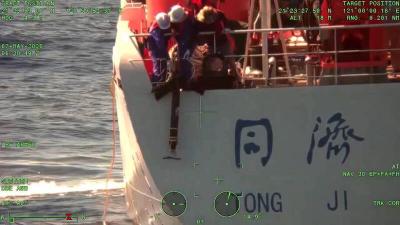
The coast guard today said that it had disrupted "illegal" operations by a Chinese research ship in waters close to the nation and driven it away, part of what Taipei sees a provocative pattern of China's stepped up maritime activities. The coast guard said that it on Thursday last week detected the Chinese ship Tongji (同濟號), which was commissioned only last year, 29 nautical miles (54km) southeast of the southern tip of Taiwan, although just outside restricted waters. The ship was observed lowering ropes into the water, suspected to be the deployment of scientific instruments for "illegal" survey operations, and the coast

A former soldier and an active-duty army officer were yesterday indicted for allegedly selling classified military training materials to a Chinese intelligence operative for a total of NT$79,440. The Taipei District Prosecutors’ Office indicted Chen Tai-yin (陳泰尹) and Lee Chun-ta (李俊達) for contravening the National Security Act (國家安全法) and the Anti-Corruption Act (貪污治罪條例). Chen left the military in September 2013 after serving alongside then-staff sergeant Lee, now an army lieutenant, at the 21st Artillery Command of the army’s Sixth Corps from 2011 to 2013, according to the indictment. Chen met a Chinese intelligence operative identified as “Wang” (王) through a friend in November


 RSS
RSS