


The Ketagalan of Taiwan Indigenous Culture Alliance yesterday accused government officials of overlooking the destruction of valuable artifacts used by Taiwanese Aborigines 4,500 years ago in order to construct access roads to the Lungmen nuclear power plant.
Legislator Tien Chiu-chin (田秋堇), paleontologists and descendants of Aborigines yesterday told a press conference that they found the Ministry of Economic Affairs' (MOEA) refusal to halt construction of the nuclear power plant’s access roads unacceptable.
The Lungmen nuclear power plant, also known as the Fourth Nuclear Power Plant, is currently being constructed in Taipei County’s Gungliao Township (貢寮).
Lin Sheng-yi (林勝義), executive director of the alliance, held up a part of what is believed to be a crucible used by ancestors of the Pingpu Tribe (平埔族) that was found at the power plant construction site and said that carbon dating has shown it to be from the year 2440 BC.
“Scholars from the Academia Sinica and the National Science Council all denied its [the artifact's] value,” Lin said.
Lin wasn’t discouraged and sent a sample to the Beta Analytic Radio Carbon Dating Laboratory in Miami, Florida, which informed him that test results indicated that the sample was from 2440 BC.
“The adhesive used in these artifacts is proof that the articles are manmade, and not naturally occurring,” he said.
Taiwan Paleo-Civilization Research Center's Ho Hsien-jung (何顯榮) also recognized geometric characters that are believed to be early forms of writing found on rocks dug up from the area surrounding the nuclear power plant.
“These artifacts are like tape recordings that our ancestors left us,” Tien said. “Our ancestry comes not only from Emperor Qin Shi Huang, but many other different cultures as well. About a quarter of all Taiwanese have Pingpu blood in their veins.”
Their petitions to halt construction of certain areas near the plant have gone unanswered.
“[Minister of Economic Affairs Shih Yen-hsiang 施顏祥] has vowed to halt construction if the location is indeed an archaeological site. We hope he will keep his word,” Tien said.
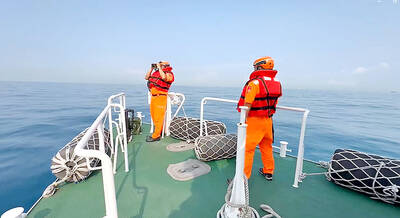
An increase in Taiwanese boats using China-made automatic identification systems (AIS) could confuse coast guards patrolling waters off Taiwan’s southwest coast and become a loophole in the national security system, sources familiar with the matter said yesterday. Taiwan ADIZ, a Facebook page created by enthusiasts who monitor Chinese military activities in airspace and waters off Taiwan’s southwest coast, on Saturday identified what seemed to be a Chinese cargo container ship near Penghu County. The Coast Guard Administration went to the location after receiving the tip and found that it was a Taiwanese yacht, which had a Chinese AIS installed. Similar instances had also

GOOD DIPLOMACY: The KMT has maintained close contact with representative offices in Taiwan and had extended an invitation to Russia as well, the KMT said The Chinese Nationalist Party (KMT) would “appropriately handle” the fallout from an invitation it had extended to Russia’s representative to Taipei to attend its international banquet last month, KMT Chairman Eric Chu (朱立倫) said yesterday. US and EU representatives in Taiwan boycotted the event, and only later agreed to attend after the KMT rescinded its invitation to the Russian representative. The KMT has maintained long-term close contact with all representative offices and embassies in Taiwan, and had extended the invitation as a practice of good diplomacy, Chu said. “Some EU countries have expressed their opinions of Russia, and the KMT respects that,” he

AMENDMENT: Contact with certain individuals in China, Hong Kong and Macau must be reported, and failure to comply could result in a prison sentence, the proposal stated The Chinese Nationalist Party (KMT) and the Taiwan People’s Party (TPP) yesterday voted against a proposed bill by Democratic Progressive Party (DPP) lawmakers that would require elected officials to seek approval before visiting China. DPP Legislator Puma Shen’s (沈伯洋) proposed amendments to the Act Governing Relations Between the People of the Taiwan Area and the Mainland Area (臺灣地區與大陸地區人民關係條例), stipulate that contact with certain individuals in China, Hong Kong and Macau should be reported, while failure to comply would be punishable by prison sentences of up to three years, alongside a fine of NT$10 million (US$309,041). Fifty-six voted with the TPP in opposition
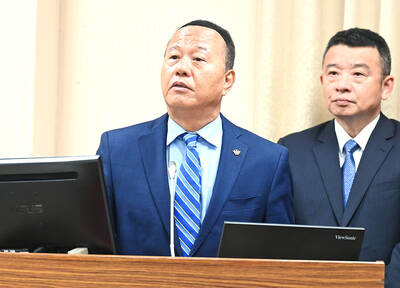
VIGILANCE: The military is paying close attention to actions that might damage peace and stability in the region, the deputy minister of national defense said The People’s Republic of China (PRC) might consider initiating a hack on Taiwanese networks on May 20, the day of the inauguration ceremony of president-elect William Lai (賴清德), sources familiar with cross-strait issues said. While US Secretary of State Anthony Blinken’s statement of the US expectation “that all sides will conduct themselves with restraint and prudence in the period ahead” would prevent military actions by China, Beijing could still try to sabotage Taiwan’s inauguration ceremony, the source said. China might gain access to the video screens outside of the Presidential Office Building and display embarrassing messages from Beijing, such as congratulating Lai


 RSS
RSS