


Officials from the state-run Taiwan Water Corp yesterday condemned a group of Tainan environmentalists for saying chemical pollutants, including a cancer-causing agent, had been found in underground water supplies near a Tainan-area reservoir.
The remarks came after officials from the Tainan branch of the non-profit Taiwan Environmental Protection Union (TEPU) said on Monday that according to a previously unpublished investigation undertaken by the Environmental Protection Administration (EPA), underground water from four of twelve wells in areas surrounding Wushantou Reservoir (烏山頭水庫) tested positive for chemicals ranging from chloromethane to arsenic, citing documents obtained by the organization.
Calling the group’s comments “unprofessional and biased,” and blaming it for causing panic among residents, company president Chen Fu-tien (陳福田), speaking alongside EPA Deputy Director Chang Tzi-chin (張子敬), said that the reservoir’s water stores were completely safe because the company did not source its water from underground supplies.
Chen said that the main source of water for Wushantou Reservoir was run-off water from nearby hydro-generating plants in the Zengwun Reservoir (曾文水庫).
The TEPU said on Monday that eight of the 20m to 30m deep wells investigated were 0.5km upriver, while the other four were in the reservoir’s immediate vicinity.
Three of the samples tested positive for chloromethane, a heavily flammable toxic chemical, while traces of toluene and arsenic were also found.
However, it was unclear if the pollutant levels exceeded EPA regulations. The agency sets standards for water in reservoirs and for drinking water that are different from standards for groundwater.
While the TEPU compared pollutant levels against the strict criteria set for drinking and reservoir supplies, EPA officials said that the sampled water sources were instead regulated as normal underground water supplies.
There is a large discrepency between the two. The maximum amount of toluene allowed in drinking water is 1mL per liter compared to 10mL per liter for normal groundwater. Similarly, chloromethane levels are 0.03mL per liter and 0.3mL per liter respectively.
Using the agency’s standards for groundwater, none of the chemical levels exceed regulations except for arsenic, which was sampled at 0.0565mg per liter, higher than the 0.05mg per liter groundwater standard and the 0.005mg per liter drinking water standard.
Sources at the agency confirmed that the findings were the result from an investigation undertaken by the agency in November. The results were only published yesterday evening in response to queries by reporters.
TEPU officials said yesterday that they were uncertain how the non-naturally occurring pollutants entered the water supply. However, they said that according to local citrus farmers in the area, heavy-duty trucks had been seen trawling up narrow roads in the past three months.
Cheng Hsiu-ju (鄭秀如), a TEPU official that worked on the investigation, said residents suspected that a local landfill operator — the only known user of heavy-duty trucks in the area — was illegally dumping waste into the water.

FUKUOKA SITUATION: Japanese media reported that the pathogen is expected to be identified by the summer, while the CDC downplayed the idea that it was hMPV A “mysterious cold-like illness” reported in Japan’s Fukuoka Prefecture does not seem to be a new disease, but Japanese authorities have been asked about the situation, the Centers for Disease Control (CDC) said yesterday. The Fukuoka Prefectural Medical Association on Wednesday told a news conference that a “mystery cold” that has become a hot topic on social media is “highly likely to be caused by some kind of viral infection,” Japan’s KBC News reported. “Many people are experiencing symptoms starting with a sore throat, followed by a runny nose, phlegm and a severe cough,” KBC News reported, citing association officials. Health authorities are

Nvidia Corp CEO Jensen Huang (黃仁勳) arrived in Taiwan yesterday ahead of upcoming AI and technology events, saying he plans to meet with clients and Taiwan Semiconductor Manufacturing Co Chairman C.C. Wei (魏哲家) during his visit. After landing at Taipei Songshan Airport, Huang posed for photos with fans and handed out Yakult drinks to reporters and supporters waiting at the scene, saying he has “a lot to do” during the trip. Asked about reports that Nvidia’s planned headquarters site in Taipei’s Beitou Shilin Technology Park could break ground on May 27, Huang said that if the company holds an event, he would

The Ministry of Finance this afternoon announced the winning numbers for the March-April uniform invoice lottery. The winning number for the NT$10 million (US$318,060) special prize is 19531471, and the winning number for the NT$2 million grand prize is 85941329. Three numbers were drawn for the NT$200,000 first prize: 07225810, 20231230 and 83518781. Those with receipts matching the last seven digits of any of the first-prize numbers will win the NT$40,000 second prize, while those matching the last six digits will win the NT$10,000 third prize. Those whose receipts match the last five digits of the first-prize numbers can claim the NT$4,000 fourth prize,
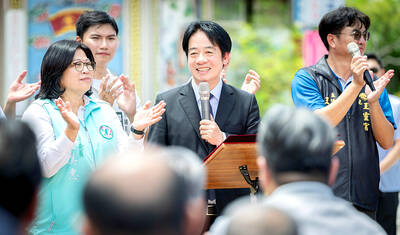
SIX SUBSIDIES: The monthly allowance for older farmers is to increase to NT$10,000, and NT$5,000 is to be given to homemakers under the national pension system, Lai said The government is to implement major welfare policies for disadvantaged groups, including raising the monthly allowance for older farmers to NT$10,000 and providing homemakers with NT$5,000 per month, President William Lai (賴清德) said yesterday. Lai made the remarks during a visit to Wangling Temple in Chiayi County, saying that the planned increases were being introduced amid economic growth and an increase in tax revenue. Touting a policy, in which the government plans to provide a monthly allowance of NT$5,000 for every child under the age of 18 in a bid to address Taiwan’s low birthrate, Lai said that if received for the


 RSS
RSS