


A plastic bottle thrown into a Taipei recycling bin could be reincarnated as a blanket to warm disaster victims in any of 20 countries, thanks to a unique project by the world’s largest Buddhist charity.
The Buddhist Compassionate Relief Tzu Chi Foundation has been taking plastic bottles from the waste stream of Taipei for three years and converting them into about 244,000 polyester blankets intended for disaster zones.
This week, Tzu Chi expanded its recycling effort to begin making shirts, scarves and cloth shopping bags. Based on an idea developed by a Taiwanese entrepreneur, Tzu Chi sends the plastic bottles to a factory that breaks them down into a polyester fabric, which is then sent to a crew of volunteers who fashion it into blankets or garments.
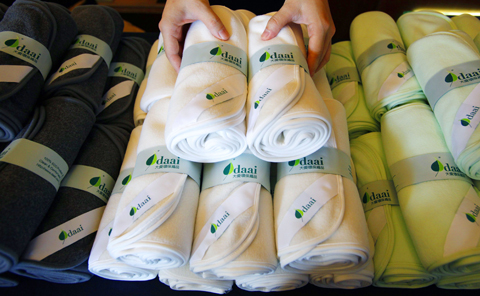
PHOTO: REUTERS
Tzu Chi, a private group founded in 1966, has sent volunteers with relief supplies to some of the world’s biggest disasters, including Hurricane Katrina in the US in 2005 and last year’s devastating Sichuan earthquake in China.
When Typhoon Morakot flooded Taiwan in August, killing more than 700 people, Lee Kui-yang and four family members found all blankets in their one-story house soaked after they were stranded for four days on the roof.
Tzu Chi gave them a dry blanket made from recycled bottles.
“Initially every cotton blanket and even our clothes were soaked in the floodwater, so when we got Tzu Chi’s blanket, it warmed our heart,” Lee said.
Some of the new shirts, scarves and bags will go directly to disaster areas. Others will be sold locally to pay for other kinds of disaster relief work.
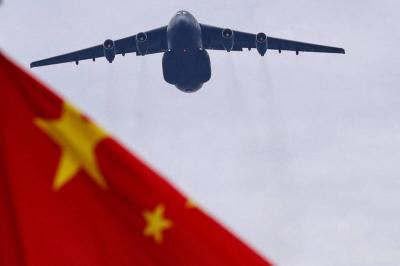
Beijing could eventually see a full amphibious invasion of Taiwan as the only "prudent" way to bring about unification, the US Department of Defense said in a newly released annual report to Congress. The Pentagon's "Annual Report to Congress: Military and Security Developments Involving the People's Republic of China 2025," was in many ways similar to last year’s report but reorganized the analysis of the options China has to take over Taiwan. Generally, according to the report, Chinese leaders view the People's Liberation Army's (PLA) capabilities for a Taiwan campaign as improving, but they remain uncertain about its readiness to successfully seize
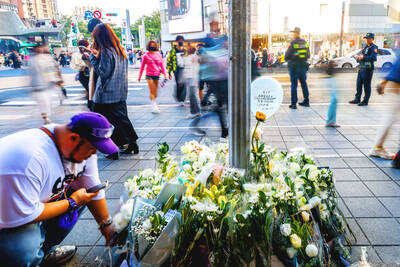
HORROR STORIES: One victim recounted not realizing they had been stabbed and seeing people bleeding, while another recalled breaking down in tears after fleeing A man on Friday died after he tried to fight the knife-wielding suspect who went on a stabbing spree near two of Taipei’s busiest metro stations, Taipei Mayor Chiang Wan-an (蔣萬安) said. The 57-year-old man, identified by his family name, Yu (余), encountered the suspect at Exit M7 of Taipei Main Station and immediately tried to stop him, but was fatally wounded and later died, Chiang said, calling the incident “heartbreaking.” Yu’s family would receive at least NT$5 million (US$158,584) in compensation through the Taipei Rapid Transit Corp’s (TRTC) insurance coverage, he said after convening an emergency security response meeting yesterday morning. National

Taiwan has overtaken South Korea this year in per capita income for the first time in 23 years, IMF data showed. Per capita income is a nation’s GDP divided by the total population, used to compare average wealth levels across countries. Taiwan also beat Japan this year on per capita income, after surpassing it for the first time last year, US magazine Newsweek reported yesterday. Across Asia, Taiwan ranked fourth for per capita income at US$37,827 this year due to sustained economic growth, the report said. In the top three spots were Singapore, Macau and Hong Kong, it said. South
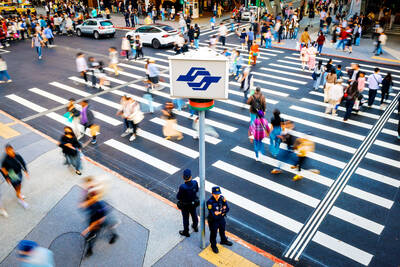
PLANNED: The suspect visited the crime scene before the killings, seeking information on how to access the roof, and had extensively researched a 2014 stabbing incident The suspect in a stabbing attack that killed three people and injured 11 in Taipei on Friday had planned the assault and set fires at other locations earlier in the day, law enforcement officials said yesterday. National Police Agency (NPA) Director-General Chang Jung-hsin (張榮興) said the suspect, a 27-year-old man named Chang Wen (張文), began the attacks at 3:40pm, first setting off smoke bombs on a road, damaging cars and motorbikes. Earlier, Chang Wen set fire to a rental room where he was staying on Gongyuan Road in Zhongzheng District (中正), Chang Jung-hsin said. The suspect later threw smoke grenades near two exits


 RSS
RSS