


Taiwanese conductor Paul Chiang (江靖波) is auctioning one of his batons, known as “Little Henry,” to raise money for the physically disabled.
“I would like to donate the proceeds from the auction to the Eden Social Welfare Foundation as a tribute to the physically disabled,” he said. “Little Henry was chosen from among my many batons because it reflects many very significant moments in my life and because the twice-damaged baton signifies the possibility that beautiful things, such as music, can be created out of imperfection.”
“Little Henry,” which Chiang has taken with him to numerous concerts around the world over the past 15 years, was also on stage with him when he won the third prize in the prestigious Sir Georg Solti Competition for Conductors at the Alte Oper Frankfurt in Germany in September 2002.
The Philharmonia Moment Musical, a symphony orchestra of young Taiwanese that Chiang founded in 1998, has given particular attention to Aboriginal communities, holding dozens of concerts in remote areas of southern Taiwan prior to the recent devastation wrought by floods and mudslides caused by Typhoon Morakot in August.
In the wake of the typhoon, Chiang said that he and his orchestra were especially concerned about post-disaster rehabilitation in remote areas.
In an effort to help raise funds for typhoon victims in the affected communities, the orchestra staged a charity concert at Huashan Culture Park in Taipei on Sept. 11.
The orchestra has also scheduled performance tours of southern Taiwan with the aim of brightening the lives of the people there.
“The feedback we’ve had from people in rural communities has invigorated our young musicians, who are as convinced as I am that music can enlighten, challenge and entertain souls and minds,” Chiang said.
The 39-year-old Chiang started out as a violinist. In 1990, he attended the University of Southern California where he met the man who would become his mentor, Professor Daniel Lewis. Lewis encouraged him to develop his potential to be an orchestra leader.
In 1995, Chiang became a fellow at Tanglewood in Lenox, Massachusetts, which has been the summer home of the Boston Symphony Orchestra since 1937. The New England resort is considered a cradle of musical talent.
In 1996, Chiang returned to Taiwan and soon grew busy teaching at Soochow University and collaborating with ensembles on their productions. He held on to his creed that “high art has a social responsibility to enlighten, to reconcile, to challenge and to entertain the souls and minds of the people of its community.”
“Unlike other genres, classical music allows a good performer to work alone in his or her artistic pursuits, and consequently, musicians very often give the impression that they are not keen on teamwork,” Chiang said. “I believe all this can change if someone takes the lead and makes consistent and continuous efforts to coordinate their progress.”
In the last two years, Chiang and Philharmonia Moment Musical have made great strides toward his goal of taking his orchestra to see the world and showing the world the standard of classical music in Taiwan.
On June 19, 2007, Chiang made a highly acclaimed debut at Carnegie Hall in New York, conducting the New England Symphonic Ensemble in a program that featured Beethoven and Mozart.
“The invitation to the prestigious Young Euro Classic Festival in Berlin in August 2008 was a great honor for our 99-member orchestra,” Chiang said. “We impressed audiences there with our interpretation of Gustav Mahler’s Symphony No. 5 and with the Germany premiere of Taiwanese composer Lai Deh-ho’s Concerto for Pipa, Bamboo Flute, Xiao and Chamber Orchestra.”

SECURITY: Starlink owner Elon Musk has taken pro-Beijing positions, and allowing pro-China companies to control Taiwan’s critical infrastructure is risky, a legislator said Starlink was reluctant to offer services in Taiwan because of the nation’s extremely high penetration rates in 4G and 5G services, the Ministry of Digital Affairs said yesterday. The ministry made the comments at a meeting of the legislature’s Transportation Committee, which reviewed amendments to Article 36 of the Telecommunications Management Act (電信管理法). Article 36 bans foreigners from holding more than 49 percent of shares in public telecommunications networks, while shares foreigners directly and indirectly hold are also capped at 60 percent of the total, unless specified otherwise by law. The amendments, sponsored by Chinese Nationalist Party (KMT) Legislator Ko

The military has spotted two Chinese warships operating in waters near Penghu County in the Taiwan Strait and sent its own naval and air forces to monitor the vessels, the Ministry of National Defense (MND) said. Beijing sends warships and warplanes into the waters and skies around Taiwan on an almost daily basis, drawing condemnation from Taipei. While the ministry offers daily updates on the locations of Chinese military aircraft, it only rarely gives details of where Chinese warships are operating, generally only when it detects aircraft carriers, as happened last week. A Chinese destroyer and a frigate entered waters to the southwest

The eastern extension of the Taipei MRT Red Line could begin operations as early as late June, the Taipei Department of Rapid Transit Systems said yesterday. Taipei Rapid Transit Corp said it is considering offering one month of free rides on the new section to mark its opening. Construction progress on the 1.4km extension, which is to run from the current terminal Xiangshan Station to a new eastern terminal, Guangci/Fengtian Temple Station, was 90.6 percent complete by the end of last month, the department said in a report to the Taipei City Council's Transportation Committee. While construction began in October 2016 with an
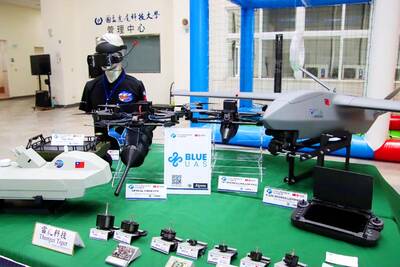
NON-RED SUPPLY: Boosting the nation’s drone industry is becoming increasingly urgent as China’s UAV dominance could become an issue in a crisis, an analyst said Taiwan’s drone exports to Europe grew 41.7-fold from 2024 to last year, with demand from Ukraine’s fight against Russian aggression the most likely driver of growth, a study showed. The Institute for Democracy, Society and Emerging Technology (DSET) in a statement on Wednesday said it found that many of Taiwan’s uncrewed aerial vehicle (UAV) sales were from Poland and the Czech Republic. These countries likely transferred the drones to Ukraine to aid it in its fight against the Russian invasion that started in 2022, it said. Despite the gains, Taiwan is not the dominant drone exporter to these markets, ranking second and fourth


 RSS
RSS