


Taiwan Association for Human Rights secretary-general Tsai Chi-hsun (蔡季勳) and Chinese democracy activists criticized President Ma Ying-jeou’s (馬英九) statement released yesterday to commemorate the 20th anniversary of the Tiananmen Square Massacre.
“Ma’s statement was too weak,” Tsai told the Taipei Times. “He mentioned remembering history, the 228 Incident and the White Terror but didn’t condemn human rights abuses in China today.”
Tsai jointly issued an open letter calling on the government and the public to pay more attention to human rights in China last week.
She said Beijing not only refuses to admit its mistakes in the bloody crackdown or conduct an official investigation into the incident, but also continues to deny free speech and assembly.
“In recent years, China has even started to arrest lawyers who stand in court to defend people’s legal rights,” she said.
Tsai therefore disagreed with Ma’s comment that China had made progress on human rights.
“Of course you could say that the human rights situation has improved if you compare the Chinese Communist Party [CCP] with the Qing Dynasty government 200 years ago,” she said.
On the other hand, exiled Chinese democracy activist Wang Min (汪岷) said that, based on his own observation, the human rights situation in China today is worse than 20 years ago.
“Twenty years ago, university students and professors could talk about politics and criticize the government in public,” Wang said. “Nowadays, the CCP has tightened its control over dissidents — it’s arresting and harassing democracy activists and people who want to say something about the Tiananmen Square Massacre.”
“In 1989, people were able to stage a demonstration in Tiananmen Square, but today, you can’t even stay in the square if there are 10 or 20 of you,” he said.
Wang said the CCP acts as if it is working to protect human rights but is actually tightening its control on dissidents.
“As a president, Ma should not weaken his criticism of the CCP government for economic interests,” he said.
Another Chinese democracy activist Cai Lujun (蔡陸軍), who lives in exile in Taiwan, said he was disappointed by Ma.
“I wonder with which eye did Ma see the CCP making any improvement in human rights? ... People are still being arrested just for writing articles criticizing the government,” Cai said. “I used to admire Ma a lot, so I was shocked last year when he said things that seemed to cover for the CCP, and this year, I am very disappointed and angry that he’s openly praising the CCP.”
Cai was jailed for three years for posting Internet articles criticizing the Chinese government.
He was also upset that Ma cited historical events in the US, Europe, South Korea and Southeast Asia to say that government crackdowns on dissidents were common.
“What are you [Ma] trying to prove by citing examples in other parts of the world? Are you trying to say that because other countries did something terrible, it’s okay for the CCP to do so?” Cai said.

Actor Darren Wang (王大陸) was sentenced to six months in prison, commutable to a fine, by the New Taipei District Court today for contravening the Personal Data Protection Act (個人資料保護法) in a case linked to an alleged draft-dodging scheme. Wang allegedly paid NT$3.6 million (US$114,380) to an illegal group to help him evade mandatory military service through falsified medical documents, prosecutors said. He transferred the funds to Chen Chih-ming (陳志明), the alleged mastermind of a draft-evasion ring, although he lost contact with him as he was already in detention on fraud charges, they said. Chen is accused of helping a

SECURITY: Starlink owner Elon Musk has taken pro-Beijing positions, and allowing pro-China companies to control Taiwan’s critical infrastructure is risky, a legislator said Starlink was reluctant to offer services in Taiwan because of the nation’s extremely high penetration rates in 4G and 5G services, the Ministry of Digital Affairs said yesterday. The ministry made the comments at a meeting of the legislature’s Transportation Committee, which reviewed amendments to Article 36 of the Telecommunications Management Act (電信管理法). Article 36 bans foreigners from holding more than 49 percent of shares in public telecommunications networks, while shares foreigners directly and indirectly hold are also capped at 60 percent of the total, unless specified otherwise by law. The amendments, sponsored by Chinese Nationalist Party (KMT) Legislator Ko
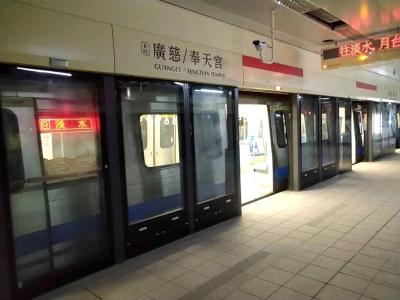
The eastern extension of the Taipei MRT Red Line could begin operations as early as late June, the Taipei Department of Rapid Transit Systems said yesterday. Taipei Rapid Transit Corp said it is considering offering one month of free rides on the new section to mark its opening. Construction progress on the 1.4km extension, which is to run from the current terminal Xiangshan Station to a new eastern terminal, Guangci/Fengtian Temple Station, was 90.6 percent complete by the end of last month, the department said in a report to the Taipei City Council's Transportation Committee. While construction began in October 2016 with an
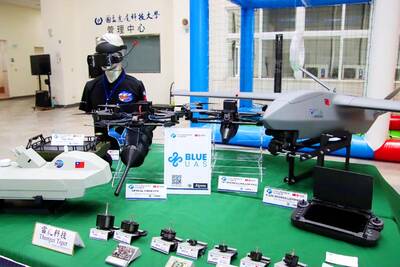
NON-RED SUPPLY: Boosting the nation’s drone industry is becoming increasingly urgent as China’s UAV dominance could become an issue in a crisis, an analyst said Taiwan’s drone exports to Europe grew 41.7-fold from 2024 to last year, with demand from Ukraine’s fight against Russian aggression the most likely driver of growth, a study showed. The Institute for Democracy, Society and Emerging Technology (DSET) in a statement on Wednesday said it found that many of Taiwan’s uncrewed aerial vehicle (UAV) sales were from Poland and the Czech Republic. These countries likely transferred the drones to Ukraine to aid it in its fight against the Russian invasion that started in 2022, it said. Despite the gains, Taiwan is not the dominant drone exporter to these markets, ranking second and fourth


 RSS
RSS