


The recent controversy surrounding the repainting of the Chinese Nationalist Party (KMT) emblem on Taipei’s historical East Gate sparked concerns over the government’s apparent attempts to sneak autocratic symbols onto historical sites.
The Taipei City Government drew criticism from the opposition camp last week by painting the KMT emblem on the East Gate, also known as Jingfumen (景福門), during its renovation.
The KMT emblem was to be painted on another two historical gates in Taipei City, including the South Gate and Little South Gate, but the city government halted restoration work following the East Gate controversy.
PROTEST
The uproar led Democratic Progressive Party (DPP) Taipei City councilors Chuang Ruei-hsiung (莊瑞雄), Huang Hsiang-chun (黃向群) and Liu Yao-ren (劉耀仁) to climb to the roof of the East Gate last week and splash white paint over the emblem in protest against what they called a “symbol of dictatorship.”
In its defense, Taipei City’s Department of Cultural Affairs said the emblems were carved and painted in 1966 by the former-KMT regime during a modification of the Qing Dynasty gates and the department was simply restoring the monuments accordingly.
Commenting on the controvery, architecture and historical sites expert Huang Fu-san (黃富三), a member of Taipei City’s Cultural Assets Review Committee, said the KMT emblem on the gates was a product of the party-state system under the KMT regime.
Huang said the Council of Cultural Affairs (CCA) was responsible for failing to identify the emblem when it designated the four gates as national monuments in 1998.
Lee Chiang-lang (李乾朗), a professor of architecture at Chinese Culture University, was on the central government’s cultural assets review committee when the four historical gates were designated as monuments.
He said the committee had originally planned to designate the North Gate as a national monument because it was the only gate that preserved its original Qing Dynasty structure.
RESTORATION
The East Gate, South Gate and the Little South Gate were reconstructed in ancient Chinese palace style after former dictator Chiang Kai-shek (蔣介石) and the KMT came to Taiwan, he said.
The committee later agreed that all four historical gates, which had played a vital role in shaping the old downtown Taipei, should be designated as national monuments.
Lee did not explain whether the committee knew about the KMT emblem on the gates and said the committee had not addressed the issue of the emblem when designating the gates as monuments.
Lee and Hsin Wan-chiao (辛晚教), both members of Taipei City’s Cultural Assets Review Committee, said the emblem was representative of the situation at the time it was added.
As such it should be preserved but the issue was debatable and that modifications were permissible if carried out legally, they said.
“The KMT emblem on the gates can serve as a reminder of the old KMT dictatorship and how the party forced its ideologies into people’s lives. Reflecting the situation at a particular time is one of the values of monuments,” Hsin said.
Chuang, on the other hand, insisted the KMT emblem should be removed because it was “smuggled” onto the monuments by the KMT, and condemned President Ma Ying-jeou’s (馬英九) administration for restoring it.
Aside from the East Gate incident, the city government was also slammed for hanging two pieces of Ma’s calligraphy on municipal monuments, violating the Culture Heritage Preservation Law (文化資產保存法).
The Datung Police District Office, formerly the 1930s Taipei North Police Station, was designated as a municipal monument for its well-preserved Western-style structure.
Taipei City’s Culture Department hung an inscription with a piece of calligraphy by Ma that reads “Taiwan New Culture Memorial Hall Preparatory Office” on the front door of the office in 2006, DPP Taipei City Councilor Chien Yu-yen (簡余晏) said.
CALLIGRAPHY
Earlier this year, Taipei City’s Department of Civil Affairs put another piece of Ma’s calligraphy in Taipei’s Confucius Temple. The inscription is below another that Chiang Kai-shek sent to the temple in 1950, she said.
“The Taipei City Government’s move is no different to the former KMT regime adding the party emblem on the gates. It showed the KMT government’s autocratic mindset,” she said.
Chien accused the city government of violating Article 30 of the law by damaging the appearance of the monuments.
She said the city government should fine itself before taking action against the DPP councilors for painting over the emblem.

UPGRADE: The Kang Ding-class frigate is replacing its Chaparall missiles with Tien Chien II and Hua Yang VLS, which would provide it with long-range, 360° air defense Taiwan plans to produce 1,200 to 1,376 Hai Chien II missiles (海劍二, Sea Sword II) — also known as TC-2N — to serve as the standard air defense system of the navy’s surface combatant fleet, a source said yesterday. Last week, the Hai Chien II, the naval version of the Tien Kung II missile (天劍二, Sky Sword II), completed a live-fire test in waters off the National Chungshan Institute of Science and Technology’s Jiupeng facility (九鵬) in Pingtung County’s Manjhou Township (滿州). The MIM72 Chaparral and other dated air defense missiles that currently arm Taiwanese ships have inadequate range to combat Chinese

REASONS FOR TRAVEL: An assistant professor said that proposed amendments to penalize drivers if they used drugs overseas would not deter people from traveling People who operate a motor vehicle under the influence of marijuana would have their driver’s license revoked, even if they used the substance while overseas, the Ministry of Transportation and Communications said yesterday, citing proposed amendments to the Road Traffic Management and Penalty Act (道路交通管理處罰條例). The amendments would also authorize the government to revoke the licenses of people determined to have used Category 1 or Category 2 narcotics, even if they were not operating a vehicle while under the influence of drugs, as well as ban them from taking the license test for three years, the ministry said. People aged 18 or
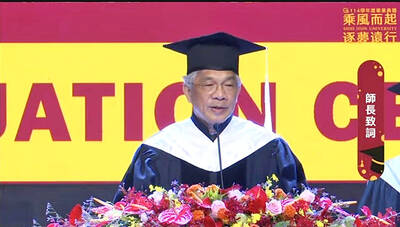
Shih Hsin University President Chen Ching-he (陳清河) yesterday issued a public apology for comments made in his commencement speech last week, stating that he has asked the school to suspend his duties and halt his wages for two months as a show of contrition. At the commencement ceremony on May 30, Chen said, “If you don’t manage your time well, or your own emotions, or your health, then I am telling every one of you — put a quick end to ‘you,’ because the world has no need for ‘you.’” The comments have sparked significant controversy online, and Chen through an open
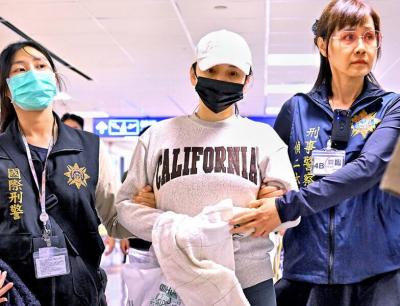
Johanne Liou (劉喬安), a Taiwanese woman who shot to unwanted fame during the Sunflower movement protests in 2014, returned to Taiwan last night after being deported from the US. She is to stand trial in Taiwan for charges involving embezzlement, fraud and drug crimes. The Criminal Investigation Bureau (CIB) said it took her into custody at Taiwan Taoyuan International Airport and would first question her before transferring her to the New Taipei District Prosecutors’ Office. She was arrested upon disembarking a flight from San Francisco that landed shortly before 7pm. Liou absconded to the US in 2019 after jumping bail


 RSS
RSS