


Former US ambassador Harvey Feldman, a giant within Washington’s tight community of China watchers and a good friend of Taiwan, died on Tuesday following emergency heart surgery.
“The people of Taiwan owe him a lot,” said Christopher Nelson, editor of the Nelson Report.
“Without Harvey there would have been no Taiwan Relations Act [TRA],” he said.
“Harvey was able to span the gulf between Congress and the administration, and to this day the TRA has played a central role in keeping peace in the region and safeguarding the rights of more than 20 million people on Taiwan,” he said.
Derek Scissors, a research fellow in the Asian Studies Center at the Heritage Foundation, where Feldman served as a distinguished fellow in China Policy, recalled his intellectual generosity.
At a recent roundtable debate on Asian policies, the two clashed over economic matters. At the height of the dispute, Feldman shared an insight that supported Scissors’ argument and made it more persuasive, even though it undercut his own point of view.
Feldman was known for his sharp sense of humor, sense of fun and enthusiasm.
Longtime colleague Jim Wolf said: “Harvey was a lofty spirit who took an almost impish delight in deflating those who thought they were high and mighty.”
Walter Lohman, director of the Asian Studies Center at Heritage said: “I’ll miss his advice and his passion for all things Taiwan. But most of all, I’ll just miss him — his wisecracking, tell-it-like-it-is, endearing self.”
Feldman worked for the American Foreign Service for more than 30 years, most of them as an East Asian specialist.
He served in Hong Kong for eight years, Taiwan for six and Japan for four.
As a member of the State Department’s Policy Planning Council, he helped plan late US president Richard Nixon’s first visit to China in 1972.
Later, he became director of the Office of the Republic of China Affairs and created the American Institute in Taiwan, which replaced the US embassy after relations were shifted to Beijing.
After serving as ambassador to Papua New Guinea and the Solomon Islands, Feldman was appointed an alternative US representative to the UN.
On retiring from the Foreign Service, Feldman spent a year as vice president of the Institute for East-West Security Studies, taught graduate seminars at New York University and became a partner in Global Business Access Ltd, a consulting firm formed by retired senior diplomats.
He joined the Heritage Foundation in 1996.
Feldman spoke Mandarin, Japanese and Bulgarian. He was the editor of two books, Taiwan in a Time of Transition and Constitutional Reform and the Future of China.
In a tribute delivered at Feldman’s funeral, Nelson — speaking for himself and professor Jim Przystup of the National Defense University — said: “In 1978, Harvey was the Republic of China desk officer at State, which meant that he was in charge of managing and safeguarding the official diplomatic relations between the United States and Taiwan.”
“His immediate boss was Dick Holbrooke, who was characteristically hell-bent on accomplishing his assigned task of ‘de-recognizing’ Taiwan,” he said.
“It was Harvey who helped conceive of the compromise which was hammered out between Congress and [former US president Jimmy Carter’s] administration, a piece of legislation called the Taiwan Relations Act,” he said. “If we were asked how to characterize Harvey’s role, we’d immediately say, without question there would have been no Taiwan Relations Act without him.”
“Carter and State would have just let the place go and certainly would never have agreed to a continued arms sales requirement,” Nelson said.
Feldman is survived by his wife, Laura Sherman, and three sons, Christopher, Peter and Alex.

REASONS FOR TRAVEL: An assistant professor said that proposed amendments to penalize drivers if they used drugs overseas would not deter people from traveling People who operate a motor vehicle under the influence of marijuana would have their driver’s license revoked, even if they used the substance while overseas, the Ministry of Transportation and Communications said yesterday, citing proposed amendments to the Road Traffic Management and Penalty Act (道路交通管理處罰條例). The amendments would also authorize the government to revoke the licenses of people determined to have used Category 1 or Category 2 narcotics, even if they were not operating a vehicle while under the influence of drugs, as well as ban them from taking the license test for three years, the ministry said. People aged 18 or

GLOBALGIVING: ‘ Caving to external pressure is not acceptable for an organization that has cultivated justice reform and human rights for 30 years,’ one NGO said A slew of non-government organizations (NGOs) have withdrawn from the GlobalGiving fundraising platform after it announced it would use “Chinese Taipei” instead of “Taiwan” from next month. The Taiwan Good Rice Association wrote on Facebook on Friday that it was informed on April 28 via a teleconference call of the change, which was made because the platform wanted to operate in China. Taiwan Good Rice is to terminate all cooperative relationships with GlobalGiving in response to the platform’s “unilateral and non-negotiable” decision to remove references to Taiwan, the NGO said. “Taiwan is in the official name of Taiwan Good Rice Association and the

HEAVY WEATHER: Typhoon Jangmi is due to crash straight into the Ryukyus as airlines look to shift flights to larger aircraft or cancel flights to Okinawa entirely Taiwan’s international air carriers announced flight adjustments over the weekend as Typhoon Jangmi is forecast to hit the Ryukyu Islands today and tomorrow. The Central Weather Administration (CWA) upgraded Jangmi from a tropical storm to a typhoon at 8am yesterday, with the eye located 580km south of Naha city. It was moving north at 19kph. Today, China Airlines’ CI-120, CI-121, CI-122 and CI-123 flights between Taoyuan and Naha, Okinawa, have been canceled as well as CI-132 and CI-133 between Kaohsiung and Naha. EVA Air’s BR-112, BR-113, BR-186 and BR-185 flights between Taoyuan and Naha are also canceled. Low-cost carrier Tigerair Taiwan canceled IT-230,
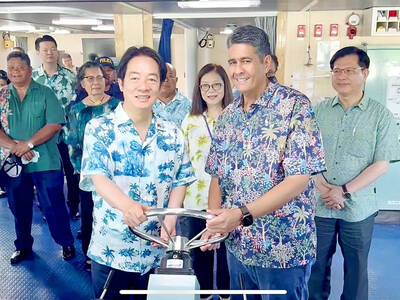
MULTIPRONGED APPROACH: China has sought to pressure Palau across a number of fronts, but the island nation has staunchly resisted overtures to ditch Taiwan Palau has been firm in backing Taiwan despite Chinese pressure that uses tourism economics, cyberattacks and criminal infiltration as tools to threaten the Pacific ally into renouncing its recognition of Taiwan as a sovereign state. The Presidential Office yesterday announced that Vice President Hsiao Bi-khim (蕭美琴) would visit Palau from Saturday to Wednesday next week at the invitation of Palauan President Surangel Whipps Jr. Whipps in April said in an interview that China had outspokenly asked Palau to “denounce Taiwan.” “And we have said: ‘We have no enemies, but nobody tells us who our friends are,’” he said. Whipps has told reporters multiple times


 RSS
RSS