


A breakthrough has shed light on the biological mystery of why there are so many different types of species in the world after the discovery of a “speciation” gene in budding yeast by Academia Sinica (AS) researcher Leu Jun-yi (呂俊毅), the academy announced yesterday.
Leu’s finding was published in the renowned journal Cell on Friday, it added.
Speciation is the process in which one type of organism evolves — most of the time because of environmental factors — into two or more different species, Leu said, adding that a speciation gene is one that is involved in such a process.
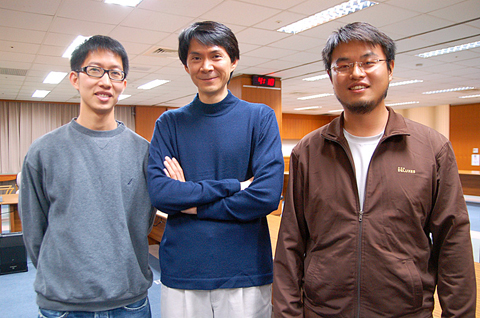
PHOTO: HSIEH WEN-HUA, TAIPEI TIMES
“The question we want to ask is, why are there so many different species in the world?” he said. “Like cars of different brands, although they look alike, they function differently. For example a Porsche runs faster than a Ford, but a Ford is more energy efficient ... [Similarly] we want to know why [this occurs in different species].”
One function of speciation genes is that after organisms evolve into different species to adapt to different environments, the speciation genes make sure that the resulting different species cannot be crossbred, Leu said. In other words, the genes maintain novel adaptations during evolution, because they lose proper functions when mixed with alleles from other species.
“An example is the horse and the donkey — although they look very similar, they produce mules, which are sterile ... There are other examples where the offspring die as fertilized eggs,” he said.
Without such function, the species may lose its characteristics vital for survival, Leu said.
“For example, if a fish was crossed with a dog, the resulting offspring may be a creature that cannot function well in water or on land,” he said.
Although the speciation gene concept was discovered more than 80 years ago by famous US geneticist Theodore Dobzhansky and Hermann Muller, few speciation genes have been identified in organisms to date, Leu said.
Recently, Leu’s team discovered a gene in two similar yeasts that makes their offspring sterile, which sheds light on how the mechanism of speciation takes place.
“When crossbred, the mitochondria [the “cellular power plant” that provides energy to cells] and the nucleus [control center] of cells in the yeast do not function properly,” Leu said.
Because one yeast relies on non-fermentable carbon sources for energy, while the other depends on fermentation, the discovery also provides support for Leu’s postulation that the mitochondria in different species evolved to be different because of the ways they consume energy, he said.
Asked how his discovery could impact the field of evolutionary biology, Leu said the influence is two-fold.
“Although speciation genes have been discovered before, we can provide a clear description how this particular speciation gene functions; this is because we have a strong database documenting the functions of genes in yeasts,” he said.
Leu added that as the approach his team took was very systematic, it provides a first step to potentially discovering a universal mechanism for speciation genes.
“We want to figure out whether other yeasts also use the [mitochondria mechanism] … We have a preliminary conclusion that some of them do; [if we confirm that], this mechanism can become a universal mechanism, instead of that for a single case,” he said.

FUKUOKA SITUATION: Japanese media reported that the pathogen is expected to be identified by the summer, while the CDC downplayed the idea that it was hMPV A “mysterious cold-like illness” reported in Japan’s Fukuoka Prefecture does not seem to be a new disease, but Japanese authorities have been asked about the situation, the Centers for Disease Control (CDC) said yesterday. The Fukuoka Prefectural Medical Association on Wednesday told a news conference that a “mystery cold” that has become a hot topic on social media is “highly likely to be caused by some kind of viral infection,” Japan’s KBC News reported. “Many people are experiencing symptoms starting with a sore throat, followed by a runny nose, phlegm and a severe cough,” KBC News reported, citing association officials. Health authorities are

Nvidia Corp CEO Jensen Huang (黃仁勳) arrived in Taiwan yesterday ahead of upcoming AI and technology events, saying he plans to meet with clients and Taiwan Semiconductor Manufacturing Co Chairman C.C. Wei (魏哲家) during his visit. After landing at Taipei Songshan Airport, Huang posed for photos with fans and handed out Yakult drinks to reporters and supporters waiting at the scene, saying he has “a lot to do” during the trip. Asked about reports that Nvidia’s planned headquarters site in Taipei’s Beitou Shilin Technology Park could break ground on May 27, Huang said that if the company holds an event, he would

The Ministry of Finance this afternoon announced the winning numbers for the March-April uniform invoice lottery. The winning number for the NT$10 million (US$318,060) special prize is 19531471, and the winning number for the NT$2 million grand prize is 85941329. Three numbers were drawn for the NT$200,000 first prize: 07225810, 20231230 and 83518781. Those with receipts matching the last seven digits of any of the first-prize numbers will win the NT$40,000 second prize, while those matching the last six digits will win the NT$10,000 third prize. Those whose receipts match the last five digits of the first-prize numbers can claim the NT$4,000 fourth prize,

SIX SUBSIDIES: The monthly allowance for older farmers is to increase to NT$10,000, and NT$5,000 is to be given to homemakers under the national pension system, Lai said The government is to implement major welfare policies for disadvantaged groups, including raising the monthly allowance for older farmers to NT$10,000 and providing homemakers with NT$5,000 per month, President William Lai (賴清德) said yesterday. Lai made the remarks during a visit to Wangling Temple in Chiayi County, saying that the planned increases were being introduced amid economic growth and an increase in tax revenue. Touting a policy, in which the government plans to provide a monthly allowance of NT$5,000 for every child under the age of 18 in a bid to address Taiwan’s low birthrate, Lai said that if received for the


 RSS
RSS