


US president-elect Barack Obama formally nominated the key players in his national security team on Monday, setting the stage for a continuation of the policies of US President George W. Bush’s administration toward China and Taiwan.
With his former rival Senator Hillary Clinton as secretary of state, Robert Gates continuing as secretary of defense and retired Marine General James Jones taking over as White House national security adviser — all predicted appointments — there were no signals of a significant policy change for Asia.
“I don’t see any change at all,” said John Tkacik, a senior research fellow in the Asian Studies Center at the Heritage Foundation, a Washington-based think tank.
Tkacik said he expected the new team to follow Bush administration polices, which are to encourage closer relations between China and Taiwan.
June Teufel Dreyer at the political science department at the University of Miami agreed.
“I don’t think the new team will do anything differently. President Ma [Ying-jeou 馬英九] is doing what they want him to do. They will just sit back and say ‘Atta-boy,’” she said.
“Actually, the strength of the Washington bureaucracy is such that it doesn’t make much difference who is president. The existing culture at the State Department and the CIA has a cement hold on policy,” she said.
Obama has said very little about Taiwan. A speech he made in the US Senate would indicate he supports the “status quo.”
After insisting the US should welcome China’s growing prominence and prosperity, Obama said: “At the same time, we must remain prepared to respond should China’s rise take a problematic turn. This means maintaining our military presence in the Asia-Pacific region, strengthening our alliances and making clear to both Beijing and Taipei that a unilateral change in the status quo in the Taiwan Strait is unacceptable.”
During her intense campaign against Obama for the Democratic presidential nomination, Clinton was accused of saying during a private conversation that the US would never go to war over Taiwan.
The Taiwan Relations Act requires the US to assist Taiwan in defending itself.
Questioned during the campaign, Clinton said she supported the policy of maintaining “ambiguity” over whether Washington would defend Taiwan in a conflict with China.
Following Ma’s election, Clinton issued a statement that said: “I would hope that cross-strait dialogue would be possible and will contribute significantly to a reduction of tensions in the Taiwan Straits [sic] and East Asia.”
“Meanwhile, I want to reaffirm my commitment to the longstanding relevant principles of American policy, including the Three Communiques and the Taiwan Relations Act,” she said.
As the holdover secretary of defense, Gates’ views are well known. During Senate confirmation hearings he said: “We should maintain our capabilities to resist China’s use of force or coercion against Taiwan and assist Taipei in maintaining its self-defense. China’s near-term focus is on generating sufficient combat power to rapidly erode Taiwan’s will to resist and to deter or deny effective intervention in a cross-strait conflict.”
Jones, who as national security adviser will personally brief the new president several times a day on the state of the world, is believed to echo the views of Gates, whose major assignment over the next year will be to begin a military pullout from Iraq.
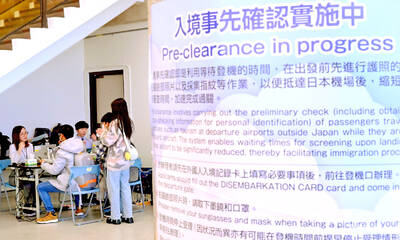
A preclearance service to facilitate entry for people traveling to select airports in Japan would be available from Thursday next week to Feb. 25 at Taiwan Taoyuan International Airport, Taoyuan International Airport Corp (TIAC) said on Tuesday. The service was first made available to Taiwanese travelers throughout the winter vacation of 2024 and during the Lunar New Year holiday. In addition to flights to the Japanese cities of Hakodate, Asahikawa, Akita, Sendai, Niigata, Okayama, Takamatsu, Kumamoto and Kagoshima, the service would be available to travelers to Kobe and Oita. The service can be accessed by passengers of 15 flight routes operated by
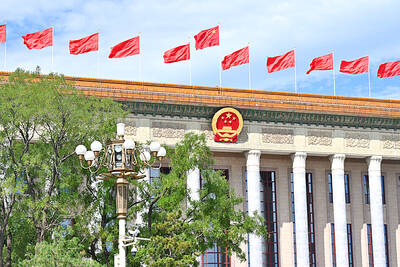
MORE FALL: An investigation into one of Xi’s key cronies, part of a broader ‘anti-corruption’ drive, indicates that he might have a deep distrust in the military, an expert said China’s latest military purge underscores systemic risks in its shift from collective leadership to sole rule under Chinese President Xi Jinping (習近平), and could disrupt its chain of command and military capabilities, a national security official said yesterday. If decisionmaking within the Chinese Communist Party has become “irrational” under one-man rule, the Taiwan Strait and the regional situation must be approached with extreme caution, given unforeseen risks, they added. The anonymous official made the remarks as China’s Central Military Commission Vice Chairman Zhang Youxia (張又俠) and Joint Staff Department Chief of Staff Liu Zhenli (劉振立) were reportedly being investigated for suspected “serious
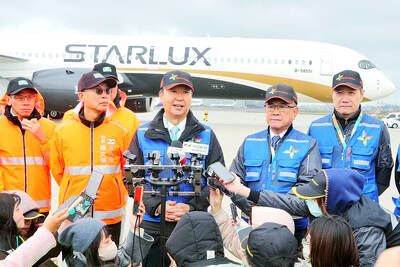
ENHANCING EFFICIENCY: The apron can accommodate 16 airplanes overnight at Taoyuan airport while work on the third runway continues, the transport minister said A new temporary overnight parking apron at Taiwan Taoyuan International Airport is to start operating on Friday next week to boost operational efficiency while the third runway is being constructed, the Ministry of Transportation and Communications said yesterday. The apron — one of the crucial projects in the construction of the third runway — can accommodate 16 aircraft overnight at the nation’s largest international airport, Minister of Transportation and Communications Chen Shih-kai (陳世凱) told reporters while inspecting the new facility yesterday morning. Aside from providing the airport operator with greater flexibility in aircraft parking during the third runway construction,
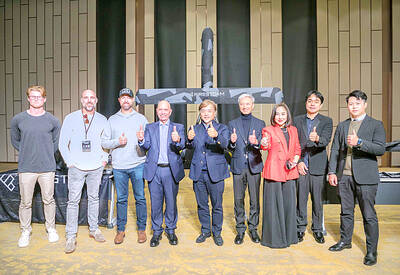
Taiwanese and US defense groups are collaborating to introduce deployable, semi-autonomous manufacturing systems for drones and components in a boost to the nation’s supply chain resilience. Taiwan’s G-Tech Optroelectronics Corp subsidiary GTOC and the US’ Aerkomm Inc on Friday announced an agreement with fellow US-based Firestorm Lab to adopt the latter’s xCell, a technology featuring 3D printers fitted in 6.1m container units. The systems enable aerial platforms and parts to be produced in high volumes from dispersed nodes capable of rapid redeployment, to minimize the risk of enemy strikes and to meet field requirements, they said. Firestorm chief technology officer Ian Muceus said


 RSS
RSS