


On Friday night, more than 1,000 people gathered outside the legislature, flashlights in hand. Encircling the legislature and shining their lights at the compound, they called on the country’s lawmakers to overhaul the Referendum Law (公民投票法).
The demonstrators were there in support of Tsai Ting-kuei (蔡丁貴), chairman of the Taiwan Association of University Professors (TAUP), who was on day seven of a hunger strike intended to call attention to what he said were fundamental problems with that law as well as the legislative election system.
“Hand in hand, protect civil rights,” the protestors chanted. “Amend the Referendum [Law]. Safeguard Taiwan.”
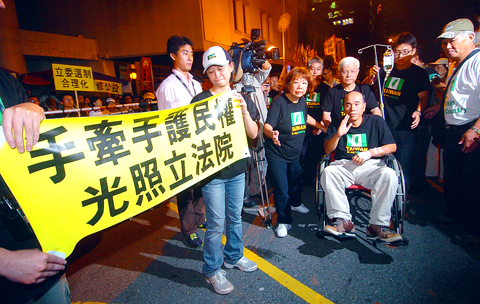
PHOTO: LO PEI-DER, TAIPEI TIMES
In an interview with the Taipei Times, Tsai said it was a “feeling of powerlessness” that led him to adopt the approach of a hunger strike.
OPPOSITION
Tsai decided to stage the hunger strike during the Oct. 25 rally organized by the Democratic Progressive Party (DPP) in opposition of the current administration’s cross-strait policies.
After the march ended, he began his hunger strike outside the legislature, without even telling his wife of his plan. Other TAUP members held a sit-in protest.
“I didn’t want to go home and wait for the next time I get a call to take to the streets again. The rally was a success but it was not enough, because the KMT always turns a deaf ear to us,” Tsai said.
“How much longer can we tolerate [President] Ma [Ying-jeou (馬英九)], who is about to capitulate to China?” he asked, referring to Ma’s statement that he hoped to sign a peace accord with China during his term.
AGREEMENT
As described by Ma in an interview with the India and Global Affairs quarterly, the peace agreement would come once economic relations with China have been normalized. This included normalizing direct air and sea links, which was on the agenda for the second round of cross-strait talks in Taipei this week.
In July, cross-strait charter flights were launched and the quota for Chinese tourists raised to 3,000 per day.
Tsai called Ma’s steps “clearly a timetable for Taiwan’s unification with China,” and added that this week’s visit by Association for Relations Across the Taiwan Strait Chairman Chen Yunlin (陳雲林) for the talks made amending the Referendum Law even more “imperative.”
The checks-and-balances system enshrined in the Constitution is being undermined, Tsai said, adding that the KMT had won an overwhelming majority in the legislature because of the “flaws” of the new electoral system, Tsai said.
CRITICISM
Tsai’s criticism centered on the “single district, two votes” system adopted for the legislative polls in January. Tsai said this resulted in disproportional results in terms of the population of each constituency compared with the votes received by each political party.
Under the new system, the KMT won 58.12 percent of the votes but won 81 seats of the legislature’s 113 seats, while the DPP’s 41.88 percent of the vote gave it just 27 seats.
Because of this imbalance, Tsai said the public must exercise its right to initiate referendums to veto Ma’s cross-strait policies, which he said were selling out national interests to Beijing.
The problem, he said, was that the plebiscite law was “toothless.”
Since the Referendum Law was promulgated in 2003, it has been dubbed a “birdcage” law by critics who said the thresholds for putting a referendum proposal on the ballot and passing it were excessively high.
To apply for a referendum, the signatures of 0.5 percent of all eligible voters in the most recent presidential election — approximately 80,000 — must be collected. An additional 5 percent of the population — appropriately 800,000 — must sign the petition before the referendum can be put to a vote.
For the results of the referendum to be considered valid, more than 50 percent of the electorate — approximately 8 million people — must vote on it.
“These unreasonable thresholds limit direct democracy and deprive the people of their right to decide the future of the country,” Tsai said.
Tsai’s voice was feeble.
During his hunger strike, he has only had water, refusing food, but has received intravenous nutrition.
The 60-year-old hydraulic engineering professor from National Taiwan University was sent to the hospital for a health examination after joining the 1,000 or so people at the rally in front of the legislature on Friday night in a wheelchair.
He then called off his hunger strike temporarily, and Wu Li-hui (吳麗慧), secretary-general of the TAUP, began her own.
Tsai promised to continue his hunger strike once his doctor allowed it, saying that he looked forward to seeing young and old people alike join in supporting reform.

UPGRADE: The Kang Ding-class frigate is replacing its Chaparall missiles with Tien Chien II and Hua Yang VLS, which would provide it with long-range, 360° air defense Taiwan plans to produce 1,200 to 1,376 Hai Chien II missiles (海劍二, Sea Sword II) — also known as TC-2N — to serve as the standard air defense system of the navy’s surface combatant fleet, a source said yesterday. Last week, the Hai Chien II, the naval version of the Tien Kung II missile (天劍二, Sky Sword II), completed a live-fire test in waters off the National Chungshan Institute of Science and Technology’s Jiupeng facility (九鵬) in Pingtung County’s Manjhou Township (滿州). The MIM72 Chaparral and other dated air defense missiles that currently arm Taiwanese ships have inadequate range to combat Chinese

REASONS FOR TRAVEL: An assistant professor said that proposed amendments to penalize drivers if they used drugs overseas would not deter people from traveling People who operate a motor vehicle under the influence of marijuana would have their driver’s license revoked, even if they used the substance while overseas, the Ministry of Transportation and Communications said yesterday, citing proposed amendments to the Road Traffic Management and Penalty Act (道路交通管理處罰條例). The amendments would also authorize the government to revoke the licenses of people determined to have used Category 1 or Category 2 narcotics, even if they were not operating a vehicle while under the influence of drugs, as well as ban them from taking the license test for three years, the ministry said. People aged 18 or
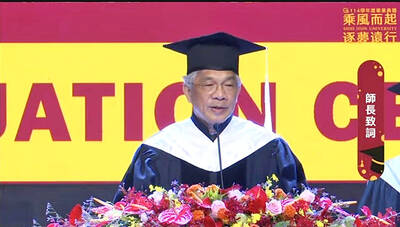
Shih Hsin University President Chen Ching-he (陳清河) yesterday issued a public apology for comments made in his commencement speech last week, stating that he has asked the school to suspend his duties and halt his wages for two months as a show of contrition. At the commencement ceremony on May 30, Chen said, “If you don’t manage your time well, or your own emotions, or your health, then I am telling every one of you — put a quick end to ‘you,’ because the world has no need for ‘you.’” The comments have sparked significant controversy online, and Chen through an open
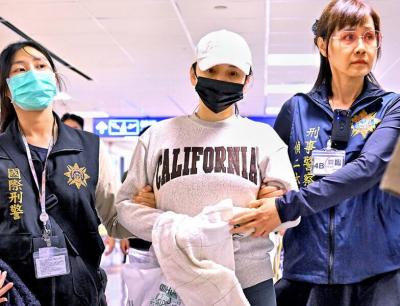
Johanne Liou (劉喬安), a Taiwanese woman who shot to unwanted fame during the Sunflower movement protests in 2014, returned to Taiwan last night after being deported from the US. She is to stand trial in Taiwan for charges involving embezzlement, fraud and drug crimes. The Criminal Investigation Bureau (CIB) said it took her into custody at Taiwan Taoyuan International Airport and would first question her before transferring her to the New Taipei District Prosecutors’ Office. She was arrested upon disembarking a flight from San Francisco that landed shortly before 7pm. Liou absconded to the US in 2019 after jumping bail


 RSS
RSS