


Prosecutors yesterday questioned former presidential adviser Wu Li-pei (吳澧培) as a witness to learn details about money wired to him by former president Chen Shui-bian (陳水扁), who is under investigation for alleged money laundering.
On Wednesday, Chen said he had donated US$1.91 million to “someone of great seniority” to be used to promote Taiwan’s diplomatic relations.
In an interview with the Chinese-language Liberty Times (the Taipei Times’ sister paper) on Thursday, Wu said that Chen contacted him in February and said he was willing to provide capital “to help do something toward the expansion of Taiwan’s diplomatic relations.”
Wu said he then gave Chen four bank account numbers, under two different names with two accounts each. None of the accounts were in Wu’s name, but Wu said he had access to the accounts.
Chen Yun-nan (陳雲南), spokesman for the Special Investigation Panel of the Supreme Prosecutors’ Office, said yesterday that the prosecutors had interviewed Wu to learn more about the matter.
“Since the timing of the transfer is close to when the former head of the Ministry of Justice’s Investigation Bureau Yeh Sheng-mao (葉盛茂) allegedly leaked information to Chen on the money-laundering investigation, prosecutors would like to learn the origin of the funds and the transfer,” Chen Yun-nan said.
Yeh stands accused of covering up and warning the former president that a foreign anti-money laundering organization was investigating alleged money-laundering by his family.
During the questioning yesterday, Chen Yun-nan said that Wu was very cooperative and authorized the prosecutors to investigate the four overseas accounts.
Wu, a long-time independence advocate, said in the interview with the Liberty Times that he and the former president met at Chen’s official residence on Feb. 3. Wu said the former president told him he wanted to build a network of people friendly to Taiwan or to facilitate future foreign visits. Wu said he was very moved by this gesture and therefore agreed to do what he had been asked.
Wu said he received information from an overseas bank on Feb. 22 saying that US$1.91 million had been deposited.
The former president was implicated when the Next Magazine weekly reported on Aug. 13 that the former first family had transferred large sums of money abroad and might be engaged in money laundering.
The former president admitted the following day that his wife had wired family funds abroad without his knowledge, but insisted that all the money was clean.
Chen Shui-bian said the money was the remaining balance from political contributions for his two mayoral and two presidential bids between 1993 and 2004.
Chen Shui-bian is also under investigation for alleged embezzlement of public funds by using other people’s receipts for reimbursements from his “state affairs fund.” He said he is his innocent and said that he didn’t use a dime from the discretionary “state affairs fund” to line his own pocket.
ADDITIONAL REPORTING BY CNA
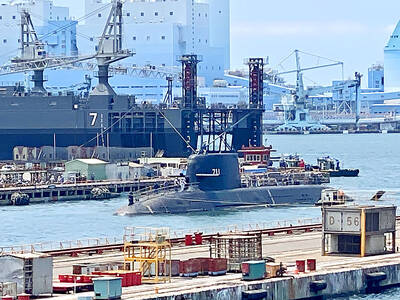
AGING: While Japan has 22 submarines, Taiwan only operates four, two of which were commissioned by the US in 1945 and 1946, and transferred to Taiwan in 1973 Taiwan would need at least 12 submarines to reach modern fleet capabilities, CSBC Corp, Taiwan chairman Chen Cheng-hung (陳政宏) said in an interview broadcast on Friday, citing a US assessment. CSBC is testing the nation’s first indigenous defense submarine, the Hai Kun (海鯤, Narwhal), which is scheduled to be delivered to the navy next month or in July. The Hai Kun has completed torpedo-firing tests and is scheduled to undergo overnight sea trials, Chen said on an SET TV military affairs program. Taiwan would require at least 12 submarines to establish a modern submarine force after assessing the nation’s operational environment and defense
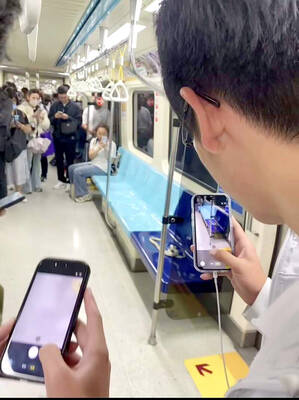
A white king snake that frightened passengers and caused a stir on a Taipei MRT train on Friday evening has been claimed by its owner, who would be fined, Taipei Rapid Transit Corp (TRTC) said yesterday. A person on Threads posted that he thought he was lucky to find an empty row of seats on Friday after boarding a train on the Bannan (Blue) Line, only to spot a white snake with black stripes after sitting down. Startled, he jumped up, he wrote, describing the encounter as “terrifying.” “Taipei’s rat control plan: Release snakes on the metro,” one person wrote in reply, referring
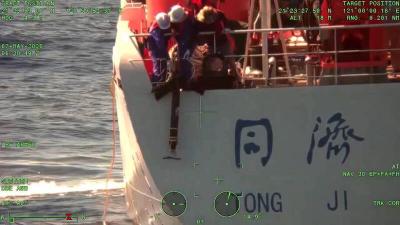
The coast guard today said that it had disrupted "illegal" operations by a Chinese research ship in waters close to the nation and driven it away, part of what Taipei sees a provocative pattern of China's stepped up maritime activities. The coast guard said that it on Thursday last week detected the Chinese ship Tongji (同濟號), which was commissioned only last year, 29 nautical miles (54km) southeast of the southern tip of Taiwan, although just outside restricted waters. The ship was observed lowering ropes into the water, suspected to be the deployment of scientific instruments for "illegal" survey operations, and the coast
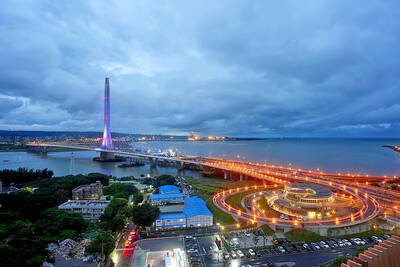
An inauguration ceremony was held yesterday for the Danjiang Bridge, the world’s longest single-mast asymmetric cable-stayed bridge, ahead of its official opening to traffic on Tuesday, marking a major milestone after nearly three decades of planning and construction. At the ceremony in New Taipei City attended by President William Lai (賴清德), Premier Cho Jung-tai (卓榮泰), Minister of Transportation and Communications Chen Shih-kai (陳世凱) and New Taipei City Mayor Hou Yu-ih (侯友宜), the bridge was hailed as both an engineering landmark and a long-awaited regional transport link connecting Tamsui (淡水) and Bali (八里)


 RSS
RSS