


The Chinese Nationalist Party (KMT) caucus will thoroughly discuss Premier Liu Chao-shiuan’s (劉兆玄) nomination list of National Communications Commission (NCC) members before the legislature votes on the nominees on Friday, KMT caucus whip Lin Yi-shih (林益世) said yesterday.
Asked for comment, Lin said the caucus would hold a meeting to decide whether to support the nominees after evaluating their performance during the question-and-answer sessions in today’s Education and Culture Committee meeting.
Lin said that so far he had not heard of any complaints regarding the nominees’ qualifications.
Liu submitted a list of seven NCC nominees to the Legislative Yuan on July 1.
The Organic Law of the National Communications Commission (國家通訊傳播委員會組織法) stipulates that the nominees must be approved by the legislature.
Approached for comment, KMT Legislator Hung Hsiu-chu (洪秀柱), a member of the Education and Culture Committee, said the list was imperfect as none of the nominees specialized in information science.
Of the candidates, Hsieh Chin-nan (謝進男) was the only incumbent NCC member to be renominated, while Liu Chorng-jian (劉崇堅), a professor of economics at National Taipei University, was the only nominee affiliated with a political party. Liu is a member of the KMT.
The other nominees included Weng Hsiao-ling (翁曉玲), an associate professor of law at the Institute of Law for Science and Technology at National Tsing Hua University, Chen Cheng-tsang (陳正倉), a professor of economics at National Taiwan University, Lee Ta-sung (李大嵩), an electrical engineering professor at National Chiao Tung University, Chung Chi-hui (鍾起惠), director of the journalism department at Shih Hsin University and Bonnie Peng (彭芸), a professor of journalism at National Chengchi University.
In comparison with their predecessors, most of the nominees were relatively unknown to the public.
Media organizations, however, have raised questions with Liu’s qualifications. Aside from being a professor at National Taipei University, Liu was secretary-general of the Taiwan Telecommunication Industry Development Association.
The association members include all the major telecoms operators in Taiwan, including Chunghua Telecom, Taiwan Mobile and FarEastone Telecommunications.
The chairmen of these companies take turns as chairman of the association.
Liu did not resign from the position until the end of last month, when the association was scheduled to select new administrative staff.
Last year, when the NCC held a series of seminars to help it draft the nation’s first telecommunications law, Liu participated in every one of them and actively spoke on behalf of the association.
Asked for comment on the nominees, NCC spokesman Howard Shyr (石世豪) said on Thursday that it was not surprising for Hsieh to have once again been nominated, given his remarkable contributions in ensuring broadband connections to every village around the country.
As to any controversy Liu’s candidacy could generate, Shyr was reluctant to comment and simply said the commission would ensure that the changeover would be smooth.
Hung Chen-ling (洪貞玲), a spokesperson of the Campaign for Media Reform, said that aside from the two journalism professors, the rest of the nominees were unknowns.
“We cannot ascertain how involved they are in terms of the fields they represent,” she said.
Hung said that their only concern was that the nominees might side more closely with corporations than citizen groups and would therefore be more likely to advocate corporate interests side with the interests of the public.
Hung said lawmakers should turn the deliberations into a comprehensive qualification review session.
Candidates would be challenged by various questions, from where they stand on certain telecommunication policies to how they plan to solve the issues with drafted telecommunication law, she said.
Last month, the Citizen’s Coalition for Media Reform asking the government to establish a “reverse” revolving-door policy that would bar anyone who has held positions in the private sector relevant to administration’s business from becoming a NCC commissioner within three years of their having those jobs.
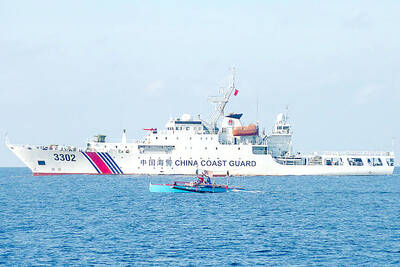
EXPANSIONIST: China deploys an average of 40 to 50 warships and coast guard vessels daily in the South China Sea, despite pledges not to militarize the region, an official said China is attempting to expand its influence across the First Island Chain and increase pressure on Japan by sending coast guard vessels into waters off of Taiwan under the pretext of maritime negotiations with Japan and the Philippines, a national security official said yesterday. China’s recent actions in the waters east of Taiwan and Japan and the Philippines’ exclusive economic zones (EEZ) are attempts to establish dominance in First Island Chain waters, said the official who declined to be named, adding that this is “expansion disguised as law enforcement.” Framing China’s actions solely as a cross-strait issue is a serious misjudgment that
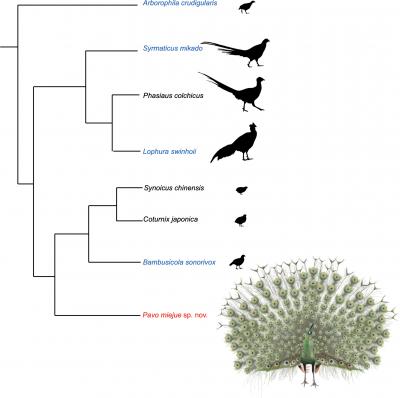
Through analyzing fossil evidence, a research team at National Taiwan University (NTU) discovered the largest endemic bird to have lived in Taiwan, naming it Pavo miejue, or extinct peafowl (滅絕孔雀). The Mikado pheasant, which is printed on the back of the NT$1,000 bank note, was previously believed to be the biggest endemic bird to Taiwan. The research team’s findings suggest that Pavo miejue lived during the Pleistocene epoch tens of thousands of years ago. It is the first endemic extinct bird species discovered and formally named in Taiwan. The study was coauthored by NTU Institute of Ecology and Evolutionary Biology professor Tsai Cheng-hsiu (蔡政修),
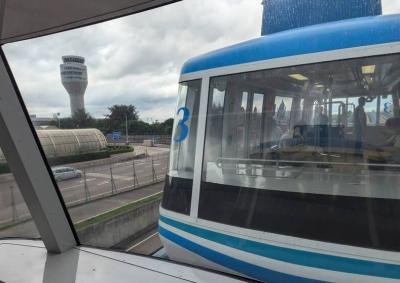
Taiwan Taoyuan International Airport is to suspend its automated Skytrain service connecting Terminal 1 and Terminal 2 starting on July 1 to facilitate connection works for the upcoming Terminal 3, the airport operator said today. Passengers and staff who need to travel between the two terminals after the suspension can instead use the Taoyuan MRT or the airport's 24-hour shuttle bus service, Taoyuan International Airport Corp said. The Taoyuan MRT Airport Line directly links the two terminals, while the shuttle buses are to operate around the clock, the company added. The Skytrain provides free transportation between the airport’s two terminals for travelers and
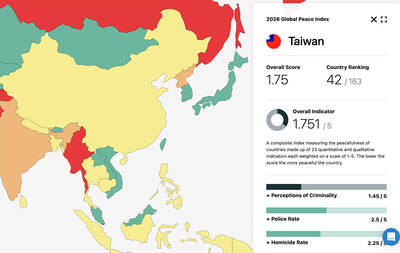
Taiwan ranked 42nd in terms of peacefulness among 163 countries, down five places from last year, according to this year’s Global Peace Index. With an overall score of 1.751, Taiwan dropped from 37th last year, the report published by the global Institute for Economics and Peace showed. The overall score measures a country’s level of peacefulness using 23 quantitative and qualitative indicators across three domains — ongoing domestic and international conflict, societal safety and security, and militarization. While Taiwan ranked 42nd worldwide, it was listed in ninth place among the 19 Asian-Pacific countries in the report, after New Zealand, Singapore, Japan, Malaysia,


 RSS
RSS