


It has been 20 years since the ban on new newspapers was lifted, but the press still fails to serve as defenders of the public interest as they are dependent on the state, advertisers, businesses or their owners, media experts said yesterday.
In 1951, the former Chinese Nationalist Party (KMT) government imposed strict restrictions on the registration of newspapers, magazines and news agencies, "to forbid dissidents from owning presses," said Lin Lih-yun (
Not until Jan. 1, 1988, was the ban rescinded, a year after the lifting of martial law.
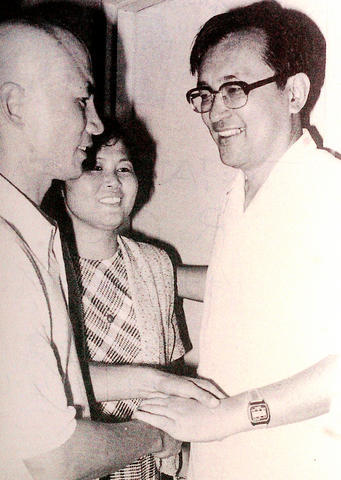
PHOTO: WANG MIN-WEI, LIBERTY TIMES
The ban included restrictions on applications for the registration of a newspaper, a limited number of pages in a newspaper and the stipulation that a newspaper must be printed and published in the place where the application for its registration was submitted, Lin said.
The ban was implemented by the Taiwan Garrison General Headquarters -- the security institution responsible for administering martial law. In addition to written rules, more pressure came in the form of background checks on reporters and monitoring of their every word and deed.
EYE ON THE MEDIA
"To control media reports, not only did the Taiwan Garrison publicly set up news offices in each newspaper, its agents were asked to report back on what journalists had said or done at any time," said Chen Shun-shaw (陳順孝), a journalism lecturer at Fu Jen Catholic University.
Huang Yi (
"Regardless of their beat -- politics, society, judiciary or whatever, a reporter's name was quickly added to a list at the headquarters if they ever cast doubt on the government ... and some reporters were put in jail for no reason in the 1950s," Huang said.
Huang said that as a result, "It's fair to say that there lived an invisible Taiwan Garrison in every reporter's mind. If you wanted to keep your job, you had to speak and act cautiously."
A good example of the treatment was the transfer of Antonio Chiang (
The restrictions contributed to the emergence of various dangwai magazines during the process of democratization, Huang said, adding: "The most important mission of the dangwai magazines was to show the public the stories that weren't allowed to be published in newspapers."
Lin described the link between the newspapers and the KMT regime as "patron-client relationships" while the ban was in effect.
During the era, there were 20 privately owned and 11 state-owned newspapers, with the two biggest -- the Chinese-language United Daily News and the China Times -- together occupying two-thirds of the market in terms of advertising and circulation.
"Almost all owners of private newspapers were affiliated with the ruling clan. Being given charters, the newspapers went along and become government mouthpieces," Lin said.
The most famous instance of media control was the coverage of the Lin family murders (
The China Times ran a story quoting the twin's older sister Lin Huan-chin (
Huang said that Yu Chi-chung (
"No matter what kind of stories were published at that time, they reflected the ruling group's political intentions," she said. "To create an impression that the murder was committed by Lin I-hsiung's pro-independence comrades and not the KMT, the newspapers made up many groundless stories."
The industry has flourished since the lifting of the restrictions in 1988, with the number of newspapers jumping to 360 within a year, followed by the subsequent opening up of television channels.
SLOW TO CHANGE
Hsieh San-tai
Hsieh recalled how when taking a photo of Soong Hsin-lian (宋心濂), then chief of the National Security Bureau, at a KMT party convention late 1980s, Soong's bodyguards suddenly headed straight towards him, snatched his camera and took away his negatives.
"It was the first time Soong had made a public appearance and it was newsworthy to let readers know what the head of the intelligence agency looked like, but I was then placed under strict surveillance for the remainder of the event," Hsieh said.
Although the newspaper restrictions were lifted in 1988, the Publication Law (出版法) was not repealed until Jan. 12, 1999.
The Publication Law contained provisions imposing various forms of punishment on publications for breaches of the regulations. In a 1958 amendment, a provision that empowered the government to revoke the registration of a publication was added to the law.
"With the progress of democratization, the government's power over newspapers is fading away, but newspapers are now subject to the political and commercial interests of their owners," said Lu Tung-hsi (呂東熹), deputy manager of the News Department of Taiwan Public Television Service.
Chen said that the degree advertising clients can influence the newspapers is "comparable" to the restriction period.
"It often happens that advertisers ask newspapers to omit news that is unfavorable to their enterprises or run stories advantageous to them by threatening to withdraw their advertising," Chen said.
What's worse, he said, is that newspapers often publish stories which have little to do with the public interest and are actually promotional ads so they can earn a sum of money in return, a deal known as "product placement."
It's a regrettable thing that once there were media personnel who showed bravery in the face of totalitarianism, only to start bowing to advertiser pressure, Chen said.
Huang said that not only do businesses try to take command of newspapers by using product placement, "the government has also learned how to use the method to control the press."
Just because no special laws and regulations restricting newspapers exist after the abolishment of the Publication Law doesn't mean that newspapers are independent from the state, as political power takes different forms in newspapers, Huang said.
"Aside from product placement, the government financially supports several major newspapers," Huang said, adding that her comments were based on research by lawmakers.
Reviewing the influence of the 37-year-long restrictions on the development of newspapers in the country, Lin Lih-yun said that the result is that "Newspapers failed to raise public awareness on a number of issues related to social concerns."
`READER-CENTERED'
Before the publication of the Chinese-language Apple Daily, from Hong Kong, the country's traditional newspapers never took a "reader-centered approach," Lin Lih-yun said.
Lin Lih-yun said that the main problem was that the owners of newspapers always "put their ideological positions ahead of professional journalism," especially when it comes to political news, because they believe that "only by doing so can they retain their readership."
"But what happens is that when newspapers lose their objectivity, they lose more readers," she said.
For the Apple Daily, Lin Lih-yun said that although it cares more about what readers want than other newspapers, it treats newspapers like a "commodity" and believes that only the stories that readers prefer to read are newsworthy and thus doesn't focus on serious issues.
Lin Lih-yun suggested the government establish an environment that would foster relatively small newspapers.
For example, she said, the government could start a public circulation network, which in a market dominated by the several large newspapers could ensure the pluralism of opinion, she said.

The Ministry of Finance this afternoon announced the winning numbers for the March-April uniform invoice lottery. The winning number for the NT$10 million (US$318,060) special prize is 19531471, and the winning number for the NT$2 million grand prize is 85941329. Three numbers were drawn for the NT$200,000 first prize: 07225810, 20231230 and 83518781. Those with receipts matching the last seven digits of any of the first-prize numbers will win the NT$40,000 second prize, while those matching the last six digits will win the NT$10,000 third prize. Those whose receipts match the last five digits of the first-prize numbers can claim the NT$4,000 fourth prize,

SIX SUBSIDIES: The monthly allowance for older farmers is to increase to NT$10,000, and NT$5,000 is to be given to homemakers under the national pension system, Lai said The government is to implement major welfare policies for disadvantaged groups, including raising the monthly allowance for older farmers to NT$10,000 and providing homemakers with NT$5,000 per month, President William Lai (賴清德) said yesterday. Lai made the remarks during a visit to Wangling Temple in Chiayi County, saying that the planned increases were being introduced amid economic growth and an increase in tax revenue. Touting a policy, in which the government plans to provide a monthly allowance of NT$5,000 for every child under the age of 18 in a bid to address Taiwan’s low birthrate, Lai said that if received for the
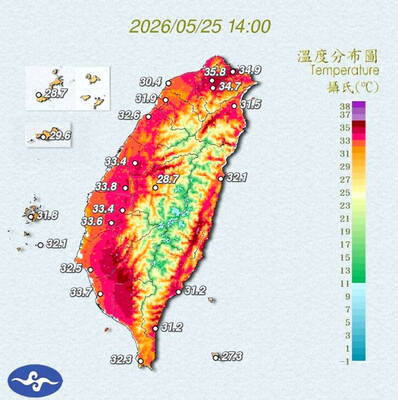
STAY COOL: The HPA recommended that people stay hydrated, use air-conditioning or fans while indoors, wear loose-fitting clothes and walk in the shade while outdoors Employers must implement measures such as installing cooling equipment, and providing drinking water and rest breaks for outdoor workers starting from Monday next week, the Taipei Department of Labor said on Sunday. Employers who fail to comply could face fines of NT$30,000 to NT$300,000 under the Occupational Safety and Health Act (職業安全衛生法), the department said. Businesses in Taipei employing fewer than 100 workers, as well as registered self-employed workers with labor insurance coverage, could receive on-site assessments and guidance from occupational safety consultants to help them apply for central government subsidies to implement or improve heat-protection measures, it said. Under the Ministry of
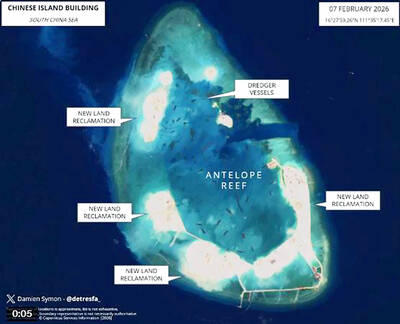
ISOLATION: The outposts would serve as support and backup bases, forcing US forces to either face China head-on or reroute, increasing travel time and operational costs China’s outposts in the South China Sea could be used to delay and constrain foreign forces during a conflict in the Taiwan Strait, giving Beijing a critical window to carry out amphibious landing and blockade operations, a report said. The Chinese Communist Party’s (CCP) forward operating bases on islands and reclaimed features in the South China Sea could delay foreign forces long enough for the Chinese People’s Liberation Army (PLA) to secure a key 48-to-72-hour window in the Taiwan Strait, a report commissioned by the Mainland Affairs Council found. The report, conducted by the Institute for National Defense and Security Research, examined


 RSS
RSS