


Representatives of the Taiwan Environmental Protection Union (TEPU) yesterday took an appeal to the Presidential Office, alleging a weather radar in Chiku Township (七股), Tainan County, was causing a high rate of mental retardation and other illnesses in the area.
Accompanied by alleged victims of the electromagnetic waves emitted by the Doppler weather radar station in Yencheng Village (
The Doppler radar station was built in 2001 and is one of four such stations in the country. The bureau's Weather Integration and Nowcasting System (WINS) employs Doppler radar both to monitor and predict precipitation.
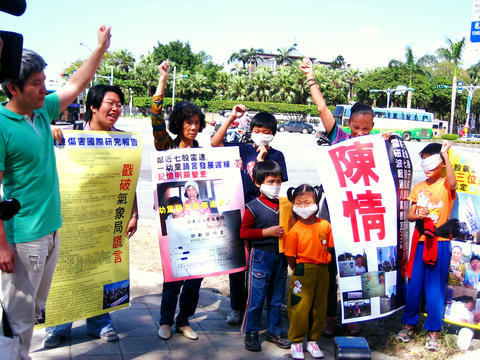
PHOTO: MEGGIE LU, TAIPEI TIMES
A woman surnamed Chang (張), whose six-year-old granddaughter was diagnosed with severe mental retardation (MR) this month, attended the appeal. Chang's granddaughter is the third in the family to be diagnosed with MR after Chang's two youngest sons received the same diagnosis, Chen said.
Chen said that medical tests had revealed no genetic predisposition in the family for MR, while lead poisoning and radioactive contamination in the area had also been ruled out.
Chen said that, in addition to MR cases, the village had also seen an increase in the incidence of hearing loss, brain damage and cancer since the installment of the radar station.
She cited 12 articles by international scientists to support her claim that radioactivity in residential areas is harmful to human health.
Chen said National Taiwan University and the Industrial Technology Research Institute had measured the electromagnetic waves in the village at 4,027 and 84,200 microwatts per square meter respectively. A report by US scientist S. Amy Sage last month suggested that levels above 1,000 microwatts per square meter be avoided for health reasons.
After meeting a Presidential Office representative, Chen said the the staffer had promised to relay the group's appeal to the president.
In addition to the appeal, Chiku residents demonstrated yesterday against the radar's presence in their community.
The weather bureau said in a press release later yesterday that the research TEPU had cited concerned low-frequency electromagnetic waves, microwaves and handheld radar, adding that Doppler waves are different.
In addition, the radar is perched 30m above the ground, it said, adding that since the installment of the station in 2001, the bureau has employed independent agencies to test electromagnetic levels on five occasions.
The most recent electromagnetic test, conducted by the Environmental Protection Agency (EPA), was completed last week, the statement said, adding that electromagnetic waves were measured at 25,200 microwatts per square meter directly around the radar and 10,200 microwatts per square meter near the closest residency. The release said this was 0.1 percent to 0.25 percent of the EPA's safety limit.

The Centers for Disease Control (CDC) yesterday reported the first case of a new COVID-19 subvariant — BA.3.2 — in a 10-year-old Singaporean girl who had a fever upon arrival in Taiwan and tested positive for the disease. The girl left Taiwan on March 20 and the case did not have a direct impact on the local community, it said. The WHO added the BA.3.2 strain to its list of Variants Under Monitoring in December last year, but this was the first imported case of the COVID-19 variant in Taiwan, CDC Deputy Director-General Lin Ming-cheng (林明誠) said. The girl arrived in Taiwan on

South Korea is planning to revise its controversial electronic arrival card, a step Taiwanese officials said prompted them to hold off on planned retaliatory measures, a South Korean media report said yesterday. A Yonhap News Agency report said that the South Korean Ministry of Foreign Affairs is planning to remove the “previous departure place” and “next destination” fields from its e-arrival card system. The plan, reached after interagency consultations, is under review and aims to simplify entry procedures and align the electronic form with the paper version, a South Korean ministry official said. The fields — which appeared only on the electronic form

The Ministry of Foreign Affairs (MOFA) is suspending retaliation measures against South Korea that were set to take effect tomorrow, after Seoul said it is updating its e-arrival system, MOFA said today. The measures were to be a new round of retaliation after Taiwan on March 1 changed South Korea's designation on government-issued alien resident certificates held by South Korean nationals to "South Korea” from the "Republic of Korea," the country’s official name. The move came after months of protests to Seoul over its listing of Taiwan as "China (Taiwan)" in dropdown menus on its new online immigration entry system. MOFA last week

A bipartisan group of US senators has introduced a bill to enhance cooperation with Taiwan on drone development and to reduce reliance on supply chains linked to China. The proposed Blue Skies for Taiwan Act of 2026 was introduced by Republican US senators Ted Cruz and John Curtis, and Democratic US senators Jeff Merkley and Andy Kim. The legislation seeks to ease constraints on Taiwan-US cooperation in uncrewed aerial systems (UAS), including dependence on China-sourced components, limited access to capital and regulatory barriers under US export controls, a news release issued by Cruz on Wednesday said. The bill would establish a "Blue UAS


 RSS
RSS