


While some pet owners say that they love their pets like children and treat them accordingly, animal rights activists criticize too much pet-pampering as wasteful and even detrimental to relationships between pets and humans.
Tsai Ming-chih (
"My wife and I never got to leave the country at the same time after we got married because we didn't want to leave our dogs behind in a kennel," he said. "In the end, we decided to take our dogs along with us to Japan instead."
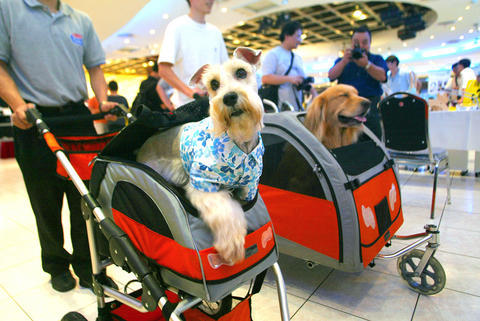
PHOTO: CNA
Although the five-day, four-night trip did not come cheap at NT$60,000 per person plus NT$15,000 per dog, not including the dog's transportation fees at NT$250 per kilogram. Tsai says that his customers are willing to pay for the experience.
"It's not just a holiday where you get to take your dog along," he said. "The whole trip is focused on the dog, and they have more fun than their owners."
Dogs are considered honored guests at specialized pet hotels and other businesses in Japan, according to Tsai.
"The dogs have their own swimming pools and their meals are as carefully prepared as their owners'," said Tsai. "During the day we might take the dogs to theme parks catering specifically to dogs."
There's nothing his customers won't do for their "canine children," Tsai said. He cited two women who went on his tours with their four daschunds.
"They are both quite busy with their careers during the week, so they have a Filipina maid just to take care of the dogs and prepare their meals," said Tsai.
"I've never had a customer with kids," said Tsai. "We find them quite like-minded with us in this respect -- their dogs are treated like their children."
At this weekend's Aqua and Pet Show, owners of rabbits, cats, pigs, flying squirrels as well as many different varieties of dogs brought their pets along to the third hall of the Taipei World Trade Center.
Many of the smaller pets were carried in bags or pushed around in pet strollers.
"It's a practical choice when the ground is muddy or my yorkshire terrier is tired," said one prospective buyer.
According to Amos Lin (
The best-selling stroller was available at the show for NT$3,990, said Lin.
However, Sean McCormack, the founder of Animals Taiwan, a stray rescue organization, groaned at the idea of dogs being treated as substitute children or being pushed around in strollers.
"The more you treat a dog like a person, the more behavioral problems you're going to get," he said.
"I think it's great that dogs are increasingly considered a part of the family in Taiwan, but they still need to be treated as dogs, not toys and not children," McCormack said, "The dogs we have the most problems with [at Animals Taiwan] are always the little dogs who might have been carried around in a handbag all their lives."
"The happiest dogs are the ones who are walked every day and allowed to interact with their environment -- not kept at home or pushed around in a pet buggy," he said.
For animal lovers with the extra cash to spend, McCormack suggests using the money to neuter the animals, or donating to animal welfare organizations so that more animals can be cared for.
"For NT$1,000, we could neuter a male dog. For NT$2,000 we could spay a female dog or fix a dog with a broken leg," he said.

The Ministry of Finance this afternoon announced the winning numbers for the March-April uniform invoice lottery. The winning number for the NT$10 million (US$318,060) special prize is 19531471, and the winning number for the NT$2 million grand prize is 85941329. Three numbers were drawn for the NT$200,000 first prize: 07225810, 20231230 and 83518781. Those with receipts matching the last seven digits of any of the first-prize numbers will win the NT$40,000 second prize, while those matching the last six digits will win the NT$10,000 third prize. Those whose receipts match the last five digits of the first-prize numbers can claim the NT$4,000 fourth prize,

SIX SUBSIDIES: The monthly allowance for older farmers is to increase to NT$10,000, and NT$5,000 is to be given to homemakers under the national pension system, Lai said The government is to implement major welfare policies for disadvantaged groups, including raising the monthly allowance for older farmers to NT$10,000 and providing homemakers with NT$5,000 per month, President William Lai (賴清德) said yesterday. Lai made the remarks during a visit to Wangling Temple in Chiayi County, saying that the planned increases were being introduced amid economic growth and an increase in tax revenue. Touting a policy, in which the government plans to provide a monthly allowance of NT$5,000 for every child under the age of 18 in a bid to address Taiwan’s low birthrate, Lai said that if received for the
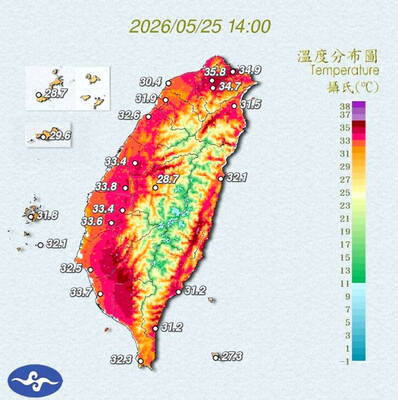
STAY COOL: The HPA recommended that people stay hydrated, use air-conditioning or fans while indoors, wear loose-fitting clothes and walk in the shade while outdoors Employers must implement measures such as installing cooling equipment, and providing drinking water and rest breaks for outdoor workers starting from Monday next week, the Taipei Department of Labor said on Sunday. Employers who fail to comply could face fines of NT$30,000 to NT$300,000 under the Occupational Safety and Health Act (職業安全衛生法), the department said. Businesses in Taipei employing fewer than 100 workers, as well as registered self-employed workers with labor insurance coverage, could receive on-site assessments and guidance from occupational safety consultants to help them apply for central government subsidies to implement or improve heat-protection measures, it said. Under the Ministry of
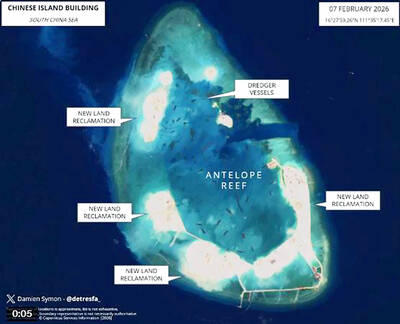
ISOLATION: The outposts would serve as support and backup bases, forcing US forces to either face China head-on or reroute, increasing travel time and operational costs China’s outposts in the South China Sea could be used to delay and constrain foreign forces during a conflict in the Taiwan Strait, giving Beijing a critical window to carry out amphibious landing and blockade operations, a report said. The Chinese Communist Party’s (CCP) forward operating bases on islands and reclaimed features in the South China Sea could delay foreign forces long enough for the Chinese People’s Liberation Army (PLA) to secure a key 48-to-72-hour window in the Taiwan Strait, a report commissioned by the Mainland Affairs Council found. The report, conducted by the Institute for National Defense and Security Research, examined


 RSS
RSS