


High-school students will have more to "unlearn" than just titles and names after a new round of controversial history textbooks go to press.
In addition to referring to what previous textbooks termed "the mainland" as "China" and the "founding father" as "Sun Yat-sen" (
Also known as the "Rape of Nanjing," the massacre occurred in 1937 when Japanese troops sacked the city, killing and raping many civilians there.
Although the death toll is disputed among Japanese scholars, most historical records put the number of civilian casualties at 300,000.
This year marks the 70th anniversary of the massacre.
Director of the ministry's Department of Secondary Education, Chen Yi-hsing (
No significant changes to textbook coverage of the massacre at the high-school level have taken place, he said.
"Our practice is that if the incident was taught at junior-high level, then we don't go into great detail in covering it again at senior-high level," Chen said.
He added that all middle-school students were required to study the incident in depth and that if high-school teachers wanted to cover it beyond their textbooks, they could do so at their leisure.
"We respect our high-school teachers' expertise. If they want to expand on the incident, we respect that," Chen said, adding that teachers were more than welcome to use their own material.
Pan-blue camp politicians and education critics, however, panned the lack of in-depth discussion on the massacre and the introduction of language treating Taiwan and China as separate nations in new textbooks as the most insidious aspect of the Democratic Progressive Party's (DPP) "name-changing" campaign that has seen the word "China" stripped from the names of state-run companies.
Pan-blue camp lawmakers singled out Minister of Education Tu Cheng-sheng (杜正勝) earlier this month for allegedly spearheading what they called the DPP's "brainwashing campaign," which in their view seeks to promote nationalism by literally rewriting history.
"This is an unconstitutional campaign to change the thinking not only of adults, but of children as well. This is a strategy to brainwash them, with Tu Cheng-sheng leading efforts to force DPP ideology onto our youth," People First Party (PFP) Legislator Lee Fu-tien (李復甸) said.
Angered by both name and textbook revisions, Pan-blue camp lawmakers vowed to call for a constitutional interpretation of the changes.
Four seniors from Taipei Municipal Nanhu High School, identifying themselves only by their surnames, told the Taipei Times that it "would feel strange if the Nanjing massacre didn't receive more attention in history class."
Chen (
When asked why they thought the education ministry sought to change their history books, Min (閔), 17, said: "It's because the DPP is in power."
Rebutting recent statements by the National Institute of Compilation and Translation -- which writes and publishes textbooks for the ministry -- that previous history books didn't broach the massacre in more depth than the latest editions, a National Taiwan University student said that the massacre was covered extensively in her high-school history classes.
"I remember we studied it quite a bit," the accounting student said, identifying herself by her surname Chen (陳). "Look at World War II and the Holocaust. The Nanjing massacre is the same. It's not Chinese history; it's human history. And isn't history about finding out why events like that happened so we can learn how not to repeat them?"

The Ministry of Finance this afternoon announced the winning numbers for the March-April uniform invoice lottery. The winning number for the NT$10 million (US$318,060) special prize is 19531471, and the winning number for the NT$2 million grand prize is 85941329. Three numbers were drawn for the NT$200,000 first prize: 07225810, 20231230 and 83518781. Those with receipts matching the last seven digits of any of the first-prize numbers will win the NT$40,000 second prize, while those matching the last six digits will win the NT$10,000 third prize. Those whose receipts match the last five digits of the first-prize numbers can claim the NT$4,000 fourth prize,

SIX SUBSIDIES: The monthly allowance for older farmers is to increase to NT$10,000, and NT$5,000 is to be given to homemakers under the national pension system, Lai said The government is to implement major welfare policies for disadvantaged groups, including raising the monthly allowance for older farmers to NT$10,000 and providing homemakers with NT$5,000 per month, President William Lai (賴清德) said yesterday. Lai made the remarks during a visit to Wangling Temple in Chiayi County, saying that the planned increases were being introduced amid economic growth and an increase in tax revenue. Touting a policy, in which the government plans to provide a monthly allowance of NT$5,000 for every child under the age of 18 in a bid to address Taiwan’s low birthrate, Lai said that if received for the
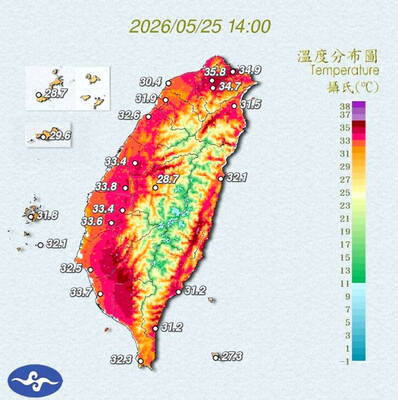
STAY COOL: The HPA recommended that people stay hydrated, use air-conditioning or fans while indoors, wear loose-fitting clothes and walk in the shade while outdoors Employers must implement measures such as installing cooling equipment, and providing drinking water and rest breaks for outdoor workers starting from Monday next week, the Taipei Department of Labor said on Sunday. Employers who fail to comply could face fines of NT$30,000 to NT$300,000 under the Occupational Safety and Health Act (職業安全衛生法), the department said. Businesses in Taipei employing fewer than 100 workers, as well as registered self-employed workers with labor insurance coverage, could receive on-site assessments and guidance from occupational safety consultants to help them apply for central government subsidies to implement or improve heat-protection measures, it said. Under the Ministry of
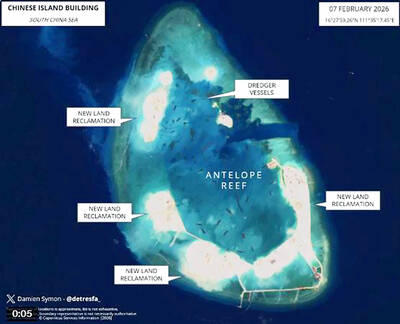
ISOLATION: The outposts would serve as support and backup bases, forcing US forces to either face China head-on or reroute, increasing travel time and operational costs China’s outposts in the South China Sea could be used to delay and constrain foreign forces during a conflict in the Taiwan Strait, giving Beijing a critical window to carry out amphibious landing and blockade operations, a report said. The Chinese Communist Party’s (CCP) forward operating bases on islands and reclaimed features in the South China Sea could delay foreign forces long enough for the Chinese People’s Liberation Army (PLA) to secure a key 48-to-72-hour window in the Taiwan Strait, a report commissioned by the Mainland Affairs Council found. The report, conducted by the Institute for National Defense and Security Research, examined


 RSS
RSS