


Taipei Times: The bilateral trade between Taiwan and Malaysia has been thriving, with approximately 2,000 Taiwanese companies investing in Malaysia. What investment does your country hope Taiwan can bring? Why should Taiwanese businesspeople choose Malaysia rather than China or other Southeast Asian countries?
Syed Hamid Albar: The trade between Taiwan and Malaysia is good, but the trade surplus is on Taiwan's side. We would like to see more balanced trade between Taiwan and Malaysia.
On the investment side, even though there are many Taiwanese companies investing in Malaysia, the investment amount is still relatively small if you compare the figures to what Taiwan invests in other countries in Asia.
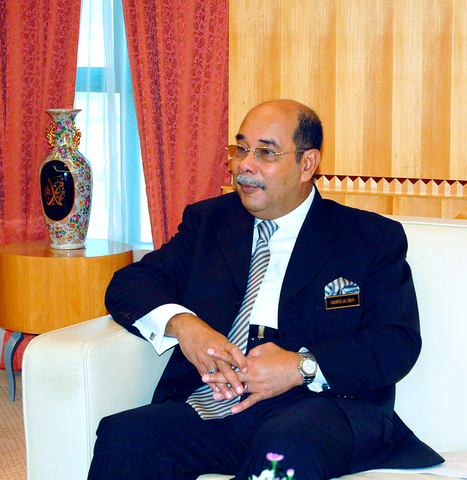
PHOTO: WANG PING-YU, TAIPEI TIMES
So we would like to see an improvement in investment by Taiwanese companies, especially in the new areas like biotechnology because Taiwan has got a lot of strength in it.
I think it is important for Taiwanese businessmen to look at Malaysia. There are a lot of opportunities here and the potential is good and the environment is conducive to living as well as investing.
Our policy is very stable and consistent.
TT: Malaysia plays a role in ASEAN, which has become an important international organization in Asia and is increasing in significance in the region. Taiwan, although a neighbor of ASEAN countries, has yet to become a member of this organization. How will be Taiwan-Malaysia relations develop in terms of this situation?
Syed Hamid: You know politically there is a recognition of "one China policy" in all the ASEAN countries and that is the position of ASEAN countries.
But that should not stop us from having friendly relations with Taiwan.
In the political context, that is acceptable to all sides.
In this regard, I think all the ASEAN countries are interested to see Taiwanese businessmen to come to Malaysia or any other ASEAN countries to invest more and see the potential availability in ASEAN.
These countries have different levels of development and you see the original ASEAN countries doing better than new ASEAN members like Cambodia, Laos and Vietnam.
I think they all welcome Taiwanese businessmen. In the context of the political reality before us, Taiwanese are most welcome to come to any one of the ASEAN countries.
TT: So you think Taiwan should focus more on developing economic relations with ASEAN member countries than on other kinds of relations?
Syed Hamid: I think there are two areas where Taiwan should focus without upsetting any political considerations.
One is the area of people-to-people contact. I think Taiwan has very high standard of living and developed so much in many aspects and has very high per capita income. ASEAN countries are the best area for Taiwanese to come as tourists.
With better people-to-people contact, it could be good for understanding the goodwill of the people of Taiwan and ASEAN countries.
The other part Taiwan could do [well in] is in the economic and investment field. Taiwan has got the strength in investing in all over the world and you have also invested a lot in China.
Taiwan could look at its economic strength as an alternative and it could bring very good return in your investment.
TT: Malaysia has a diverse population with a number of different ethnic groups, but your country has done a good job in integrating people who have different heritages and backgrounds. Taiwan is now facing the issue of the growing diversity of its population. Could you share your thoughts on this?
Syed Hamid: One of the things that Malaysia inherited from our colonial master -- so to speak -- is the diversity. We were a country divided and we did not have one single identity of Malaysians.
So when we became independent, we decide to ensure that we are a nation state that is united and mixed and uses our diversity as a soft source of strength. We have done it. We also share political power and compromise with other ethnic groups.
Even if one particular ethnic group ruled the country by itself and had a simple majority to run the country, we think that working together and sharing political power with different ethnic groups is the best way for the country.
It is not easy to achieve this because we have 14 different political countries, but we work hard to achieve this goal.
TT: Have you ever visited Taiwan? If so, what is your impression of Taiwan?
Syed Hamid: I have been to Taiwan before I became foreign minister but I only stopped over in Taiwan's airport. So I have not yet have the opportunity to visit Taiwan. I think one day I would have the opportunity to visit Taiwan.
A lot of Malaysians have visited Taiwan for holidays, for medical treatment, even for business and trading.
There are many Malaysian students studying in Taiwan and they have very positive impression of Taiwan and get along well with the people of Taiwan.
I think we have very broad relations between Taiwan and Malaysia except we don't have formal political ties because of the current situation.
TT: Malaysia has been maintaining a neutral stance for a long time. From your perspective, how do you think Malaysia should be perceived by the rest of the world? What is your foreign policy in regard to globalization, which is conceptualized by both cooperation and competition?
Syed Hamid: I think our foreign policy is comprised of three guiding approaches: One is that we believe in having a principled position; two is that we are consistent and three is that we are pragmatic.
In short, we would like to be friends to everyone and enemies to none.
We do not want to make an enemy of everybody and we want to be friendly to all.
We could play our role as a small country better and to be able to voice our feelings in a very independent way and search for global peace and justice.
I think this is what we are all looking for. Although it is a bit idealistic, sometimes it is good to have idealism and it is a power to motivate the world to become better.
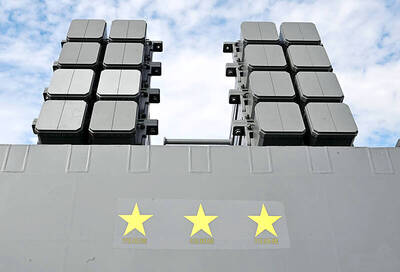
UPGRADE: The Kang Ding-class frigate is replacing its Chaparall missiles with Tien Chien II and Hua Yang VLS, which would provide it with long-range, 360° air defense Taiwan plans to produce 1,200 to 1,376 Hai Chien II missiles (海劍二, Sea Sword II) — also known as TC-2N — to serve as the standard air defense system of the navy’s surface combatant fleet, a source said yesterday. Last week, the Hai Chien II, the naval version of the Tien Kung II missile (天劍二, Sky Sword II), completed a live-fire test in waters off the National Chungshan Institute of Science and Technology’s Jiupeng facility (九鵬) in Pingtung County’s Manjhou Township (滿州). The MIM72 Chaparral and other dated air defense missiles that currently arm Taiwanese ships have inadequate range to combat Chinese

REASONS FOR TRAVEL: An assistant professor said that proposed amendments to penalize drivers if they used drugs overseas would not deter people from traveling People who operate a motor vehicle under the influence of marijuana would have their driver’s license revoked, even if they used the substance while overseas, the Ministry of Transportation and Communications said yesterday, citing proposed amendments to the Road Traffic Management and Penalty Act (道路交通管理處罰條例). The amendments would also authorize the government to revoke the licenses of people determined to have used Category 1 or Category 2 narcotics, even if they were not operating a vehicle while under the influence of drugs, as well as ban them from taking the license test for three years, the ministry said. People aged 18 or
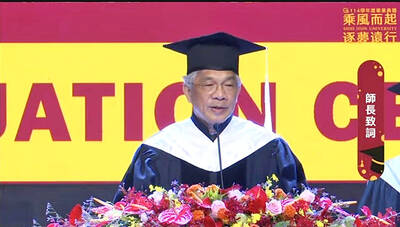
Shih Hsin University President Chen Ching-he (陳清河) yesterday issued a public apology for comments made in his commencement speech last week, stating that he has asked the school to suspend his duties and halt his wages for two months as a show of contrition. At the commencement ceremony on May 30, Chen said, “If you don’t manage your time well, or your own emotions, or your health, then I am telling every one of you — put a quick end to ‘you,’ because the world has no need for ‘you.’” The comments have sparked significant controversy online, and Chen through an open
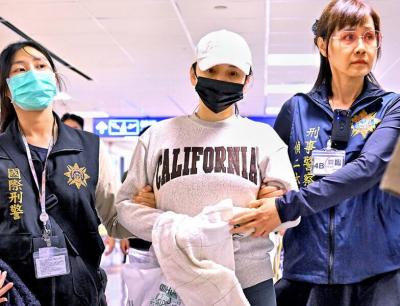
Johanne Liou (劉喬安), a Taiwanese woman who shot to unwanted fame during the Sunflower movement protests in 2014, returned to Taiwan last night after being deported from the US. She is to stand trial in Taiwan for charges involving embezzlement, fraud and drug crimes. The Criminal Investigation Bureau (CIB) said it took her into custody at Taiwan Taoyuan International Airport and would first question her before transferring her to the New Taipei District Prosecutors’ Office. She was arrested upon disembarking a flight from San Francisco that landed shortly before 7pm. Liou absconded to the US in 2019 after jumping bail


 RSS
RSS